Commercial rockets shortlisted for Qingzhou cargo spacecraft launch service, a concrete step in China’s push to expand role of commercial space: analyst
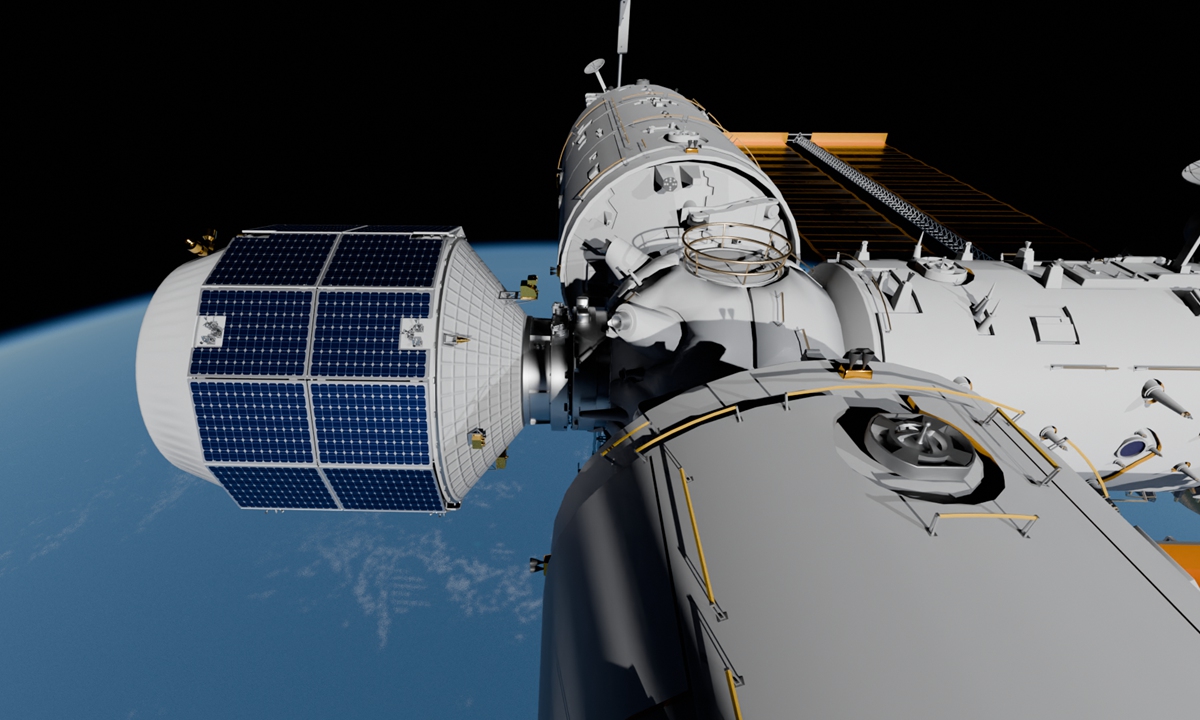
An illustration of future operation of Qingzhou cargo spacecraft, provided by its developer - Innovation Academy for Microsatellites of the Chinese Academy of Sciences. Photo: Courtesy of Innovation Academy for Microsatellites of the Chinese Academy of Sciences
China's commercial rocket companies have moved a step closer to participating in the country's space station cargo transport system, after the public notice period for the Qingzhou experimental cargo spacecraft launch service shortlist ended on Monday, with four commercial launch firms listed as candidates - a development that analysts said points to the wider opening of national-level space application scenarios to market players.
The four shortlisted candidates are Galactic Energy, CAS Space Technology Co, Orienspace (Shandong) Technology Co and LandSpace Technology Corp, listed in alphabetical order by their Chinese pinyin names, according to the notice released on the China Tendering and Bidding Public Service Platform.
The notice itself does not mean a final provider has been selected, analysts said, but the shortlist marks an important step as commercial aerospace moves beyond satellite launches and deeper into China's national space program.
The Qingzhou cargo spacecraft is tentatively scheduled for launch in January 2027, subject to the final launch window, according to the tender information.
Introducing commercial space companies into space station cargo launch missions will help further activate China's commercial aerospace market and allow different types of market players to make better use of their respective strengths, Guo Jia, a veteran market watcher and a professor at the South China Business College of Guangdong University of Foreign Studies, told the Global Times on Monday.
The Qingzhou experimental cargo spacecraft is being developed by the Innovation Academy for Microsatellites of the Chinese Academy of Sciences (CAS). It is designed for low-cost cargo transport between Earth and China's space station, according to the CAS.
The prototype of the Qingzhou experimental cargo spacecraft completed multiple key technology verification and entered the integrated testing stage in December 2025. The spacecraft was expected to move into formal model development and testing in 2026, complete factory delivery by the end of that year and conduct its first flight mission based on the needs of China's space station, according to the CAS.
The spacecraft is an important part of China's space station cargo transport system. With moderate transport capacity, fast and flexible operation and prominent efficiency advantages, the spacecraft will further enhance the safety and reliability of space station supply missions.
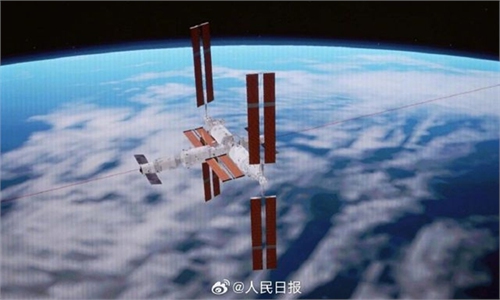
The development of the Qingzhou experimental cargo spacecraft also comes as China has been exploring smaller and more flexible cargo spacecraft in recent years to improve transport between Earth and the space station, a task that has previously been carried out mainly by the Tianzhou series, which has completed 10 cargo flights since 2017.
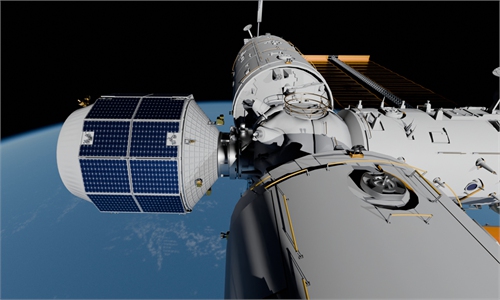
The spacecraft adopts an integrated design and consists of a pressurized cabin and an unpressurized rear cone section. It has a total weight of 5 tons, an uplink cargo capacity of no less than 1.8 tons, a downlink capacity of no less than 2.6 tons and cargo loading space of no less than 9 cubic meters, according to CAS.
After completing its scheduled missions, the Qingzhou spacecraft will work alongside existing cargo spacecraft to build a complementary space delivery system, which will further drive down cargo transportation costs.
Commercial space has become a closely watched emerging sector and has been incorporated into China's policy planning as a new growth driver, Guo said, adding "The use of public tendering and the participation of market entities in space station cargo services represent a concrete step in turning those policies into project-level implementation, which will bring positive momentum to the industry."
Commercial space is receiving stronger national policy support. The 2026 Government Work Report proposed building emerging pillar industries including integrated circuits, aerospace, biomedicine and the low-altitude economy. The outline of the 15th Five-Year Plan calls for improving China's commercial space launch capabilities.
The sector maintained rapid growth in 2025. China's commercial space sector completed 50 launches last year, accounting for 54 percent of the country's total space launches, and 311 commercial satellites were placed into orbit, accounting for 84 percent of China's total satellites launched that year, according to the China National Space Administration.
RELATED ARTICLES