What does overseas popularity of electric ‘beng bengs’ tell us?: Global Times editorial
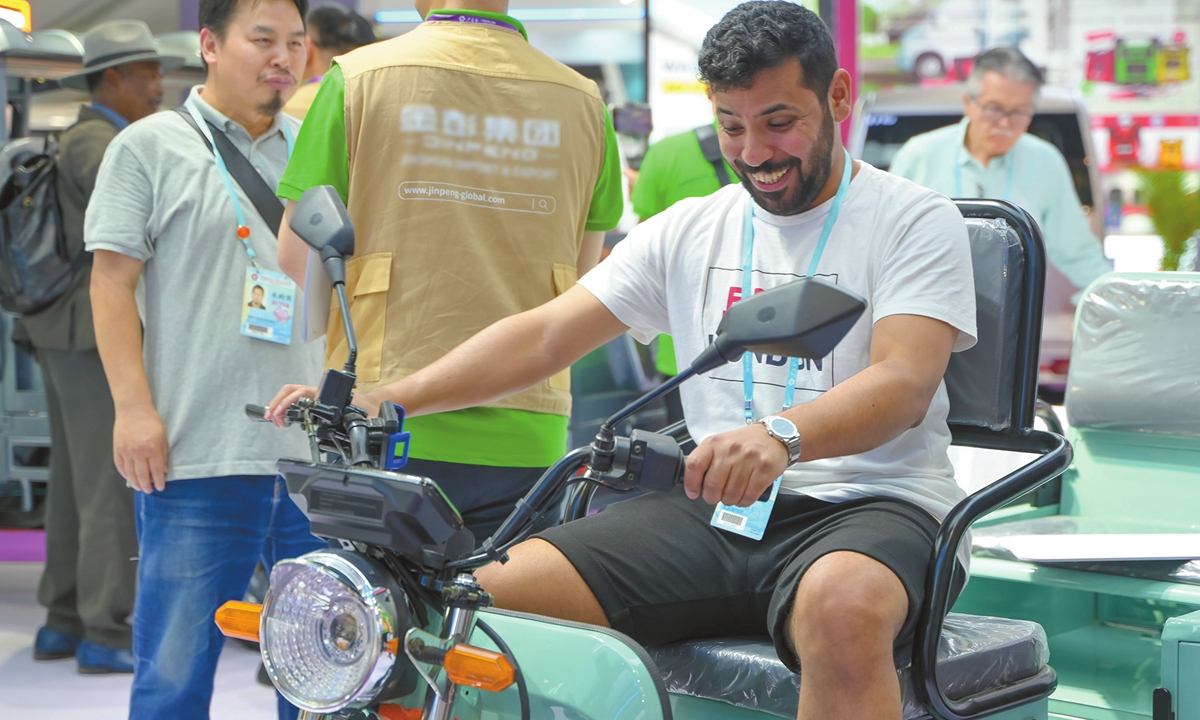
A customer experiences an electric tricycle at the 135th China Import and Export Fair held in Guangzhou, Guangdong Province, on April 15, 2024. Photo: VCG
Once viewed as "low-end transportation," China's electric two-wheelers and tricycles are now sparking a global export boom, becoming another shining example of Chinese manufacturing going global - following in the footsteps of new-energy vehicles and photovoltaic products. In the first quarter of 2026, China exported approximately 7.2 million electric two-wheelers, a year-on-year increase of 68.2 percent. On overseas social media platforms, discussions about electric "beng bengs" continue to gain momentum. The familiar Chinese warning "Reversing, please be careful," once heard on Chinese streets, is now echoing through the streets and villages of Southeast Asia, Africa, Europe, and the Americas.On the surface, this "electric 'beng beng' craze" appears to be driven by the energy crisis stemming from the blockage of the Strait of Hormuz. In reality, however, even without the turmoil caused by high oil prices, the overseas expansion and popularity of these electric "beng bengs" would have happened sooner or later. The reasons are obvious. They are economical, agile, and durable, with powerful motors and long-lasting battery life. They can address the "blind spots" in public transportation in sparsely populated countries and regions such as North America and Australia, and adapt to traffic congestion in densely populated areas like Southeast Asia. In broader application scenarios - whether navigating the hilly and mountainous regions of South America or delivering equipment and medicines to African villages during an outbreak - they can be put to use exactly when they are needed most.
More importantly, they not only align perfectly with the global trend toward green and low-carbon development, but also meet the transportation needs of low- and middle-income groups at an affordable price. Against the backdrop of the accelerating shift toward electrification in the EU automotive market and the introduction of policies that push "transitioning from fossil fuel to electric power" in many Southeast Asian countries, these electric "beng bengs" represent not only the achievements of China's green development but also serve as a key vehicle for China to export low-carbon solutions to the world.
Several years ago, many foreign media outlets predicted that small EVs would have a greater impact on climate change than four-wheeled ones, forecasting that whoever could capitalize on the wave of transportation electrification would embrace a greener future. The world has recognized the overarching trend toward electrification, so why has China been the one to successfully navigate this path?
Beyond factors such as the engineering capabilities that have shaped a full industrial chain advantage through the development of the "new trio," which includes EVs, lithium-ion batteries and photovoltaic products, what matters most is China's strategic resolve to "follow a good blueprint through to the end" in its green transition. Unlike some countries that view transformation through the lens of capital and technology - and regard the low-carbon transition as a burden - China has consistently treated green development as an opportunity of our time. By adhering to an inclusive approach, it has brought green mobility into the daily lives of ordinary people, while also providing a practical model for global energy and transportation transformation.
What is particularly noteworthy is the strong adaptability of Chinese private enterprises. They are able to identify and respond quickly to market demand, develop products that meet local needs, and continuously enhance their competitiveness through innovation. This is another key reason why electric "beng bengs," following the success of new-energy vehicles abroad, are now gaining traction in overseas markets.
Facing diverse demands across different regions, Chinese companies have shifted from a "sell what we make" approach to a "make what you need" strategy. Models exported to Southeast Asia feature enhanced waterproofing, dust resistance, and shock absorption to cope with hot, rainy climates and rough road conditions. Electric bicycles designed for Europe prioritize lightweight construction and low noise levels, meeting EU environmental standards and aligning with local cycling culture. Products sold in Africa and Latin America emphasize long battery life, high load capacity, and durability, serving multiple purposes such as passenger transport and cargo hauling. From a practical tool for US farmers, to a young person's first income-generating vehicle in Africa, to a convenient commuting option for European workers, Chinese EVs have integrated into daily life and production activities around the world through their remarkable versatility.
Why does Chinese manufacturing so often surprise the world with "low-cost solutions to major challenges"? At its core, the answer lies in the people-centered nature of Chinese modernization, which focuses on the pain points of people's livelihoods and meets the needs of the public. In a country of more than 1.4 billion people, countless challenges relate to food, clothing, housing, and transportation. Finding sustainable ways to solve these issues forms an important part of China's modernization journey. The widespread adoption of electric "beng bengs" in China emerged as a response to the challenges of costly and inconvenient transportation faced by ordinary people. As these vehicles reach overseas markets, they address similar everyday needs shared by people around the world. This, in turn, has become a unique source of competitiveness for Chinese manufacturing shaped by the experience of Chinese modernization.
International climate governance has long faced a key challenge: how developing countries can reduce emissions while continuing to grow economically. Whether it is the electric "beng bengs" becoming a household name overseas, or Chinese solar and wind power products taking root around the world, these examples all show that, through low-cost, replicable technological systems, emissions reduction and development can be compatible. Chinese companies are advancing localization in Southeast Asia, Africa, and other regions, gradually shifting from product exports to capacity collaboration and the export of service systems. Through practices such as building production bases and deploying battery-swapping networks, they are continuously expanding and replicating a low-cost electric mobility ecosystem, while also driving local industrial development.
At present, changes in the global energy landscape are further accelerating the worldwide shift toward vehicle electrification. China is seizing this trend and deepening its efforts. This wave of enthusiasm around China's electric "beng bengs" also confirms a simple truth: to fill the gap in global demand, the green capacity China provides is not "excessive" at all - in fact, it is still far from enough.
RELATED ARTICLES