China’s merchandise trade expands 15.3% in first 5 months
Market-beating data highlights exports of AI, high-tech products; demonstrates irreplaceable role in global supply chain
By Published: Jun 09, 2026 12:02 PM

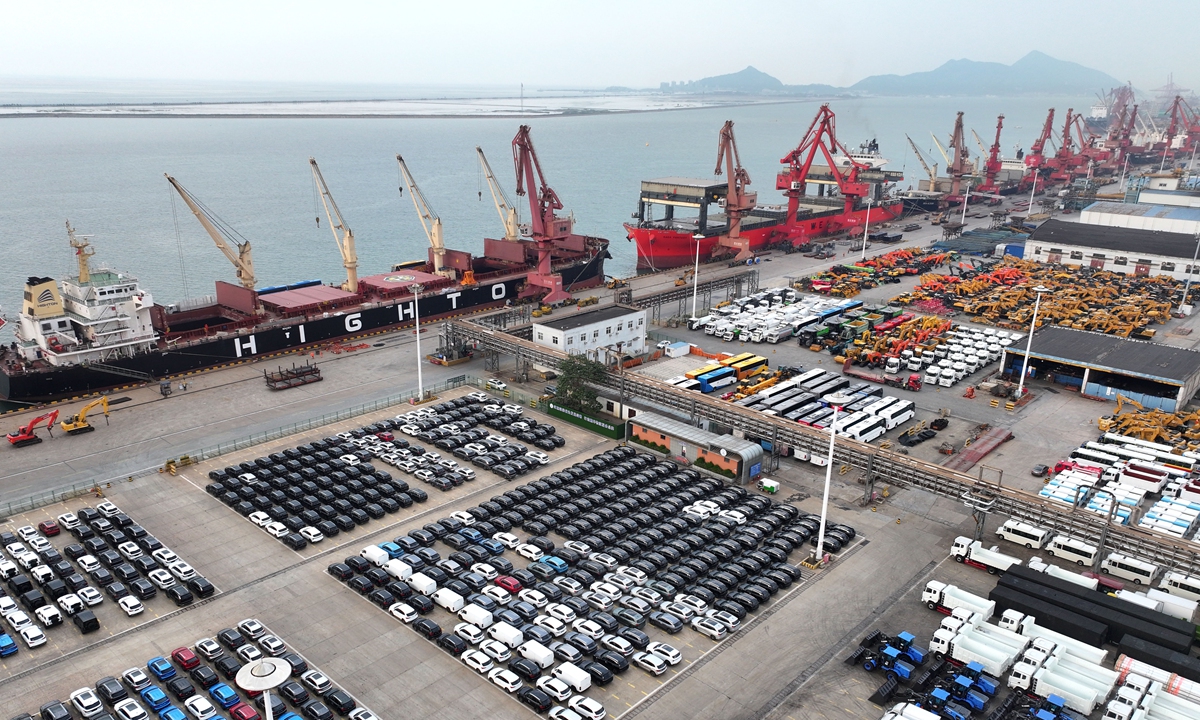
A large number of Chinese-made vehicles gather at the Lianyungang Port in East China's Jiangsu Province on May 28, 2026, preparing for shipment and export. Photo: VCG
In bustling hotels and restaurants in Japan, a fleet of delivery robots made by Chinese company Pudu Robotics are zipping through crowded dining halls with remarkable agility. Balancing trays of steaming hot dishes and fragrant coffee, these cheerful machines skillfully navigate among tables, dodge chatting guests, and deliver orders with pinpoint accuracy.
Whether delivering food, welcoming customers at sidewalk cafés, performing precise tasks on advanced vehicle and aviation production lines or even lending a steady hand in surgical suites, Chinese robots have been making inroads into the world. These widespread real-world applications underscore how high-tech products such as robots are powering a new surge in China's foreign trade, injecting fresh momentum into the country's economic engine.
China's foreign trade has maintained momentum, with the value of goods trade jumping by 15.3 percent year-on-year to reach 20.68 trillion yuan ($3.05 trillion) in the first five months, data from the General Administration of Customs (GAC) showed on Tuesday.
The market-beating performance was fueled by a number of positive factors, including strong global demand for China's high-tech and electronic products driven by the artificial intelligence (AI) wave, as well as a series of preferential trade arrangements, Chinese observers pointed out.
They stressed that these figures underscore China's irreplaceable role in underpinning global supply chain stability and resilience.
Lü Daliang, director of the GAC's Department of Statistics and Analysis, said that China's foreign trade value exceeded 4 trillion yuan for a third consecutive month as of May, sustaining a positive trajectory, China Central Television reported.
China has vigorously deepened pragmatic economic and trade cooperation with its partners this year, and China is always a stabilizing force for global trade, he said.
Tian Yun, a Beijing-based economist, told the Global Times on Tuesday that with the global economy facing pressure and a volatile geopolitical situation, the impressive growth rate showed that "China's foreign trade engine is built on a stable and solid foundation, while displaying new vitality and strong growth momentum."
He noted that the data again highlighted the country's irreplaceable position in the global supply chain and the continuous enhancement of the international competitiveness of Chinese products.
Boom in high-tech exports
The acceleration in China's exports of high-tech gadgets made headlines across global media outlets. Reuters reported China's trade figures on Tuesday under the headline "China rides AI wave as exports surge past forecast." Bloomberg, in an article headlined "AI supercycle propels China's trade with 111 percent boom in chip sales," noted that the global investment supercycle in AI is driving up prices and demand for hardware made by the world's manufacturing powerhouse.
Exports rose 11.8 percent year-on-year in the first five months, with high-tech and high value-added mechanical and electrical products up 18.4 percent and accounting for more than 60 percent of total exports. Imports soared 20.5 percent as domestic demand continued to improve, customs data showed.
Among factors supporting the stellar double-digit growth, Chinese analysts pointed to the global AI wave, which drove surging demand for China's high-tech products, ranging from robotics, AI accelerators, and data center equipment to photovoltaic panels and intelligent manufacturing systems.
"The heating-up in global AI investment fueled further price increases for chips, computer components, and electronic parts, which gave further drive to China's export value in May," Feng Lin, executive director of the research and development department at Orient Golden Credit Rating, told the Global Times on Tuesday.
The rating company provided figures on AI-related exports, which showed that in May, the value of chip exports more than doubled, while that of automatic data processing equipment and its parts rose 66.1 percent year-on-year.
Feng also highlighted significant progress in domestic manufacturing transformation and upgrading, which boosted exports of new-energy vehicles and other high-tech products.
China's cooperation with other economies as well as deeper integration into the global industrial chain has been consolidating and strengthening, analysts noted.
Among major trading partners, China's trade with the US recorded a sharp rebound in May amid stabilizing bilateral trade and economic relations, according to a research note that Orient Golden Credit Rating sent to the Global Times. China's exports to the US gained 35.4 percent year-on-year in May in dollar-denominated terms, while imports jumped 20.4 percent, the data showed.
In the first five months, China's imports and exports with ASEAN and the EU grew by 16.6 percent and 10.3 percent, respectively. Trade with Belt and Road Initiative partner countries jumped 13.6 percent year-on-year.
Since May 1, China has fully rolled out zero-tariff treatment for all African countries that have diplomatic relations with China. In the first five months, China's trade with Africa hit 1.14 trillion yuan, up 18.2 percent year-on-year. The figure broke through 1 trillion yuan for the period for the first time.
"Based on current trends, China's foreign trade is highly likely to achieve double-digit growth in the first half of the year. This would mark one of the strongest trade performances in the past four to five years," Tian said.
Feng warned that under the influence of geopolitical conflicts in the Middle East, international crude oil prices have surged, which has created inflation pressure and clouded the growth prospects of the global economy in the second half.
While external headwinds will inevitably weigh on the global economy, China's stabilizing foreign trade growth will provide a crucial buffer, supporting not only its domestic economy but also contributing positively to global economic stability, analysts stressed.
"Taking into account the current geopolitical landscape, we expect China's new-energy products to receive more orders in the coming months," Tian noted, highlighting China's dual role as both a stabilizer and a powerful driving force for the global supply chain.
RELATED ARTICLES