Time to end the absurd farce of the US ‘military companies blacklist’: Global Times editorial
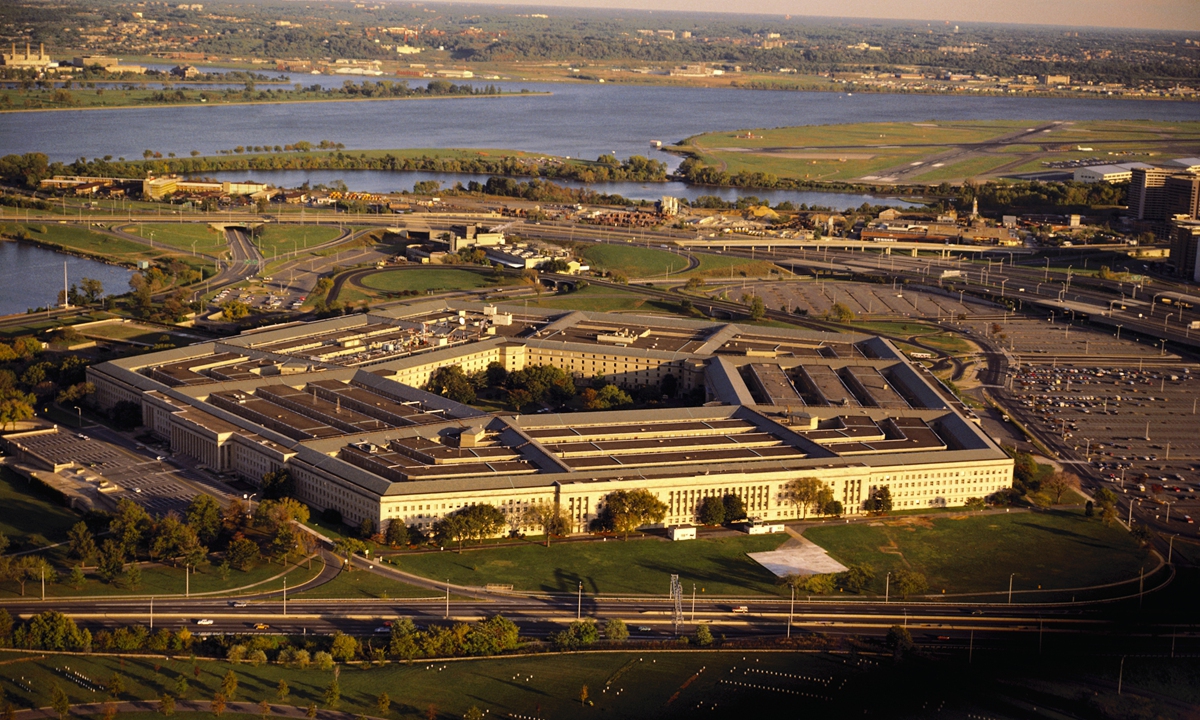
A view of the Pentagon. Photo: VCG
This week, the Pentagon updated its so-called "list of Chinese military companies," placing 188 Chinese entities on the roster. Ranging from artificial intelligence (AI), e-commerce platforms, electric vehicles, batteries, semiconductors, and robotics to biopharmaceuticals, the scope keeps expanding. This increasingly absurd farce marks yet another escalation of the US side's unreasonable suppression of Chinese enterprises, and also a blatant provocation to global trade and market rules. Notably, this year's list has "kept pace with the times," precisely targeting a large number of leading enterprises in China's high-end manufacturing and emerging technology sectors, making it look more and more like a "roll of honor" for China's new quality productive forces.
The absurdity of this "military companies blacklist" lies first in its arbitrary criteria and flawed logic. An e-commerce platform, a search engine, or a new energy vehicle company - none of which has any connection to the military - can be labeled as "supporting China's military" or "threatening US national security" simply because they have made progress in fields such as AI, cloud computing, or battery technology. At its core, this represents a presumption of guilt stemming from the logic of "being targeted simply for possessing valuable assets." Simply put, any Chinese tech firm with global competitiveness is arbitrarily labeled as having "military links," and this alone is deemed sufficient justification for the Pentagon to impose, or threaten to impose, unilateral sanctions.
If this logic were applied consistently, would a company like Coca-Cola - having developed advanced models to analyze global consumer tastes - also be deemed a "threat to other countries' national security"? And how many countries, then, should place those US tech giants - who hold massive contracts with the US Department of Defense and whose executives frequently pass through the "revolving door" - on their own lists of "threats to national security"? This bandit logic, which tolerates technological leadership only for itself while denying others the right to develop, is an undisguised double standard. It exposes a deeply rooted hegemonic mind-set and constitutes a direct violation of international norms of fairness.
The Pentagon's list covers virtually all major strategic emerging industries, including AI, electric vehicles, unmanned systems, aviation, cloud computing, and semiconductors. It encompasses many of China's leading companies in cutting-edge technology sectors. This suggests that Washington is not targeting any single Chinese tech firm, but rather treating "Chinese technology as a whole" as an arena of strategic competition. In essence, this "blacklist" amounts to a tacit acknowledgment of China's technological progress, reflecting concerns and anxieties about the country's growing capabilities. What worries Washington is the possibility that its technological dominance could face comprehensive challenges from China. What it fears is that Chinese startups are increasingly gaining the capacity to reshape global industrial landscapes. In other words, the list has long since moved beyond its stated purpose of addressing alleged military links and has become a tool for continuously identifying and suppressing China's leading technology companies.
The attempt to halt China's development by simply using an administrative list is doomed to fail. The ever-expanding scope and growing number of targeted companies reveal an uncomfortable reality: The US strategy of labeling and selectively targeting individual Chinese firms has failed. The rise of Chinese companies is broad-based, driven by improvements in innovation and competitiveness under market conditions. The development trajectories of China's electric vehicles, energy storage, and AI industries demonstrate this clearly. When one company is blocked, others emerge. When one sector is suppressed, the entire industrial chain is pushed toward greater self-reliance and innovation.
In the short term, such measures may increase pressure on competitors. In the long run, however, they risk undermining the openness of global supply chains and reducing the efficiency of innovation. Rather than safeguarding "security," the Pentagon's actions interfere with normal cross-border business cooperation, disrupt international economic and trade order, and introduce artificial risks to the stability of the global economy.
It's time to end the absurd farce of the US "military companies blacklist." Facts have shown that the blacklist has neither slowed China's determination to achieve greater technological self-reliance nor altered genuine market demand in the US for high-quality Chinese products. Instead, it is likely to stand as a testament to Chinese companies' success in overcoming technological barriers and external restrictions, documenting China's continued breakthroughs in the development of new quality productive forces.
RELATED ARTICLES