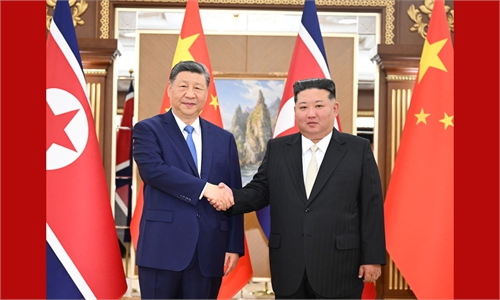
President Xi returns to Beijing after state visit to DPRK
Consensus reached on developing China-DPRK ties in new era
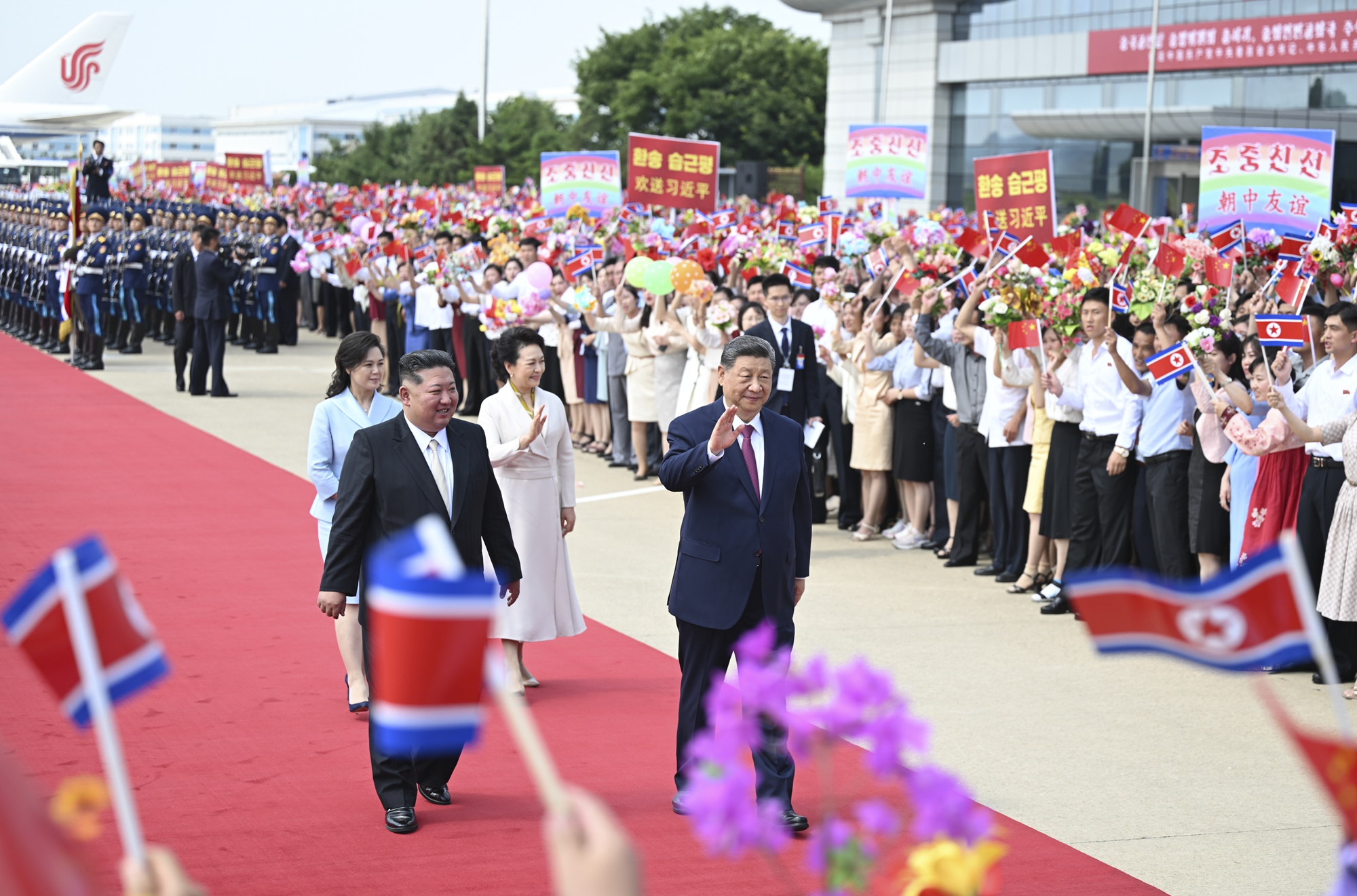
Xi Jinping, general secretary of the Communist Party of China Central Committee and Chinese president, concludes his state visit to the Democratic People's Republic of Korea (DPRK) and departs from Pyongyang, the DPRK, June 9, 2026. Kim Jong-un, general secretary of the Workers' Party of Korea and president of the State Affairs of the DPRK, and his wife Ri Sol-ju went to the airport to see Xi and his wife Peng Liyuan off and held a grand farewell ceremony in their honor. Photo: Xinhua
Xi Jinping, general secretary of the Communist Party of China (CPC) Central Committee and Chinese president, returned to Beijing on Tuesday afternoon after concluding his state visit to the Democratic People's Republic of Korea (DPRK), the Xinhua News Agency reported on Tuesday.
On Tuesday afternoon local time, Xi departed from Pyongyang. Kim Jong-un, general secretary of the Workers' Party of Korea (WPK) and president of the State Affairs of DPRK, and his wife went to the airport to see Xi and his wife off and held a grand farewell ceremony in their honor, per Xinhua.
This year marks the 65th anniversary of the signing of the China-DPRK Treaty of Friendship, Cooperation and Mutual Assistance. In recent years, under the strategic guidance of the top leaders of the two parties and the two countries, China-DPRK traditional friendly and cooperative relations have maintained sound and steady development, Xinhua wrote in an article published on Monday.
Exchanges and cooperation in areas including the economy, culture, education, and youth affairs have produced fruitful outcomes, delivering benefits to both countries and their peoples, injecting new vitality into the traditional friendship between the two nations, and making positive contributions to regional peace and development, per Xinhua.
China-DPRK relations in new era
Xi said on Tuesday that he reached important consensus with General Secretary Kim on developing relations between China and the DPRK in the new era, the Xinhua reported on Tuesday.
The two sides also had in-depth discussions on safeguarding peace and stability in the region and the world, Xi said when he and his wife Peng Liyuan attended the luncheon hosted by Kim and his wife Ri Sol-ju, per Xinhua.
Xi thanked Kim for the warm hospitality and thoughtful arrangements for the visit, noting that through the visit, the warmth and friendship extended by the DPRK party, government and people toward the Chinese party, government and people is felt even more deeply.
The mutual understanding between China and the DPRK has become deeper and more comprehensive, and the future development direction has become clearer and more definite, Xi said.
Xi said that he is ready to work with Kim to jointly lead China-DPRK relations to greater development and inject new and strong impetus into the socialist cause of the two countries.
For his part, Kim said that Xi's visit was a complete success, sending a positive message to the world that the DPRK and China are further strengthening their friendly cooperation, and attracting widespread attention from various sides.
Xi's visit was of great significance to bilateral relations and the future development of the region, Kim said, noting that the DPRK side stands ready to earnestly implement the important consensus reached during the visit, promote new tangible outcomes in bilateral cooperation, and advance DPRK-China relations to a new and higher level.
Great friendship through generations
Xi and Kim agreed on Tuesday that the two countries should carry forward their great traditional friendship from generation to generation.
Xi paid homage to the China-DPRK Friendship Tower with his wife Peng, in the company of Kim and his wife Ri.
Xi and Kim also agreed that the years when China and the DPRK fought side by side in the 1950s are an eternal historical memory shared by both sides.
The Friendship Tower was built in 1959 to honor martyrs of the Chinese People's Volunteers in the War to Resist US Aggression and Aid Korea.
Three massive gilded Korean characters reading "Friendship Tower" adorned the facade of the stately monument, gleaming in the summer sunlight.
After the national anthems of China and the DPRK were played, and honor guards laid the flower basket, Xi approached the flower basket and arranged the ribbon, which read, "The martyrs of the Chinese People's Volunteer Army live forever."
In a solemn atmosphere, all present paid silent tribute to the martyrs. Afterward, Xi and Kim watched a march-past by the honor guard.
Since the tower's erection, it has been expanded by the DPRK and renovated several times. Commemorations have been held at the site on key occasions, including anniversaries of the CPV's entry into the DPRK to fight in the War to Resist US Aggression and Aid Korea, the Korean War armistice, and China's Qingming Festival, also known as Tomb-Sweeping Day.
The two leaders pledged to jointly maintain memorial facilities dedicated to the Chinese People's Volunteers martyrs, carry out distinctive programs on revolutionary traditions and youth education, and carry forward the great spirit of the War to Resist US Aggression and Aid Korea.
On Tuesday morning, Xi, accompanied by Kim, visited the Central Cadres Training School of the WPK in Pyongyang.
In the wooded area between teaching buildings, Xi and Kim jointly planted a fir tree. The fir tree remains evergreen throughout the year, symbolizing the enduring and ever-renewing friendship between China and the DPRK.
In recent years, China-DPRK economic and trade cooperation has shown a positive development momentum. According to Chinese official statistics, bilateral trade volume reached $2.735 billion in 2025, according to Xinhua on Monday.
The Guomenwan trade zone in Dandong, a city in Northeast China's Liaoning Province, has witnessed increasingly close economic and trade exchanges between China and the DPRK. In 2025, the zone recorded 168 million yuan ($24.8 million) in imports through border residents' trade, with a total of 22,000 participants engaged in such transactions over the course of the year.
Prior to this, on March 12, an international passenger train from Dandong arrived in Pyongyang, marking the resumption of international passenger train services between China and the DPRK.
On March 30, an Air China passenger plane from Beijing arrived at Pyongyang International Airport, signaling the formal resumption of the Chinese carrier's passenger flight operations between the capitals of China and the DPRK. Road, rail and air links between the two countries have all been resumed thus far.
Cultural and artistic exchanges are an important component of China-DPRK friendship and serve as a key means of fostering mutual understanding and emotional connection between the two peoples. Multiple Chinese films have received awards at the Pyongyang International Film Festival, while the DPRK's April Spring Friendship Art Festival has repeatedly invited Chinese art troupes to participate.
RELATED ARTICLES