China’s largest solar-hydrogen-storage integrated project fully completed: media report
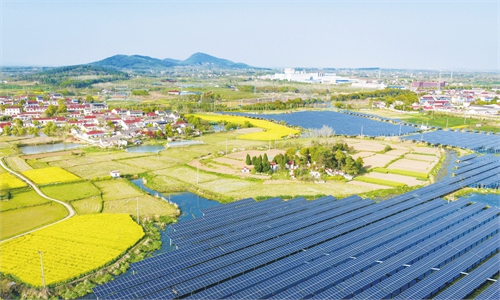
The solar-hydrogen-storage integrated project in Rudong, East China's Jiangsu Province, invested by CHN Energy Guohua Energy Investment Co, is completed. Photo: Screenshot from China Media Group
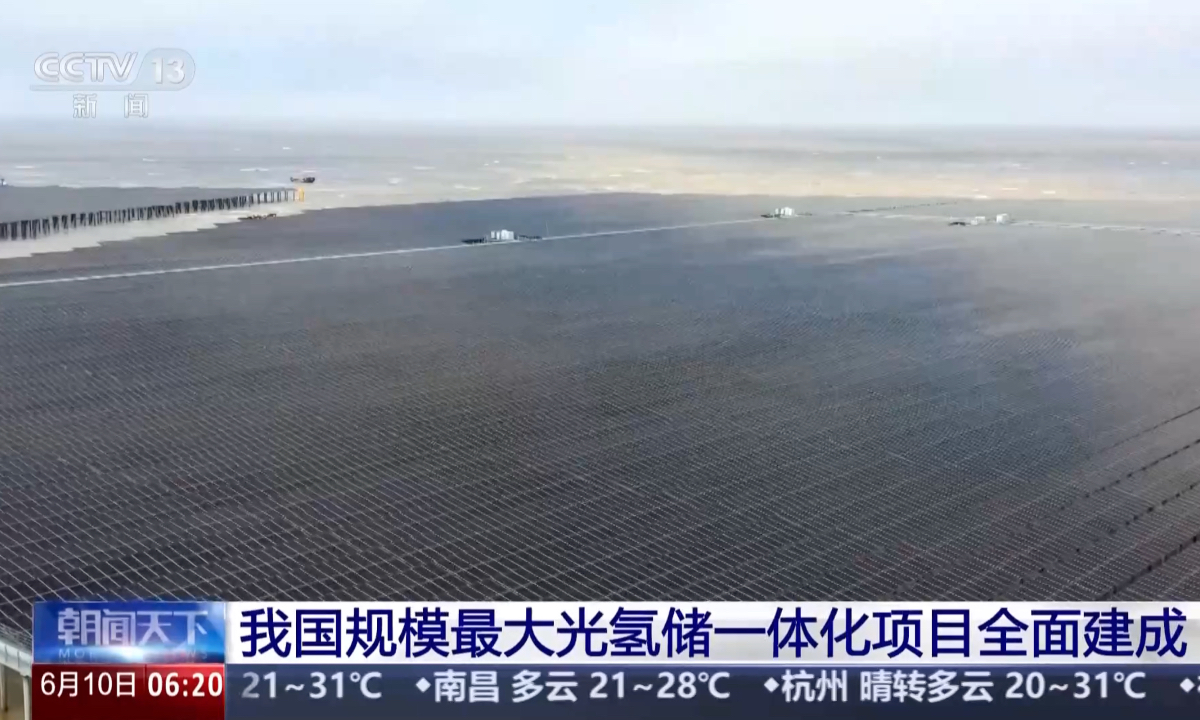
A solar-hydrogen-storage integrated project in Rudong, East China's Jiangsu Province, built with investment by CHN Energy Guohua Energy Investment Co, has been completed. This is the largest offshore photovoltaic demonstration project of its kind integrating solar, hydrogen, and energy storage in China, the China Media Group reported on Wednesday.
Located offshore from Rudong, the project has a photovoltaic capacity of 400,000 kilowatts and includes a newly built 220 kilovolt onshore booster station, a hydrogen production station with a capacity of 1,500 standard cubic meters per hour, and an electrochemical energy storage station, according to the report.
As China's first project that integrates power generation, hydrogen production, and energy storage, while also incorporating comprehensive energy utilization and coastal ecological governance, it achieves the highly efficient composite utilization of "electricity-storage-hydrogen," said the report.
Lin Boqiang, director of the China Center for Energy Economics Research at Xiamen University, told the Global Times on Wednesday that solar power is inherently unstable, but with the addition of hydrogen production and energy storage, the system can basically achieve self-stabilized output.
According to Science and Technology Daily, the project makes full use of coastal tidal flat resources, employing advanced photovoltaic technology and intelligent control systems to realize efficient energy conversion and storage. By integrating hydrogen production through water electrolysis powered by green electricity, it further enhances overall energy utilization efficiency.
The Nantong Daily reported in April this year that the photovoltaic power station achieved full-capacity grid-connected power generation on April 29, 2025. Upon full completion, the energy storage station will be able to supply 120,000 kilowatt-hours of peak-shaving electricity during daily peak hours, and the hydrogen production station will have an annual green hydrogen output of up to 180 tons.
Once the solar, hydrogen, and energy storage stations are completed, they will form a closed-loop energy system featuring "generation-storage-utilization-backup." It will not only significantly improve the consumption rate of new energy, but also provide clean fuel for local industries such as chemicals and transportation through diversified applications of green hydrogen, injecting strong impetus into the transformation of the regional energy structure, the Nantong Daily reported.
"Its completion marks a further step forward for China in the field of new-energy multi-energy complementarity," Lin said, adding that the project has moved beyond the stage of simply pursuing installed capacity expansion, shifting its focus instead to energy conversion efficiency, multi-energy synergy, and system stability.
This project serves as a demonstration for the development of clean energy in coastal areas, which possess excellent wind and solar resources, yet intermittency and instability have remained major bottlenecks. Through the integration of solar power, hydrogen production, and energy storage, the project can effectively enhance the stability and controllability of energy supply, providing more reliable clean power support for economically developed coastal regions, Lin noted.
The demonstration effect of the project mainly depends on two factors: first, whether costs can be further reduced; and second, whether new technologies can improve hydrogen production efficiency, the expert added.
Under the support and promotion of national policies, China's renewable energy hydrogen production has been developing rapidly and is transitioning from the pilot exploration stage to a new phase of large-scale development, according to the National Energy Administration.
As of the end of March, the total capacity of renewable energy-based hydrogen production projects (both completed and under construction) nationwide exceeded 1 million tons per year. More than 250,000 tons per year have been completed and put into operation — more than double the level at the end of 2024 — while projects under construction exceed 900,000 tons per year, the administration said.
RELATED ARTICLES