
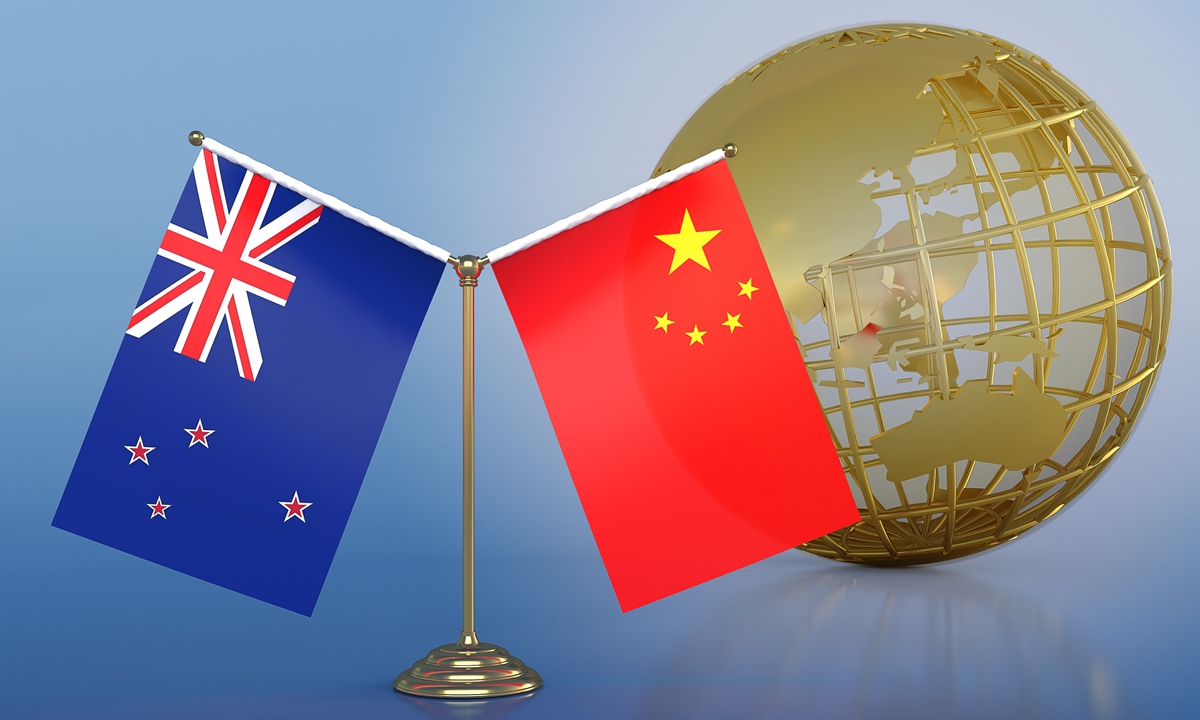
China New Zealand Photo:VCG
For the first time in a decade, New Zealanders are more likely to see China as a friend than the US, while viewing Washington as more of a threat, according to the latest report released by a New Zealand foundation on Wednesday.
Analysts noted that such findings go beyond temporary shifts and instead reveal an enduring trend. The survey results echo a prevailing desire of Asia-Pacific countries to pursue stability and growth, where China occupies a pivotal position. In comparison, Washington's disruptive moves against the international order have caused widespread anxiety, including among its long-standing allies.
Launched by the Asia New Zealand Foundation, the annual Perceptions of Asia and Asian Peoples (2026) survey found that New Zealanders' sentiment towards China has warmed since the last survey, with friend perceptions increasing from 38 percent to 43 percent. Meanwhile, sentiment towards the US has cooled significantly, with friend perceptions falling from 61 percent to 39 percent, according to the RNZ.
In addition, 35 percent of respondents saw the US as a threat. By comparison, about 23 percent saw China as a threat, Reuters reported.
The survey also found that 81 percent of New Zealanders see developing ties with Asia as important. The foundation's Chief Executive Suzannah Jessep said that "There is a growing recognition that prosperity, resilience and security will depend on the depth and quality of our relationships across Asia," per Reuters.
The annual survey, now in its 29th year, polled 2,300 people in January and February.
Chen Hong, director of the Asia-Pacific Studies Center at East China Normal University, told the Global Times on Wednesday that robust economic, trade and people-to-people exchanges have enabled New Zealand society to gain a more objective understanding of the real China, despite smearing and hype by some Western media and politicians, adding that, "compared with other Western countries, New Zealand pursues a more pragmatic and independent foreign policy, which has exerted a positive influence on its public perceptions of China."
According to the Chinese Foreign Ministry, China is New Zealand's largest goods trading partner, largest export market and largest source of imports. China is also the largest source of international students in New Zealand.
Effective July 1, 2024, China implemented a temporary visa exemption for New Zealand, with its validity extended to the end of 2026.
"In a more challenging world, New Zealanders are looking for friends," a summary of the New Zealand report said, according to the RNZ.
About a month before the New Zealand foundation released the poll, surveys conducted by an Australian organization reflected a similar trend.
According to a poll released on May 7 by The Australia Institute, a public policy think tank based in Canberra, 59 percent of Australians believe the country's interests are better served by a more independent foreign policy rather than a closer alliance with the US. Only 13 percent of Australians believe the US is a "very reliable" security ally.
Dr Emma Shortis, Director of The Australia Institute's International & Security Affairs Program, said the poll represents "a seismic shift" in the way Australians think about the US.
From waging wars to slapping tariffs, the US' actions worldwide have made even its long-standing allies in Europe and the Asia-Pacific come to see that it undermines, rather than upholds, the international order, said Chen.
According to the expert, the evolving attitudes toward China and the US in New Zealand and Australia are very likely to reflect not a temporary policy shift, but an enduring trend.
Amid a world of turmoil and profound changes, pursuing stability and development has become the shared aspiration of all Asia-Pacific countries, Chen said. "As a solid defender of regional peace and stability and a key driver of the regional economy, China plays an indispensable role in the region. For this reason, China has earned wide recognition among people in the Asia-Pacific despite slander from parts of the West," Chen said.