ARTS / CULTURE & LEISURE
Different civilizations can coexist peacefully and enrich each other: Greek scholar
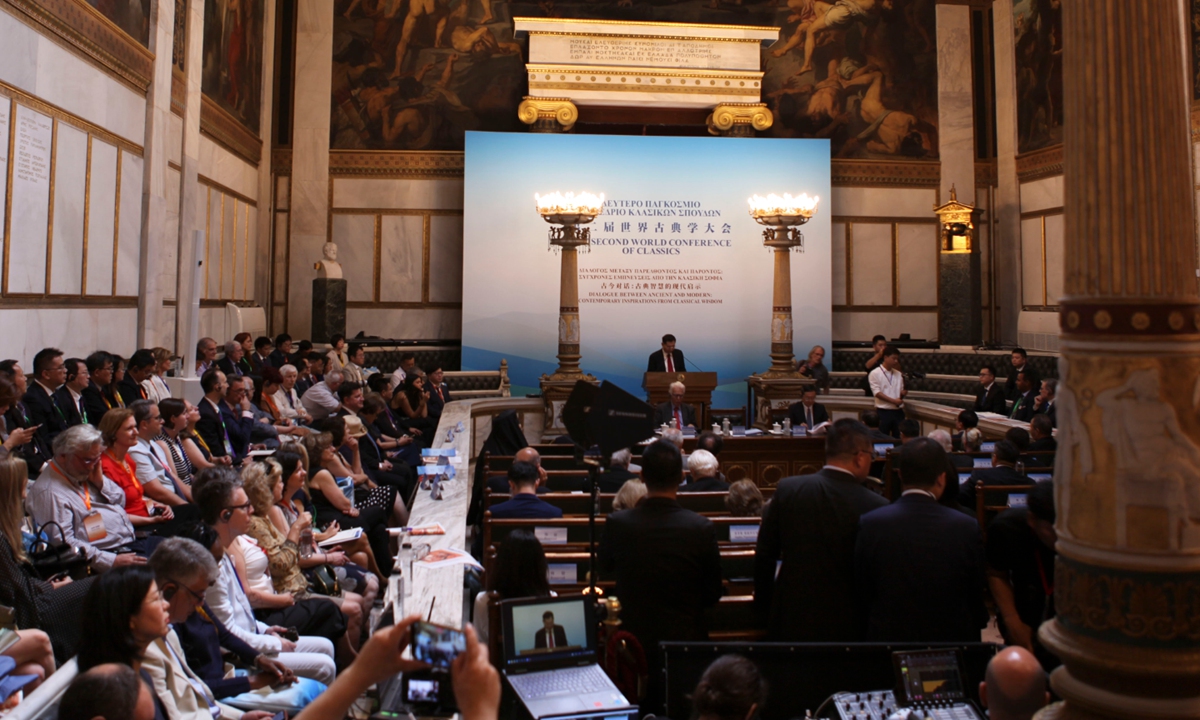
The second World Conference of Classics kicks off in Athens, Greece, on June 9, 2026. Photo: VCG
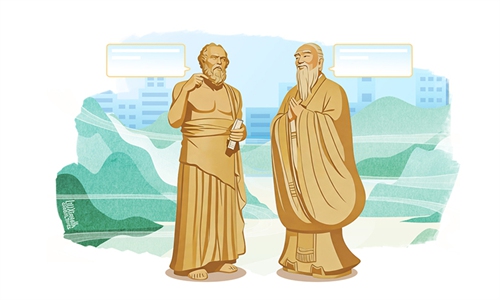
Dialogue between Greek and Chinese civilizations is more important than ever amid escalating global governance challenges and eroding international trust, Nikiforos Diamandouros, president of the Academy of Athens, said in a recent interview with the People's Daily."In his seminal work Politics, Aristotle defined the polis as a community dedicated to achieving 'the good life,' contending that true politics must embody moral practice serving the common good," Diamandouros noted. "Similarly, Confucius articulated in The Analects the principle of 'guiding people through virtue and regulating them through ritual,' revealing the profound humanism embedded in traditional Chinese culture." "Both civilizations fundamentally agree that social stability rests upon individual moral character and a balanced relationship between individual and collective aspirations," said the president. Against a backdrop of eroding global trust and intensifying governance crises, Diamandouros stressed that "dialogue and exchanges between our two civilizations possess unique contemporary relevance."
Diamandouros noted that while globalization has fostered economic interdependence, it has not commensurately deepened mutual cultural understanding. As cultural tensions and geopolitical conflicts resurface globally, humanity faces a pivotal challenge: how to creatively coexist amid profound differences.
"A sustainable international order cannot rest solely on economic power or military deterrence. It also requires shared values and cross-cultural trust. That is why I believe the Chinese philosophy of harmony without uniformity is among the most relevant contributions of traditional Chinese thought to today's world order," Diamandouros said.
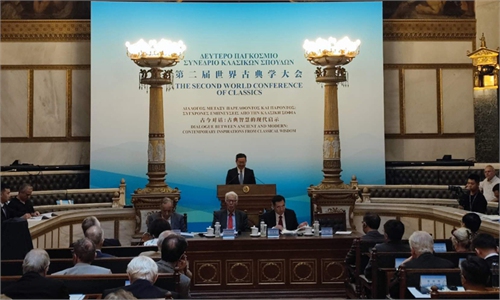
The second World Conference of Classics, themed "Dialogue between Ancient and Modern: Contemporary Inspirations from Classical Wisdom," kicked off in Athens, Greece, on Tuesday. Diamandouros said the conference's greatest significance lies in creating a platform for international-minded exchange, where different civilizations can be studied in a non-confrontational and complementary manner while expressing humanity's shared pursuit of knowledge, justice, and moral values.
"I hope this conference will encourage young scholars to revisit classical texts, not as museum artifacts, but as living sources of reflection on the major questions facing the modern world. Here, the study of classical civilizations can become a bridge for mutual understanding, peaceful coexistence, and joint creation," he said.
In recent years, institutions such as the Center of Chinese and Greek Ancient Civilizations and the Chinese School of Classical Studies at Athens have been established. Archaeological cooperation, academic exchanges, and reciprocal scholar visits have also expanded. Academic collaboration between the two nations has evolved into a more institutionalized form of cooperation and become an indispensable component of the broader friendship and cooperation between the two countries.
"Greece-China collaboration illustrates that great civilizations need not compete," he concluded. "Through dialogue, knowledge exchange, and mutual respect, they collectively shape our shared future." The scholar identified promising fields for enhanced cooperation, including comparative political philosophy, archaeology, heritage preservation, linguistics, intellectual history, and crucially, technology ethics amid AI's rapid development.
"Integrating contemporary technological research with our rich humanist traditions could yield more human-centered AI governance frameworks" Diamandouros proposed. Greece and China, as civilizations with unbroken histories and rich intellectual legacies, share profound affinities. The burgeoning warmth between their societies and peoples offers "a forceful rebuttal to the 'clash of civilizations' narrative," said the scholar.
"This warmth illustrates how different civilizations can peacefully coexist and mutually enrich one another. The collaboration between Greece and China exemplifies how great civilizations forge relationships rooted in dialogue, not confrontation. As we witness growing global mutual understanding, respect, and collective responsibility in addressing shared challenges, the vision of a community with a shared future for humanity will gain new dimensions," Diamandouros said.
He emphasized that culture's enduring value lies not only in preserving a magnificent legacy, but also in offering civilizational wisdom for shaping modern international relations.
Great civilizations can engage in constructive dialogue while retaining their distinct characteristics. Culture's greatest gift is its power to build bridges of understanding - a vital message that Greece and China offer the world today, said the scholar.
This was translated from an article originally published on Page 3 of the People's Daily on June 9, 2026.
RELATED ARTICLES