IN-DEPTH / IN-DEPTH
At India’s Chinatown, I witnessed two ancient civilizations weathering 200 years as one community
Old bond, new beginning
Editor's Note:
In an era of profound global shifts and increasingly complex regional dynamics, a proper understanding of the world must be rooted in "grounded experience" and localized insights. Global Times English edition, in collaboration with the Academy of International and Regional Communication Studies, Communication University of China, is proud to launch "Local Insights," an English-language column dedicated to original, field-based observations.
We invite Chinese scholars and professionals who are studying, conducting exchanges, or working outside China, as well as international students and friends living and studying in China who are familiar with the social contexts of their home countries or third countries, to begin from first-hand field experience and engage with social, cultural, and contemporary issues beyond China. The third article in this column features a Chinese scholar witnessing the two-century-long civilizational integration, mutual accommodation and resilient people-to-people bonds between China and India through her on-site exploration of Kolkata's centuries-old Chinatown and in-depth conversations with local Chinese-Indian residents and Bengali neighbors.
When I got out of a yellow taxi, and stepped onto the narrow, bustling lanes of Tangra in eastern Kolkata, the air was thick with a sensory symphony I had long anticipated but never fully experienced until that moment. The sharp sizzle of woks mixing with the sweet aroma of incense, the distant hum of Bengali conversations and the faint, earthy scent of leather from the old tanneries created an atmosphere that felt both foreign and profoundly familiar. For someone who has spent many years immersed in the study of South Asian politics, history and society - poring over archives, conducting interviews across Eastern and Northern India, and mastering Bengali to better understand local voices - this was not merely another academic field visit. It was a visceral return to the living roots of the China-India friendship, a dimension that no policy paper or diplomatic communiqué could ever fully capture.
Centuries of roots where civilizations converge
Kolkata's Chinatown, widely regarded as India's oldest and historically the largest Chinese community in the subcontinent, represents more than two centuries of grassroots exchange between China and India. Its origins trace back to the late 18th century, when a pioneering Chinese trader, Tong Achew (also known as Yang Dazhao), received a land grant from British Governor-General Warren Hastings around 1778. Achew established a sugar plantation and piggery near what is now Achipur, laying the foundation for what would become a thriving migrant hub. Soon, successive waves of Hakka and Cantonese migrants from Guangdong and Fujian provinces arrived, seeking opportunities in carpentry, trade, shoe-making and small businesses under British colonial rule. By the early 20th century, the community had concentrated in two main areas: the older settlement around Tiretta Bazaar in central Kolkata and the newer, more industrial enclave in Tangra to the east.
What makes this history particularly compelling is the way these migrants, arriving in a colonial context far from their homeland, forged organic bonds with local Bengali society. Unlike state-orchestrated exchanges that dominate modern diplomacy, these early interactions were born of everyday necessity and mutual benefit.
The Hakka community, renowned for its resilience and entrepreneurial spirit, transformed marshy, underdeveloped land in Tangra into a bustling industrial zone centered on the leather tanning industry. Its expertise not only supplied high-quality leather goods to local markets but also generated employment for local Bengali workers, creating interdependent economic ties that transcended ethnic lines. Restaurants and street food stalls became another enduring legacy. The fusion cuisine that emerged, such as Hakka noodles, chili chicken, crispy fried momos, sweet-and-sour dishes, has become an inseparable part of Kolkata's culinary identity, enjoyed by Bengalis, Indians from across the country and even international visitors. This culinary bridge, born from adaptation and innovation, illustrates how people-to-people exchanges can embed themselves into the daily fabric of a society.
As a scholar fluent in Bengali, I found myself uniquely positioned during my visit to engage directly with both elderly Chinese-Indian residents and their Bengali neighbors, bypassing the barriers that often limit outsider perspectives. One afternoon in a quiet Tangra lane, I sat with an 82-year-old Hakka grandmother whose family has operated a modest shoe shop for three generations. Switching effortlessly between the Hakka dialect, English and fluent Bengali, she recounted how her grandfather arrived in the 1930s seeking work opportunities. Her stories were rich with details of community life, including clan associations that provided support networks, schools where children learned both Chinese traditions and Bengali language, and festivals that drew mixed crowds. Nearby, a local Bengali shopkeeper joined our conversation, praising the Chinese community's contributions and sharing memories of joint celebrations. He spoke warmly of how Chinese New Year lion dances and lantern processions have become fixtures on Kolkata's cultural calendar, enriching the city's vibrant multicultural tapestry.
These interactions, along with conversations over shared plates of stir-fried vegetables and momos, and laughter echoing in narrow alleys, reminded me that true people-to-people ties are not abstract concepts. They are tasted in food, heard in code-switching languages and felt in the quiet continuity of neighborhoods that have weathered colonial rule, partition and independence together.
The temples stand as powerful symbols of this cultural syncretism. The iconic Chinese Kali Temple in Tangra, for instance, features Taoist deities alongside Hindu rituals, with incense, Bengali-style offerings and prayers blending seamlessly. During my visit, I witnessed devotees from both communities performing rituals side by side, a living testament to hybrid identities forged over generations. Similar fusion appears in the older Tiretta Bazaar area, where historic buildings and community halls evoke the community's peak influence in the early to mid-20th century. These spaces once hosted schools, drama societies and social gatherings that fostered not only cultural preservation but also genuine integration with Bengali society.
Of course, the history of Kolkata's Chinatown has not been one of uninterrupted harmony. The 1962 China-India border conflict cast a long and painful shadow over the community. Many Chinese-Indian residents, who were born in India and integrated into local life, suddenly faced suspicion, internment in distant camps, social ostracism and economic hardship. Properties were damaged or seized in the wake of riots, and families endured years of uncertainty. The population of Chinese community in Kolkata shrank dramatically from its mid-20th-century peak, dropping to roughly 2000 to 4000 today as younger generations emigrated to China, Canada or elsewhere in search of better opportunities and less fraught identities. Walking past faded shop signs, half-empty community halls and aging structures, one senses the tangible human cost of geopolitical tensions. Families that stayed often pivoted to new professions such as dentistry, restaurants and small-scale businesses, demonstrating remarkable adaptability.
History continues in the coexistence of civilizations
Yet resilience defines the story as much as adversity. Many Chinese-Indian families have remained deeply rooted in Kolkata, contributing quietly to the city's economy and culture. Recent years have seen modest revival efforts, including heritage preservation initiatives by Chinese-Indian associations in collaboration with local authorities and cultural organizations. Annual events, like dragon dances, Mid-Autumn Festival gatherings and food festivals, continue to draw crowds, while younger members of the community are increasingly exploring their dual heritage through education and entrepreneurship. These developments offer hope that the community's legacy can be sustained and even strengthened.
From the vantage point of a decade spent studying India's complex political landscape, economic transformations and societal dynamics, Kolkata's Chinatown provides a profound and often overlooked lens on China-India relations. While contemporary discourse frequently fixates on border frictions, strategic competition or high-level diplomacy, this historic enclave reminds us that the deepest foundations of ties between our two ancient civilizations lie in the lived experiences of ordinary people, like traders, artisans, cooks and neighbors, who have coexisted, intermarried, adapted and created shared culture for over 200 years. In an era when some voices advocate decoupling or view relations through a zero-sum lens, such living bridges underscore the enduring value of mutual respect, pragmatic cooperation and grassroots understanding.
As I departed Tangra in the evening, carrying a bag of still-warm Indo-Chinese pastries and listening to the distant sound of evening prayers drifting from the temple, a renewed sense of optimism washed over me. The challenges facing the China-India relationship are real, but so too are the opportunities embedded in places like Kolkata's Chinatown. Strengthening people-to-people exchanges through expanded youth visits, joint cultural festivals, language and heritage tourism programs, academic collaborations, and even digital storytelling initiatives can help build empathy and foster the mutual trust our two nations need.
For China and India, Kolkata's Chinatown is far more than a relic of colonial-era migration. It is a living invitation to write the next chapter of our shared history together - one conversation, one shared meal and one forward-looking step at a time.
The author is director of the South Asian Communication Studies Centre at the Academy of International and Regional Communication Studies, Communication University of China
In an era of profound global shifts and increasingly complex regional dynamics, a proper understanding of the world must be rooted in "grounded experience" and localized insights. Global Times English edition, in collaboration with the Academy of International and Regional Communication Studies, Communication University of China, is proud to launch "Local Insights," an English-language column dedicated to original, field-based observations.
We invite Chinese scholars and professionals who are studying, conducting exchanges, or working outside China, as well as international students and friends living and studying in China who are familiar with the social contexts of their home countries or third countries, to begin from first-hand field experience and engage with social, cultural, and contemporary issues beyond China. The third article in this column features a Chinese scholar witnessing the two-century-long civilizational integration, mutual accommodation and resilient people-to-people bonds between China and India through her on-site exploration of Kolkata's centuries-old Chinatown and in-depth conversations with local Chinese-Indian residents and Bengali neighbors.
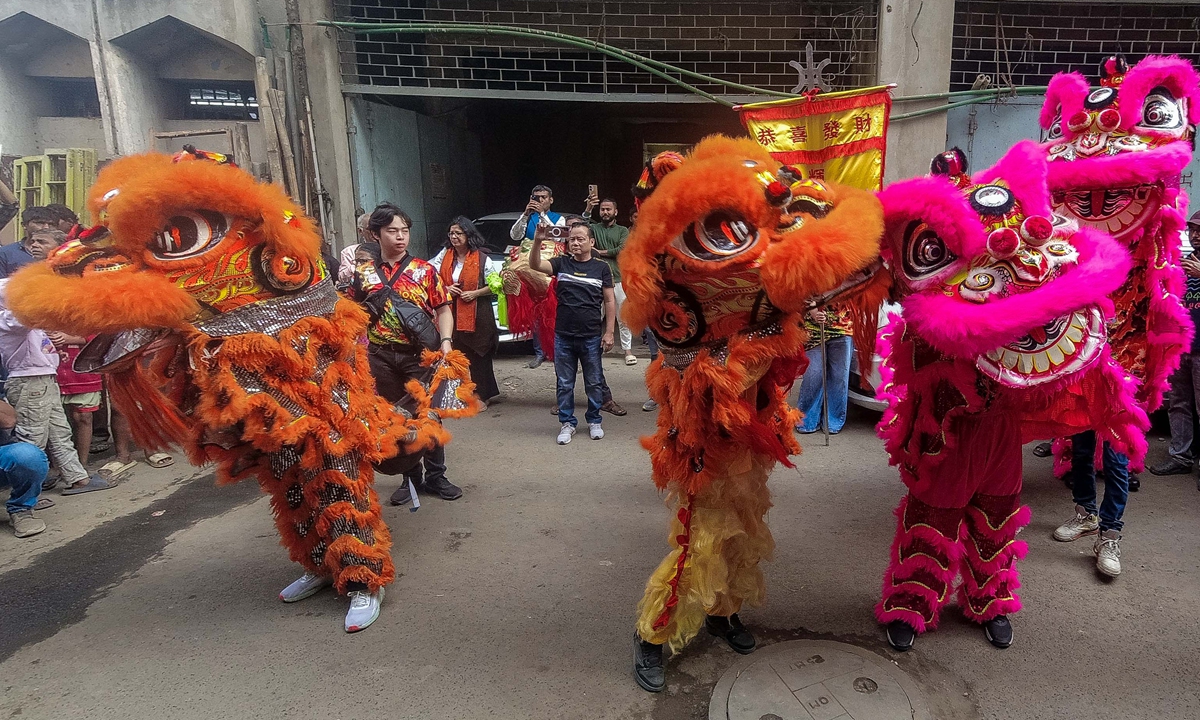
The Chinese community in Kolkata celebrates the Chinese New Year with a dragon dance on February 17, 2026. Photo: VCG
When I got out of a yellow taxi, and stepped onto the narrow, bustling lanes of Tangra in eastern Kolkata, the air was thick with a sensory symphony I had long anticipated but never fully experienced until that moment. The sharp sizzle of woks mixing with the sweet aroma of incense, the distant hum of Bengali conversations and the faint, earthy scent of leather from the old tanneries created an atmosphere that felt both foreign and profoundly familiar. For someone who has spent many years immersed in the study of South Asian politics, history and society - poring over archives, conducting interviews across Eastern and Northern India, and mastering Bengali to better understand local voices - this was not merely another academic field visit. It was a visceral return to the living roots of the China-India friendship, a dimension that no policy paper or diplomatic communiqué could ever fully capture.
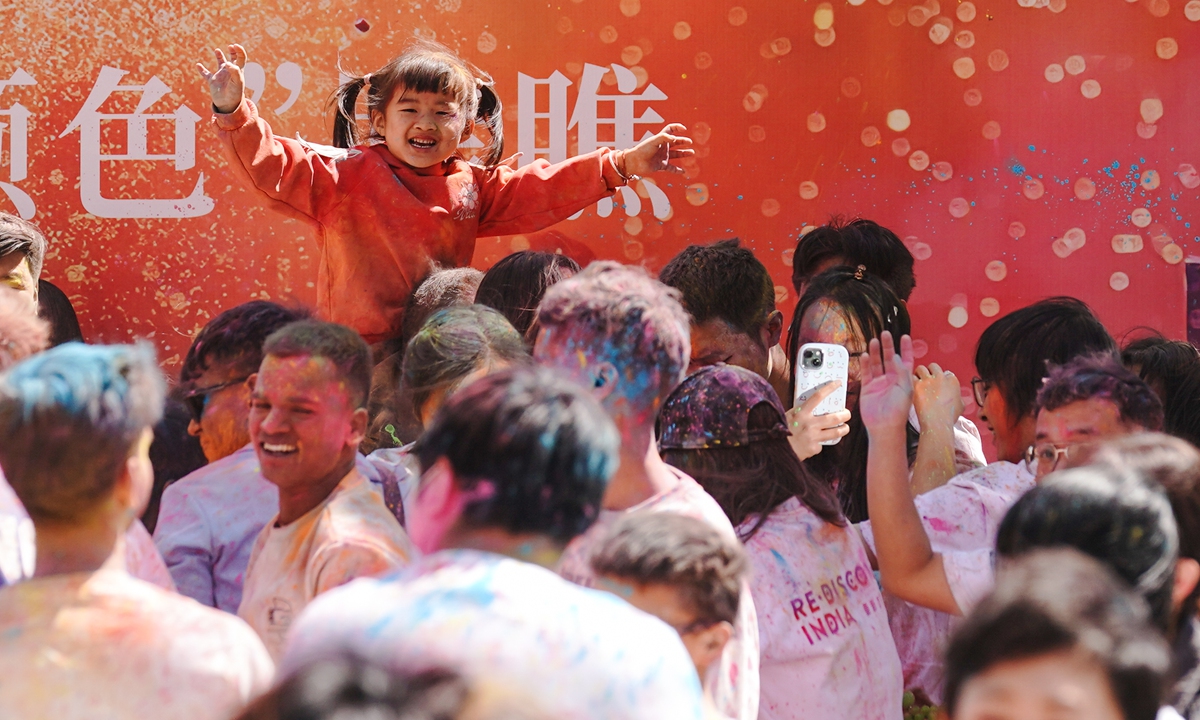
Indian people studying and working in Kunming, Southwest China's Yunnan Province, gather with local residents to celebrate Holi, India's traditional festival, on March 24, 2024. Photo: VCG
Centuries of roots where civilizations converge
Kolkata's Chinatown, widely regarded as India's oldest and historically the largest Chinese community in the subcontinent, represents more than two centuries of grassroots exchange between China and India. Its origins trace back to the late 18th century, when a pioneering Chinese trader, Tong Achew (also known as Yang Dazhao), received a land grant from British Governor-General Warren Hastings around 1778. Achew established a sugar plantation and piggery near what is now Achipur, laying the foundation for what would become a thriving migrant hub. Soon, successive waves of Hakka and Cantonese migrants from Guangdong and Fujian provinces arrived, seeking opportunities in carpentry, trade, shoe-making and small businesses under British colonial rule. By the early 20th century, the community had concentrated in two main areas: the older settlement around Tiretta Bazaar in central Kolkata and the newer, more industrial enclave in Tangra to the east.
What makes this history particularly compelling is the way these migrants, arriving in a colonial context far from their homeland, forged organic bonds with local Bengali society. Unlike state-orchestrated exchanges that dominate modern diplomacy, these early interactions were born of everyday necessity and mutual benefit.
The Hakka community, renowned for its resilience and entrepreneurial spirit, transformed marshy, underdeveloped land in Tangra into a bustling industrial zone centered on the leather tanning industry. Its expertise not only supplied high-quality leather goods to local markets but also generated employment for local Bengali workers, creating interdependent economic ties that transcended ethnic lines. Restaurants and street food stalls became another enduring legacy. The fusion cuisine that emerged, such as Hakka noodles, chili chicken, crispy fried momos, sweet-and-sour dishes, has become an inseparable part of Kolkata's culinary identity, enjoyed by Bengalis, Indians from across the country and even international visitors. This culinary bridge, born from adaptation and innovation, illustrates how people-to-people exchanges can embed themselves into the daily fabric of a society.
As a scholar fluent in Bengali, I found myself uniquely positioned during my visit to engage directly with both elderly Chinese-Indian residents and their Bengali neighbors, bypassing the barriers that often limit outsider perspectives. One afternoon in a quiet Tangra lane, I sat with an 82-year-old Hakka grandmother whose family has operated a modest shoe shop for three generations. Switching effortlessly between the Hakka dialect, English and fluent Bengali, she recounted how her grandfather arrived in the 1930s seeking work opportunities. Her stories were rich with details of community life, including clan associations that provided support networks, schools where children learned both Chinese traditions and Bengali language, and festivals that drew mixed crowds. Nearby, a local Bengali shopkeeper joined our conversation, praising the Chinese community's contributions and sharing memories of joint celebrations. He spoke warmly of how Chinese New Year lion dances and lantern processions have become fixtures on Kolkata's cultural calendar, enriching the city's vibrant multicultural tapestry.
These interactions, along with conversations over shared plates of stir-fried vegetables and momos, and laughter echoing in narrow alleys, reminded me that true people-to-people ties are not abstract concepts. They are tasted in food, heard in code-switching languages and felt in the quiet continuity of neighborhoods that have weathered colonial rule, partition and independence together.
The temples stand as powerful symbols of this cultural syncretism. The iconic Chinese Kali Temple in Tangra, for instance, features Taoist deities alongside Hindu rituals, with incense, Bengali-style offerings and prayers blending seamlessly. During my visit, I witnessed devotees from both communities performing rituals side by side, a living testament to hybrid identities forged over generations. Similar fusion appears in the older Tiretta Bazaar area, where historic buildings and community halls evoke the community's peak influence in the early to mid-20th century. These spaces once hosted schools, drama societies and social gatherings that fostered not only cultural preservation but also genuine integration with Bengali society.
Of course, the history of Kolkata's Chinatown has not been one of uninterrupted harmony. The 1962 China-India border conflict cast a long and painful shadow over the community. Many Chinese-Indian residents, who were born in India and integrated into local life, suddenly faced suspicion, internment in distant camps, social ostracism and economic hardship. Properties were damaged or seized in the wake of riots, and families endured years of uncertainty. The population of Chinese community in Kolkata shrank dramatically from its mid-20th-century peak, dropping to roughly 2000 to 4000 today as younger generations emigrated to China, Canada or elsewhere in search of better opportunities and less fraught identities. Walking past faded shop signs, half-empty community halls and aging structures, one senses the tangible human cost of geopolitical tensions. Families that stayed often pivoted to new professions such as dentistry, restaurants and small-scale businesses, demonstrating remarkable adaptability.
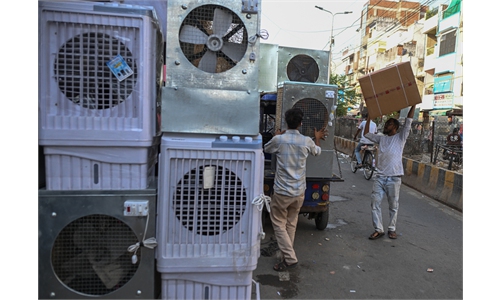
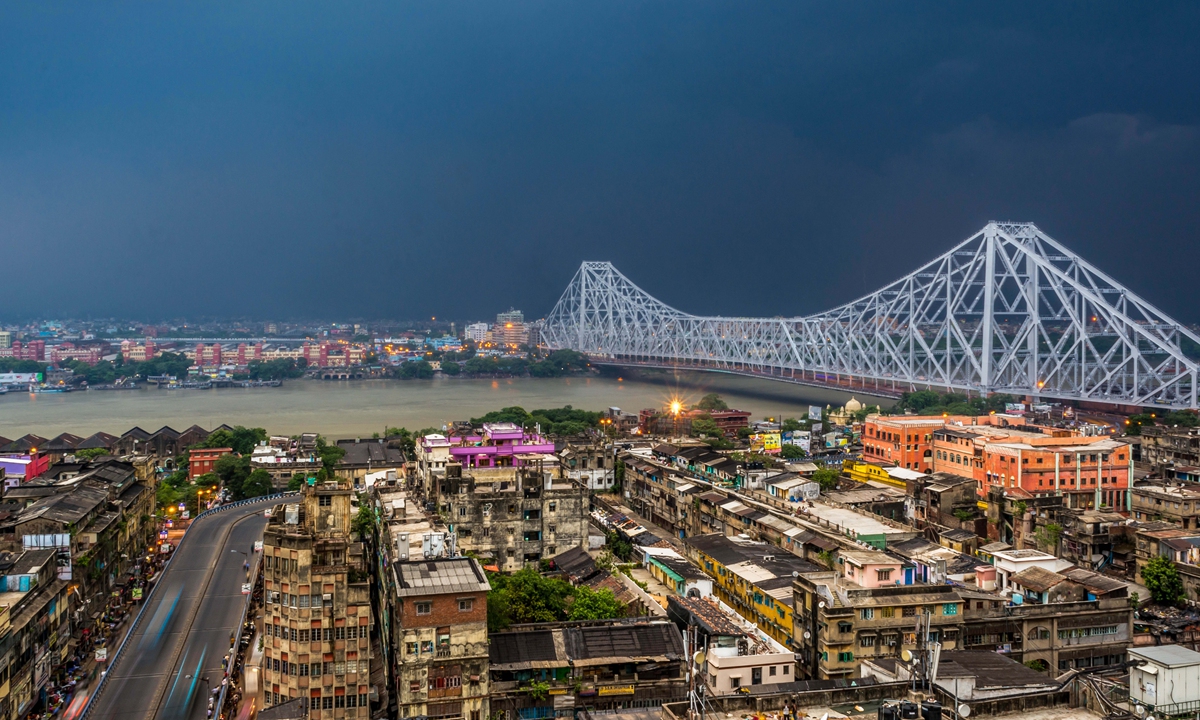
The view of Kolkata, India Photo: VCG
History continues in the coexistence of civilizations
Yet resilience defines the story as much as adversity. Many Chinese-Indian families have remained deeply rooted in Kolkata, contributing quietly to the city's economy and culture. Recent years have seen modest revival efforts, including heritage preservation initiatives by Chinese-Indian associations in collaboration with local authorities and cultural organizations. Annual events, like dragon dances, Mid-Autumn Festival gatherings and food festivals, continue to draw crowds, while younger members of the community are increasingly exploring their dual heritage through education and entrepreneurship. These developments offer hope that the community's legacy can be sustained and even strengthened.
From the vantage point of a decade spent studying India's complex political landscape, economic transformations and societal dynamics, Kolkata's Chinatown provides a profound and often overlooked lens on China-India relations. While contemporary discourse frequently fixates on border frictions, strategic competition or high-level diplomacy, this historic enclave reminds us that the deepest foundations of ties between our two ancient civilizations lie in the lived experiences of ordinary people, like traders, artisans, cooks and neighbors, who have coexisted, intermarried, adapted and created shared culture for over 200 years. In an era when some voices advocate decoupling or view relations through a zero-sum lens, such living bridges underscore the enduring value of mutual respect, pragmatic cooperation and grassroots understanding.
As I departed Tangra in the evening, carrying a bag of still-warm Indo-Chinese pastries and listening to the distant sound of evening prayers drifting from the temple, a renewed sense of optimism washed over me. The challenges facing the China-India relationship are real, but so too are the opportunities embedded in places like Kolkata's Chinatown. Strengthening people-to-people exchanges through expanded youth visits, joint cultural festivals, language and heritage tourism programs, academic collaborations, and even digital storytelling initiatives can help build empathy and foster the mutual trust our two nations need.
For China and India, Kolkata's Chinatown is far more than a relic of colonial-era migration. It is a living invitation to write the next chapter of our shared history together - one conversation, one shared meal and one forward-looking step at a time.
The author is director of the South Asian Communication Studies Centre at the Academy of International and Regional Communication Studies, Communication University of China
RELATED ARTICLES