ARTS / CULTURE & LEISURE
China-Greece cultural exchange demonstrates timeless value of classical civilizations
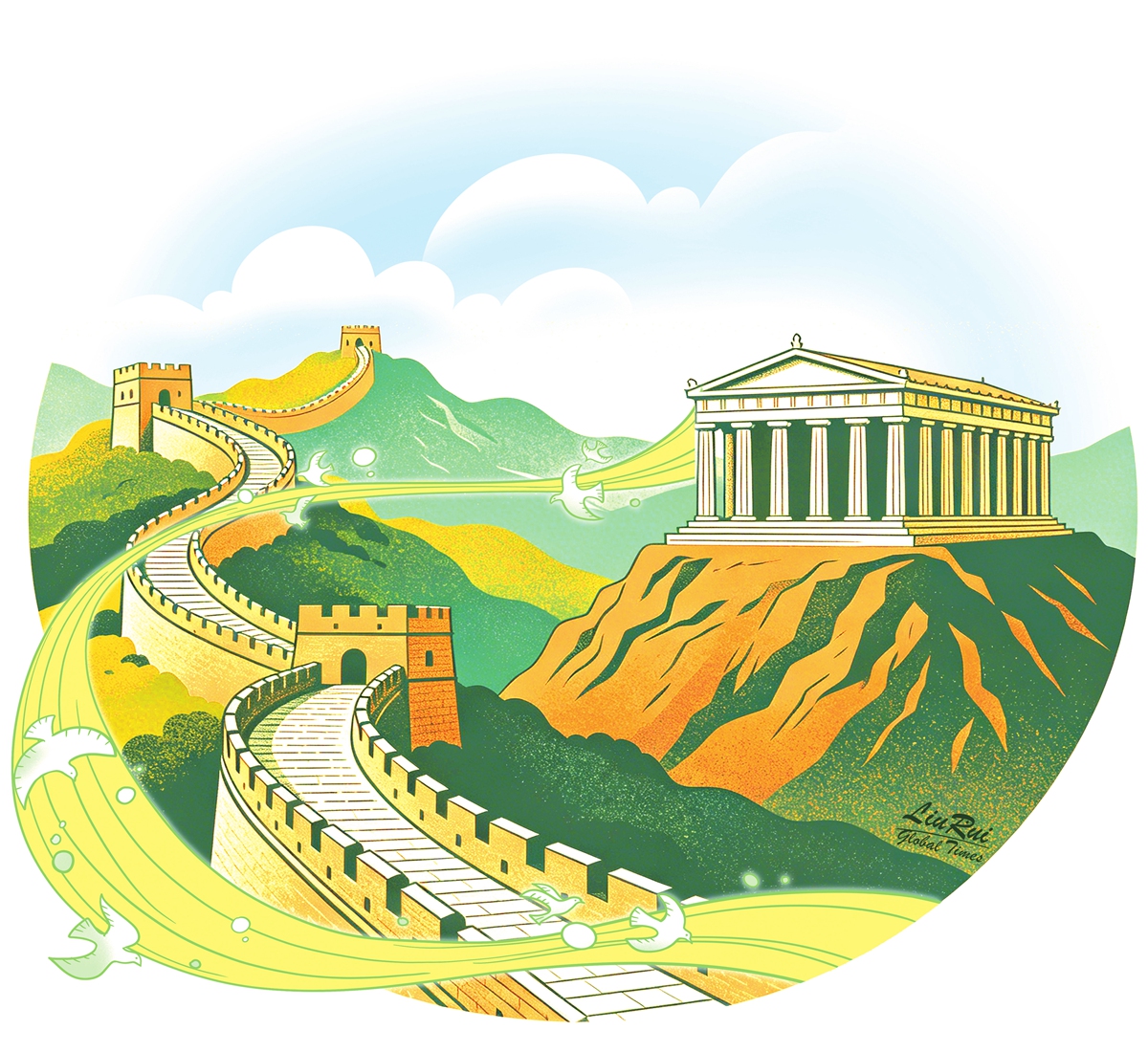
Illustration: Liu Rui/GT
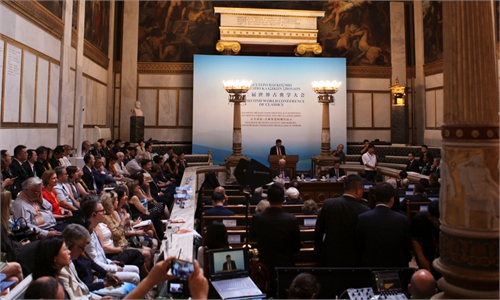
The second World Conference of Classics in Athens, Greece, held on June 9 and 10, has a significance that goes far beyond academia. It is not only a gathering of academics, archaeologists, cultural experts and historians. It is also a timely dialogue between two ancient civilizations, China and Greece, whose intellectual and cultural heritage continues to inspire humanity today.
At a time when the world is experiencing profound changes, such a dialogue is particularly valuable. Rapid technological development, social transformation, geopolitical uncertainty, and cultural misunderstanding have created new challenges for all countries. Under these circumstances, people increasingly need to look not only to the future, but also to the deepest sources of human wisdom. Classical civilizations, rather than being distant memories, can provide important guidance for addressing contemporary problems.
China and Greece are two of the most representative ancient civilizations in the world. Although geographically separated and shaped by different historical paths, both have continuously contributed to world civilization. Ancient Greece gave humanity profound thoughts on philosophy, logic, aesthetics, drama, science, political life, and the pursuit of truth. Ancient China developed rich traditions of moral cultivation, education, governance, harmony, literature, historical consciousness, and social responsibility.
From Socrates, Plato, and Aristotle to Confucius, Mencius, and Laozi, these great traditions raised questions that remain central to human life. What is virtue? What is justice? What is good governance? How should individuals relate to society? How can humans live in harmony with each other and with nature? These questions were asked thousands of years ago, but they are still relevant in the 21st century.
The conference in Athens therefore represents more than a celebration of the past. It is a discussion about the present and the future. Bringing together leading academics and experts from China, Greece and other countries, the conference offers a platform to examine how classical wisdom can meet contemporary needs and how different cultures can learn from each other through equal and respectful dialogue.
Cultural exchange and mutual learning have always been important forces in the development of human civilization. No civilization has developed in complete isolation. Ideas, technologies, arts, religions, languages, and knowledge systems have traveled across mountains, deserts, seas, and continents. Through contact with others, civilizations have gained new perspectives, renewed their own traditions, and contributed to broader human progress.
This is the deeper meaning of China-Greece cultural exchange. It is not about comparing cultures to decide which is superior. Nor is it about replacing one tradition with another. True mutual learning means recognizing that each culture has its own historical experience, intellectual achievements, and moral insights. It means approaching others with respect, curiosity, and humility. It also means understanding ourselves more deeply through dialogue with others.
In today's world, this spirit is urgently needed. Some voices still describe relations between civilizations in terms of conflict, division, or competition. Such thinking limits the imagination and deepens misunderstanding. The dialogue between China and Greece offers a different vision. It shows that ancient civilizations can meet not as adversaries, but as partners. They can appreciate their differences while discovering common human issues.
Both China and Greece understand the importance of cultural continuity. Their ancient heritage is not simply stored in museums, monuments, books, or archaeological sites. It lives on in language, values, education, social customs, festivals, architecture, literature, and ways of thinking. It continues to shape the way people understand the world and their place in it. This shared respect for history gives China and Greece a natural foundation for deeper cultural cooperation.
The World Conference of Classics is a substantial expression of this foundation. According to the organizers, the conference includes discussions on virtue and education, moral communities in changing societies, culture-based approaches to global order, and the role of humanistic values in the digital age. These themes show that classical studies are not far from reality. On the contrary, they speak directly to some of the most pressing issues of our time.
Take the issue of virtue and education, for example. Both Chinese and Greek traditions placed great importance on moral formation. In ancient China, education was closely linked to self-cultivation, responsibility, and contribution to society. In ancient Greece, education was also linked to the development of character, reason, and political life. Today, education systems are often evaluated on the basis of technical skills, employment outcomes, and economic competitiveness. These are important, but they are not enough. Classical wisdom reminds us that education should also cultivate judgment, responsibility, empathy, and a sense of the common good.
The role of human values in the digital age is another topical issue. New technologies, including artificial intelligence, big data, and digital platforms, are transforming every aspect of life. They offer great convenience and opportunity, but they also raise difficult questions about ethics, privacy, human dignity, and social responsibility. Technology can process information, but it cannot by itself define wisdom. It can connect people directly, but it cannot guarantee mutual understanding. Classical traditions remind us that human beings must remain at the center of progress.
That is why the China-Greece dialogue on classics is not nostalgic. It is future-oriented. It asks how ancient wisdom can help modern societies think more carefully about development, justice, responsibility, and human dignity. It also encourages people to see culture not as an obstacle, but as a bridge.
In recent years, cultural exchanges between China and Greece have continued to deepen. Cooperation has expanded to areas such as archaeology, education, museums, cultural heritage protection, academic research, translation, tourism and youth exchanges. These activities contribute to the rapprochement of cultures on many levels. They allow scholars to collaborate, students to learn from each other, and ordinary people to experience the beauty and depth of another culture.
The second World Conference of Classics also continues the momentum created by the inaugural conference held in Beijing in 2024. From Beijing to Athens, the journey of this conference has a symbolic meaning. It connects two capitals of culture and two great traditions of thought. It shows that the exchange of classical wisdom is becoming a joint enterprise between scholars and institutions in all countries.
Looking ahead, China and Greece have broad prospects for further enhancing cultural exchanges and mutual learning. The two sides can encourage more joint academic projects, support the translation and publication of classics, promote cooperation between universities and museums, develop youth exchange programs, and use digital technologies to preserve and present cultural heritage. Digital platforms, virtual exhibitions, and online courses can make classical cultures more accessible to people around the world.
At the same time, cultural exchange should not remain only between experts. The wisdom of classical civilizations should enter public life. Museums, schools, media organizations, cultural festivals and tourism programs can all play a role in helping people understand the value of China-Greece dialogue. When ordinary people encounter another culture through literature, art, history, food, music, architecture or travel, mutual understanding becomes more vivid and lasting.
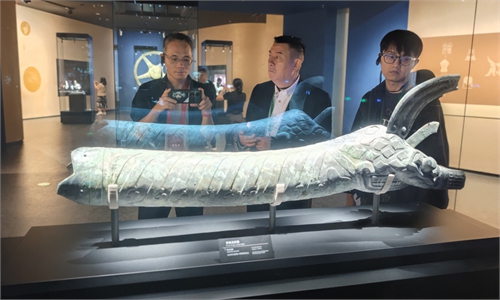
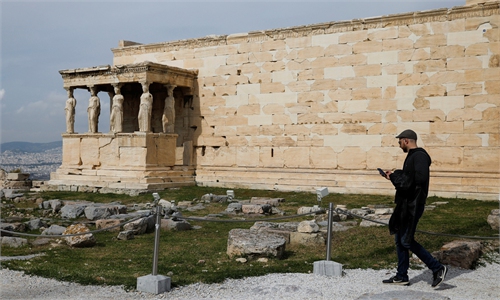
The Aegean Sea and the Yellow River nurtured different cultures, but both gave birth to the wisdom that belongs to all humanity. Greek temples, Chinese classics, ancient theaters, bronze vessels, philosophical dialogues, and historical records speak in different ways to humanity's search for truth, order, beauty, and meaning.
As scholars gather in Athens for the second World Conference of Classics, the world is invited to reflect on a simple but profound truth: civilizations are strengthened through open-mindedness. Dialogue does not weaken cultural identity, it enriches it. Mutual learning does not erase differences, it helps people understand them with respect. Classical wisdom does not belong only to history, it can help guide the future.
In a world facing uncertainty and division, the cultural exchange between China and Greece offers confidence and inspiration. It tells us that ancient civilizations still have contemporary value, that different cultures can meet through respect rather than suspicion, and that the common future of humanity depends not only on technological progress or economic development, but also on wisdom, understanding and moral vision. The conference in Athens is therefore more than an academic event. It is a reminder that the dialogue of civilizations remains one of the most important paths to a more peaceful, thoughtful and humane world.
This was translated from an article originally published on Page 3 of the People's Daily on June 10, 2026. Greek author Rodanthi Hatzopoulou is a lecturer at Zhongnan University of Economics and Law.
RELATED ARTICLES