Major e-commerce platforms in China summoned by market regulator to stop ‘rat race’ pricing war
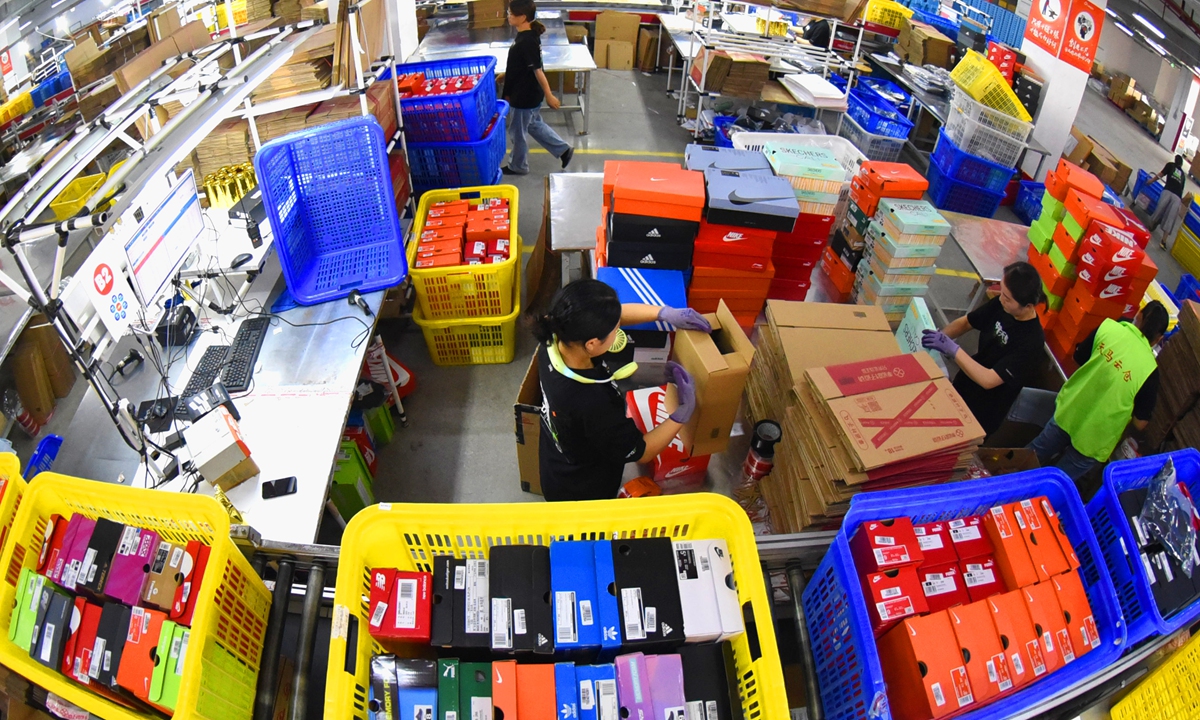
Staff at an industry zone in Lianyungang, East China's Jiangsu Province sort packages on Friday, the day China's major e-commerce platforms including JD and Alibaba's Tmall celebrate this year 618 mid-year shopping festival. Photo: VCG
The market regulator in Beijing on Thursday summoned five major e-commerce platforms - Taobao (Tmall), JD.com, Pinduoduo, Douyin, and Xiaohongshu - over a range of irregularities identified under a campaign to crack down on "rat race" competition among them.
The Beijing Municipal Market Supervision Administration said that their problems include false promotional claims, non-transparent business practices, and failure to properly disclose sellers' information. The administration aims to stop brutal "rat race" competition ahead of China's annual "618 (June 18) "online shopping festival and protect consumers' rights and maintain market order.
Taobao (Tmall) was cited for promoting a "10 billion yuan subsidy" campaign without confirming that it actually invested 10 billion yuan of its own funds for this campaign. The platform refused to disclose the actual subsidy amount or the proportion of funding split between the platform and merchants, and it failed to display sellers' qualification information for some products.
Pinduoduo, while offering its own "10 billion yuan subsidy" campaign, did not specify the subsidy amount, nor could it provide any supporting documents. Its own business rules unilaterally absolved the platform of liability in product-related disputes, which the regulator said violates statutory duties.
JD.com failed to disclose the exact time of promotional sales, its subsidy amount, or funding splits for its "10 billion yuan subsidy" and "10 billion yuan agricultural subsidy" campaigns, which the company provided no verifiable documentation.
Douyin.com ran its "618 Goodies Festival" and "10 billion yuan consumption voucher" campaigns without publishing promotional rules to the public. Its merchant recruitment rules allowed the platform to adjust terms without soliciting opinion from the public.
Rednote.com, also known as Xiaohongshu, omitted key information such as winning probabilities for its luck-draw campaign. The terms also allowed the platform to change rules unilaterally, with continued participation taken as consent - effectively excluding consumers' legitimate rights to negotiate the terms.
The administration urged the platforms to fully recognize the dangers of rat-race competition, shifting from subsidizing and pricing wars to innovation and service excellence for win-win outcomes with merchants and consumers. The platforms were ordered to immediately review and rectify all of their "618" promotional rules. The regulator said it will continue to monitor platform activities in order to maintain market order.
Liu Dingding, an internet industry expert, told the Global Times on Thursday that the regulatory move serves as a reminder for the e-commerce platforms ahead of the "618" shopping festival and will help platforms upgrade their services.
Rat-race competition disrupts market order, and erodes companies' long-term competitiveness. For many years, the platforms are found engaging in inefficient price wars. This regulatory move will push them to stop pricing competition and shift to improve their products and services, leading the industry toward high-quality growth, Liu said.
This regulatory action is part of a broader government effort to crack down on rat-race competition in e-commerce.
The State Administration for Market Regulation, the National Development and Reform Commission, and the Office of the Central Cyberspace Affairs Commission in April flagged price compliance problems among some platform companies and urged them to promptly rectify any misconduct, and effectively curb price-related violations, according to the Xinhua News Agency.
They called on platform companies to strictly regulate subsidy practices and curb malicious pricing wars, noting that they must not make false or exaggerated claims about the scale of their subsidies.
Maintaining fair market competition is a major task highlighted in China's 15th Five-Year Plan (2026-2030), which calls for improving market regulation rules, unifying standards and enhancing regulation to foster a market order characterized by high quality, fair pricing and healthy competition.
RELATED ARTICLES