Four rockets fail to launch in Taiwan island’s reported HIMARS firing; expert slams insufficient capability and separatist ambition
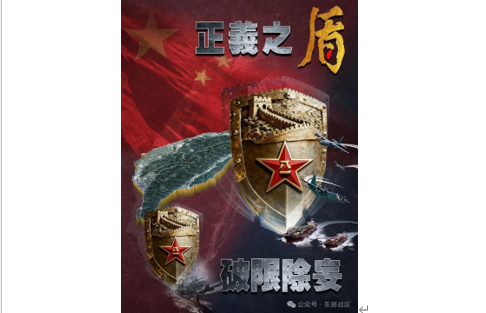
Theme poster on military drills "Shield of Justice, Smashing Illusion" Photo: PLA Eastern Theater Command
Foreign media outlets reported that the military in the Taiwan region fired its High Mobility Artillery Rocket Systems (HIMARS) on the western coast of the island on Wednesday, but according to media on the island, four live rounds failed to launch. A Chinese mainland military affairs expert told the Global Times that the premise underpinning Taiwan's high expectations with the HIMARS is fundamentally flawed, the Chinese People's Liberation Army (PLA) will not allow such threats to materialize and is more than capable of countering them.Reuters claimed that the firing of the HIMARS demonstrated the Taiwan regional military's ability to "shoot-and-scoot" by avoiding counter strikes.
According to the Reuters report, Taiwan test fired its Lockheed Martin-made HIMARS for the first time last year off its east coast. Wednesday marked the first time it has fired the precision weapon on the west coast.
However, according to Taiwan island's media outlet United Daily News on Wednesday, the military in the Taiwan region had originally planned to launch 36 M28 reduced-range practice rockets but ultimately only managed to successfully launch 32 due to system-related issues. Military sources revealed that system problems had already emerged before, and the US side had assisted in updating the software last year. The exact cause this time still needs to be determined.
Zhang Junshe, a Chinese mainland military affairs expert, told the Global Times on Thursday that the US has twice sold HIMARS to the Taiwan region, totaling 111 units. Assuming these systems are not destroyed by the mainland, they could pose a certain level of threat to some bases, airfields, and ports along the mainland's southeastern coast if launched from Taiwan island's western coast.
However, this threat is built on the assumption that the systems would "survive" - an assumption that is highly unlikely to hold, Zhang said. The PLA will not allow these missile and artillery positions to remain operational.
Although HIMARS has a certain degree of mobility, executing a "shoot-and-scoot" tactic on the island of Taiwan is extremely difficult. Taiwan island has limited space and lacks strategic depth, with a total area of only about 35,000 square kilometers, fragmented terrain, and a sparse road network, making it impossible to maneuver widely to evade strikes, the expert said.
Meanwhile, Zhang said that Taiwan island is highly transparent under the PLA's surveillance coverage. A multi-dimensional reconnaissance network consisting of satellites, aircraft, and drones enables round-the-clock, seamless monitoring of the island. HIMARS launcher vehicles have little chance to outrun missile and artillery strikes. The PLA's long-range rocket artillery systems have full coverage of Taiwan and are abundant in quantity, enabling saturation strikes against military targets and key facilities on the island, including HIMARS positions and other types of installations.
During the PLA Eastern Theater Command's "Justice Mission 2025" exercise against "Taiwan independence" separatist forces in December 2025, a video report by the People's Daily showed footage of strikes against mobile ground targets, demonstrating that after receiving targeting data on HIMARS, the PLA conducted continuous simulated strikes using long-range modularized rocket systems.
This so-called drill is nothing more than a tactic of the Democratic Progressive Party (DPP) authorities to hype up the so-called "mainland threat." It is aimed at demonstrating to the US their value as a pawn, signaling their loyalty to Washington. Also, it reflected their fear of being abandoned by the US, as they seek to draw Washington's attention in order to continue receiving arms support. However, such schemes are doomed to fail, Zhang said.
In response to a question about the claim by the head of Taiwan island's defense affairs department that the region would continue to strengthen its "self-defense" capabilities and maintain close military cooperation with the US, Zhang Xiaogang, a spokesperson of China's Ministry of National Defense, said on Tuesday that recent US statements related to Taiwan show that the US side has gained a better understanding of, and attached greater importance to, China's position and concerns on the Taiwan question. More and more facts prove that the historical trend that China will and must be reunified is unstoppable.
Any attempt to "seek independence by relying on external forces" or "seek independence through military means" is doomed to fail. Forces that remain obstinate and go against the tide of history will be swept away by the historical current, Zhang Xiaogang said.
RELATED ARTICLES