ARTS / CULTURE & LEISURE
Uncovering Ningbo’s land-and-sea heritage through millennia-old archaeological sites
A city with two souls
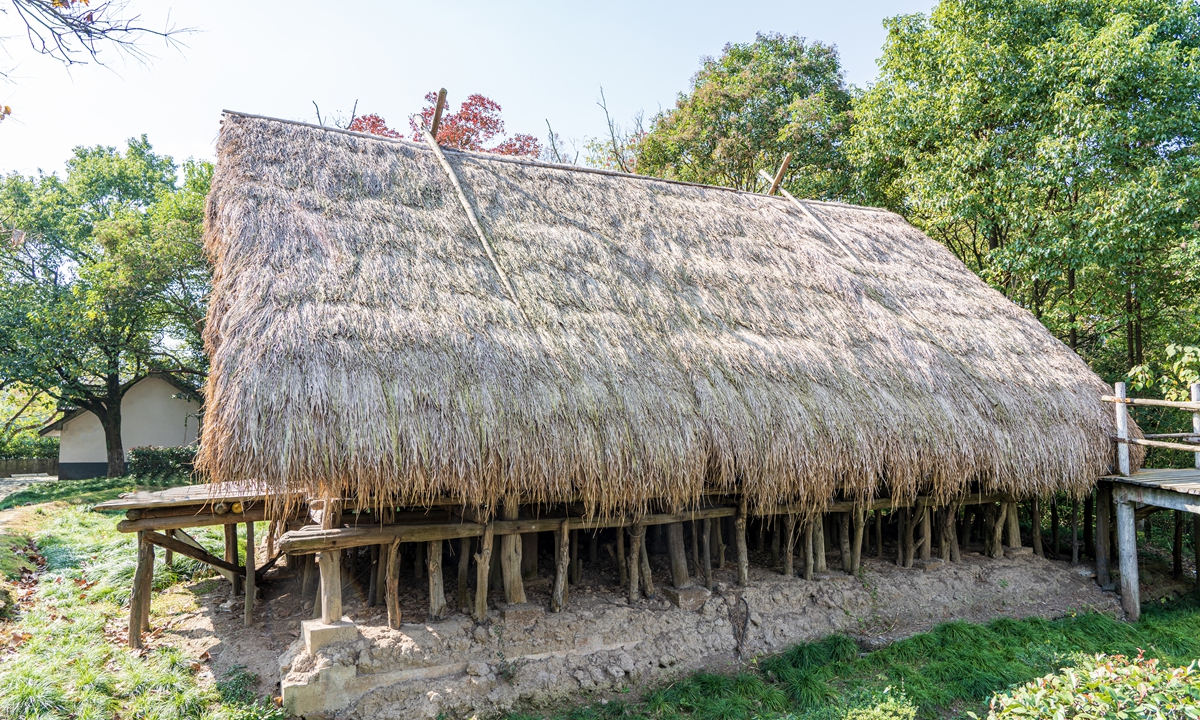
Replica of an ancient building at the Hemudu site in Ningbo, East China's Zhejiang Province Photo: VCG
Walking around the city of Ningbo, East China's Zhejiang Province, one can instantly grasp its modern pulse.The city's defining landmark, Ningbo Center, rises over 400 meters into the clouds, with its silhouette evoking a lotus bud poised to bloom. Near the city's coast lies the Ningbo-Zhoushan Port, the world's busiest cargo harbor.
As night falls, strolling through Ningbo's Laowaitan, also known as the Ningbo Old Bund, one can smell the aroma of grilled meat from a Romanian food truck, while foreign tourists and locals alike wander along the riverside, enjoying the evening breeze.
These fragments of urban landscapes form Ningbo's inclusive and international character. Yet, if one delves a little deeper, one can discover the city's long history hidden beneath its modern look. And it is by stepping into two millennia-old archaeological sites - Hemudu and Jingtoushan - that one can truly uncover the blend of tradition and modernity that characterizes the city.
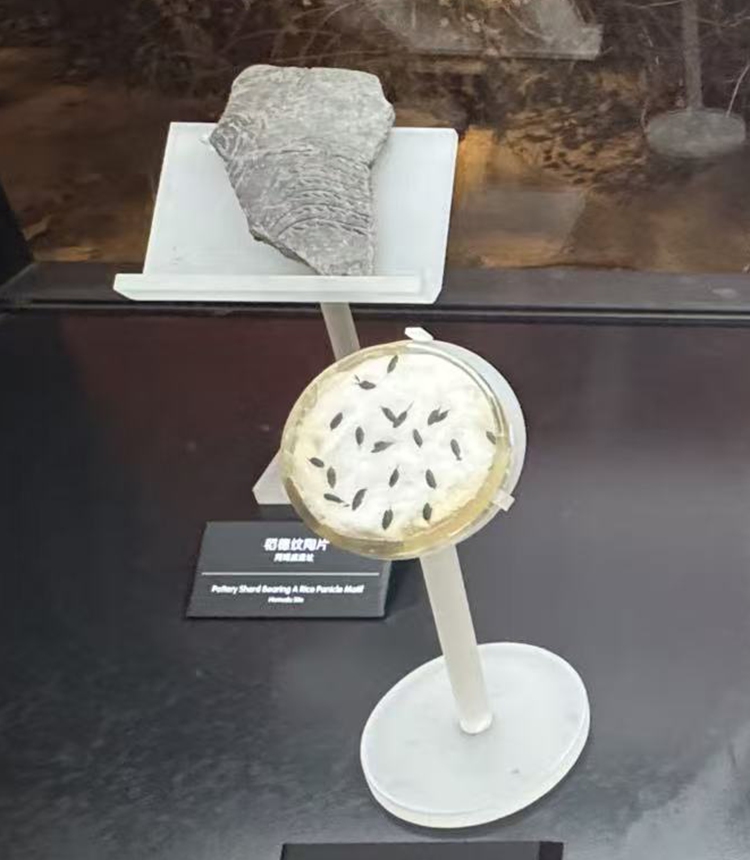
Excavated pottery piece and paddy seeds Photo: Li Yuche/GT
Secrets in grainsAbout a 40-minute drive from downtown Ningbo leads to the Hemudu Site, a Neolithic settlement dating back 7,000 years. Next to the site, the Hemudu Site Museum tells its unique rice-cultivating story.
In the museum, inside a glass display case lie carbonized rice grains, each just slightly larger than a black sesame seed and appearing grayish-black. Nowadays, the tiny grains appear unremarkable. However, Xu Kai, the museum's director, told the Global Times that when they were first unearthed, they were still golden yellow.
"Back in the 1970s, archaeologists discovered these 7,000-year-old rice remains. What came out of the earth was not just a grain or two, but massive accumulations of golden rice," Xu noted. "It was a sight that shocked the archaeological world at the time."
These rice remains were later recognized as one of the world's earliest known examples of cultivated rice. They not only reveal the practice of China's agricultural civilization in ancient Ningbo, but also shattered the previous archaeological assumption that China's japonica rice was introduced from India and that indica rice was introduced from Japan.
"The rice remains found within the Hemudu site helped establish China's Yangtze River Basin as a primary center of the world's rice farming civilization," Xu remarked.
Continuing to wander through the museum, one can find out about Ningbo's agricultural wisdom, which is embodied not only in the cultivation of rice, but also in the design of each delicate and ingenious tool.
Shaped like a stick with both ends tapering to points like sharpened pencil tips, the dibbling stick displayed at the museum was used by Neolithic ancestors for planting seeds. Another wooden board with one or two handles on top was used as a plowing tool, an important implement for turning the soil.
Most intriguing of all is a piece of pottery that still bears the remains of scorched rice. This discovery reflects the ancestors' complete process "from cultivation to cooking, from the field to the table," cultural expert Guan Zhixing told the Global Times, adding that this ancient custom, born from the cultivation of rice, "still lives on in the lifestyle of modern Ningbo inhabitants."
Just over 10 kilometers from Hemudu lies Cicheng Ancient Town. Going back as far as the Neolithic period, this area was already home to the early ancestors of Ningbo.
"Rice cake" is the most famous specialty here. With chewy and smooth textures, it is a staple on the daily dining tables of Ningbo people.
"Rice cake is not just food; it also serves as a cultural symbol during special times like the Spring Festival," said Shen Guofeng, a local resident.
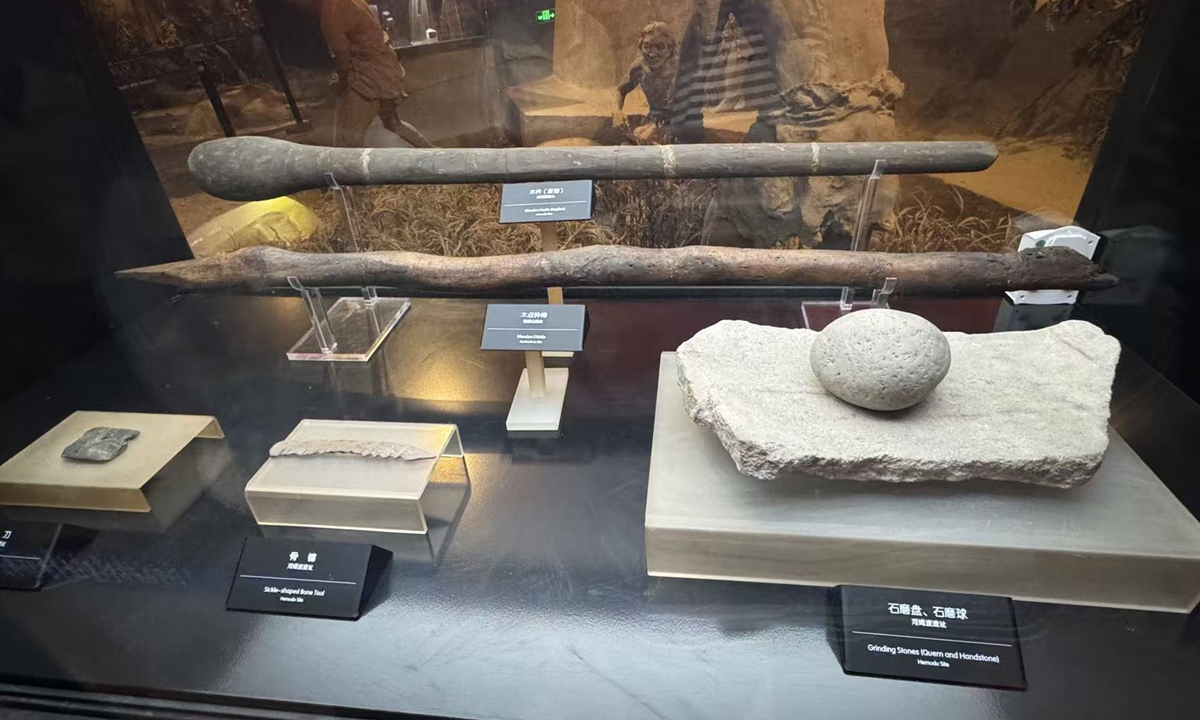
Excavated tools on display at the Hemudu site in Ningbo, East China's Zhejiang Province Photo: Li Yuche/GT
Exploring the deep blueNingbo's rice cakes are prepared in a surprising way: Instead of being served as a sweet treat, locals prefer to pair it with savory flavors and seafood such as crab and yellow croaker.
This dietary preference is closely tied to the city's abundant marine resources. And this exploration of the sea has an ancient origin - the archaeological site of Jingtoushan, located just around 13 kilometers from the Hemudu site.
The Jingtoushan site, dating back over 8,000 years, is the deepest buried and earliest coastal shell midden site along China's coastline. What strikes visitors most when visiting the site is the sheer number of shells spread across the ground and covering the entire site like a carpet.
A large amount of remains has been unearthed here showing that early humans consumed seafood such as shells and crabs. Among the discoveries, the excavation of yellow croaker otoliths, each no larger than a fingernail, provides evidence that yellow croaker had already become an important food resource for local inhabitants thousands of years ago.
Meanwhile, a well-preserved wooden paddle was also unearthed at the Jingtoushan site. The paddle has been identified as China's earliest known example of a seafaring paddle and is among the earliest such discoveries in the world.
"These remains represent the earliest footprints of China's ancestors adapting to and exploring the ocean," Sun Guoping, the lead archaeologist of the site's excavation, told the Global Times.
Chen Feilong, a local cultural expert, told the Global Times that both the Jingtoushan and Hemudu sites represent a prime example of "maritime and agricultural fusion."
RELATED ARTICLES