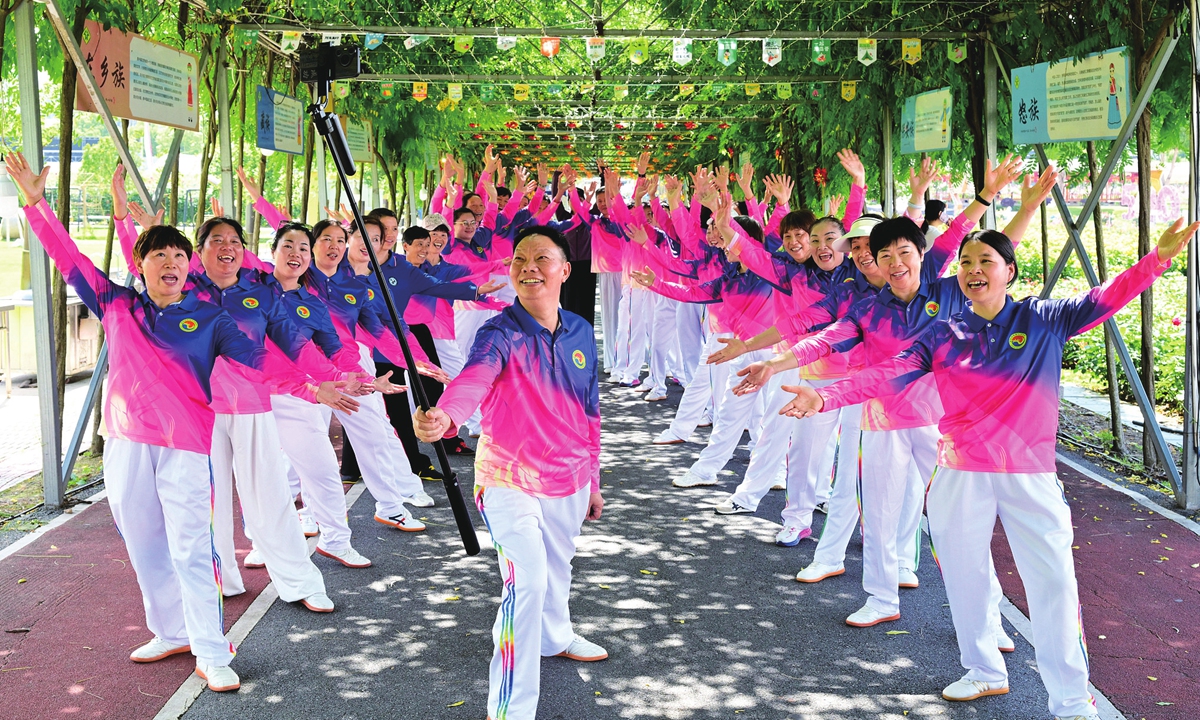
Villagers pose for a group photo in Huayuan village of Dongyang city, East China's Zhejiang Province on May 16, 2026. Huayuan village has developed from a backward mountain village to an eco-friendly scenic area. Photo: VCG
Editor's Note:The 2026 Forum on Global Human Rights Governance is being held in Beijing from Thursday to Friday, with the theme of "Joint Development, Shared Human Rights." This year also marks the 40th anniversary of the adoption of the Declaration on the Right to Development. China has comprehensively bolstered its human rights protection capability, according to an evaluation report released last week. At the opening of the forum, China released the National Human Rights Action Plan of China (2026-30), aiming to ensure the principal position of the people is respected and the people's fundamental interests are safeguarded.
"Putting the people first" is the fundamental principle guiding China's pursuit of well-rounded personal development of the people and advancement of human rights in all fields in the new era. In an interview with Global Times (GT) reporter Wang Wenwen, Ahmed Moustafa (Moustafa), director and founder of the Asia Center for Studies & Translation, Egypt, explained his understanding of China's philosophy behind its people-centered approach in human rights development.
GT: "Living a happy life is the primary human right." Why do you think China emphasizes the importance of the people so much?
Moustafa: China emphasizes "putting the people first" because it forms the foundational governing philosophy of the Communist Party of China (CPC) and the core of its people-centered human rights approach in the new era. "Living a happy life is the primary human right," reflecting a deep-rooted commitment to the well-being of the masses as the ultimate goal of development and governance.
This emphasis stems from multiple intertwined reasons. Historically, it draws from traditional Chinese thought like "the people are the foundation of the state" and the CPC's revolutionary mission since 1921 to serve the people, national rejuvenation and human progress.
Ideologically, it integrates Marxist principles with Chinese realities, prioritizing the rights to subsistence and development as primary, viewing collective progress as the pathway to individual fulfillment and common prosperity.
Practically, with a population of over 1.4 billion, China recognizes that stability, legitimacy and sustainable modernization depend on delivering tangible improvements in living standards, happiness and security. This has driven remarkable achievements in poverty alleviation, rural revitalization and the 15th Five-Year Plan's focus on common prosperity. By centering on the people, China ensures policies respond to popular aspirations, fosters social harmony and offers a pragmatic model contrasting abstract individualism - ultimately strengthening national cohesion and global contributions to human rights through development.
GT: What are the fundamental differences between China's people-centered human rights philosophy and the Western individual-centric human rights narrative? How does China's approach enrich and expand the current global human rights concept?
Moustafa: China's philosophy, rooted in "putting the people first" and the principle that "living a happy life is the primary human right," prioritizes collective well-being, subsistence, development and societal harmony. It views human rights as interdependent with national sovereignty, stability and comprehensive development, drawing from Confucian traditions of relational duties and Marxist emphasis on material conditions for the masses.
In contrast, the Western narrative centers on the autonomous individual, emphasizing civil and political rights, for example, freedom of expression, assembly, as inherent and often prior to state obligations, with a stronger focus on adversarial accountability and so-called universal liberal norms.
China's approach integrates economic, social and cultural rights as foundational, seeing individual fulfillment through collective progress rather than abstract individualism. This fosters pragmatic governance tailored to national conditions, avoiding one-size-fits-all impositions.
China enriches global human rights by operationalizing "people-centered" development, expanding the concept beyond legal-political safeguards to include the right to a happy, dignified life through poverty eradication, infrastructure and well-rounded personal growth. It advances the universality of rights while respecting diversity and prioritizing the rights to subsistence and development as primary - achieving UN 2030 poverty goals a decade earlier.
This model contributes practical experiences in balancing individual and collective rights, demonstrating that state-led initiatives can deliver tangible gains in happiness, security and equity. It counters politicization and selectivity, promoting dialogue, mutual learning and a community with a shared future for humanity, thus making human rights more inclusive and development-oriented for diverse civilizations.
GT: What experiences, different from Western models, has China provided in areas such as poverty alleviation through its human rights practices?
Moustafa: China has provided a compelling alternative through targeted, whole-of-society poverty alleviation, lifting more than 800 million rural residents out of poverty since 1978 - about 75 percent of global reduction - via precision strategies, rural revitalization and industrial development in formerly poor areas.
Unlike market-driven Western models, the Chinese approach emphasizes government leadership, party mobilization and integration of economic growth with social equity and ecological protection.
China promotes infrastructure-led connectivity, for example via the Belt and Road Initiative (BRI), and common prosperity. It focuses on societal harmony, public safety nets and shared stability over individualistic protections. These offer scalable, context-specific paths prioritizing collective upliftment.
GT: How does China's human rights philosophy resonate with the development paths and aspirations of the Global South?
Moustafa: China's philosophy resonates deeply with the Global South by affirming the primacy of development, sovereignty and people-centered progress over external conditionalities. Many nations share aspirations for poverty reduction, infrastructure and self-determined paths free from historical interference, aligning with China's emphasis on rights to subsistence, collective security and win-win cooperation.
Through South-South forums, BRI and partnerships like the Global Partnership for Poverty Alleviation and Development (initiated by China together with 53 countries and nine international organizations), it offers practical models of rapid modernization without Western-style prescriptions. This fosters solidarity, mutual respect and equitable global governance, echoing decolonization-era efforts to broaden human rights beyond individualism toward shared prosperity and cultural diversity.
GT: How can China and the countries of the Global South work together to promote a more diversified global human rights discourse?
Moustafa: China and the Global South can collaborate via multilateral platforms (UNHRC, BRICS, China-CELAC Forum, FOCAC) to advocate for non-politicized, development-focused norms emphasizing sovereignty, dialogue and capacity-building over confrontation. Joint initiatives like poverty partnerships, human rights exchanges and incorporating "people-centered" principles into resolutions can amplify Southern voices.
By sharing successful practices in poverty alleviation and sustainable development, they can build inclusive mechanisms prioritizing collective well-being, equity and tailored paths, fostering a truly universal yet pluralistic human rights framework. By jointly opposing the selective application of human rights standards and resisting coercive diplomacy disguised as human rights advocacy, China and other Global South countries can safeguard policy space for national development paths.
Concrete steps include setting up shared human rights training hubs, launching comparative studies on rights protection under different legal systems and mainstreaming the right to development as an equal priority alongside civil-political rights.
Such cooperation not only rebalances global narrative power but also contributes to a more just and inclusive international human rights governance system.
RELATED ARTICLES