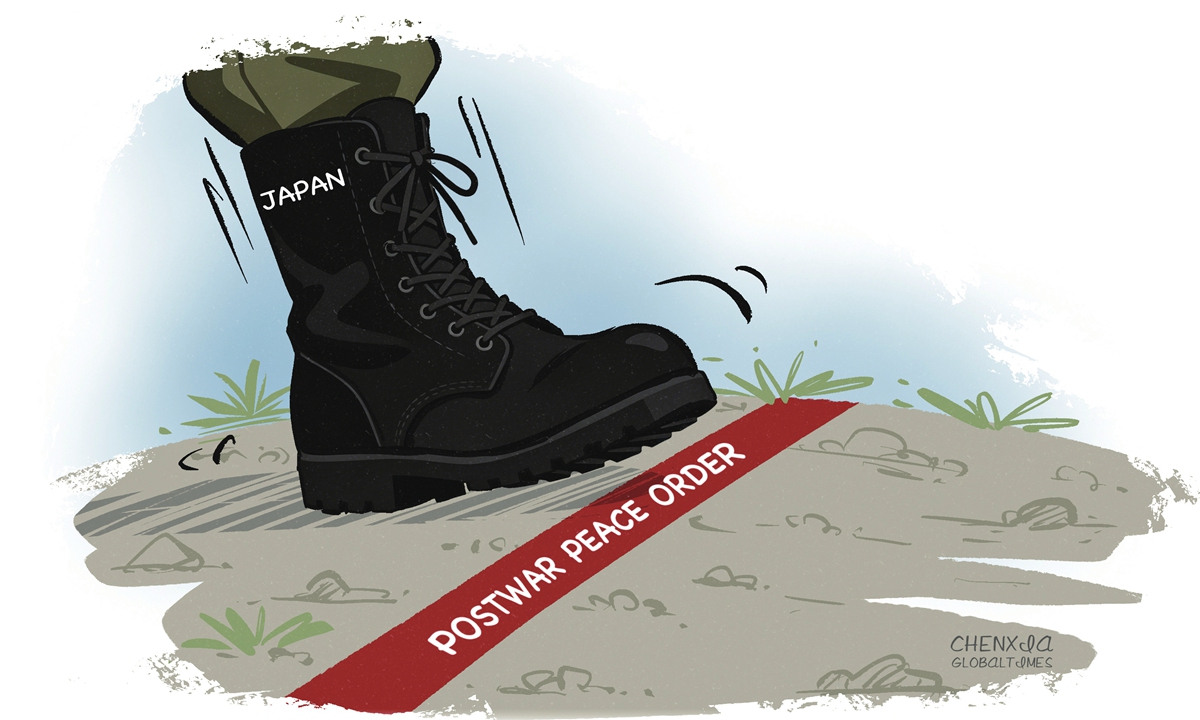
Illustration: Chen Xia/GT
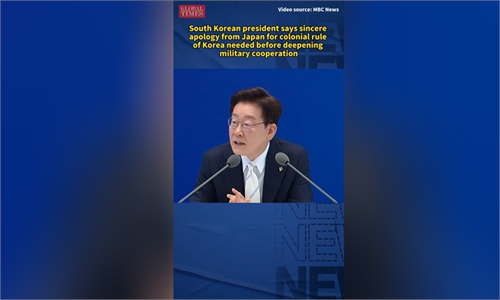
On June 8, at a press conference marking the first anniversary of his inauguration, South Korean President Lee Jae-myung commented on the South Korea-Japan Acquisition and Cross-Servicing Agreement (ACSA). He noted that he had told Japanese Prime Minister Sanae Takaichi that, given public sentiment in South Korea, it would be difficult to conclude the agreement at this time.On the surface, ACSA is a technical arrangement enabling the two militaries to share logistical support, including fuel, rations, ammunition, transport and medical services. Yet against the backdrop of Japan's ongoing push to become a major military power and its drive to build a regional military cooperation network by wooing neighboring states, the agreement is by no means a simple logistical one. It represents a key step for Japan to shake off postwar restrictions and redefine its military role in the region.
Lee's comments are striking because they cut straight to the most sensitive political crux of South Korea-Japan military cooperation: Japan has never offered genuine reflection on its history of aggression, nor has it issued a clear, sincere and unequivocal apology to the Asian nations it once victimized.
Having suffered under Japanese colonial rule, wartime atrocities and forced labor, South Korean society sees it as far more than routine military cooperation to institutionalize a framework that allows Japan's Self-Defense Forces to provide logistical support during times of "emergency" on the Korean Peninsula. While Lee attributed his stance to "public sentiment," it ultimately reflects the fact that South Korean society's historical memory of Japanese militarism has not faded, and there remains deep-seated wariness toward the rightward shift in Japan's security policies.
The issue is that Lee did not outright reject the ACSA. While he acknowledged its "realistic necessity," he believed that the timing is not yet ripe. This indicates that the possibility that South Korea will change its position under pressure from the US, continued push from Japan, and pressure from the domestic conservative forces cannot be ruled out.
In fact, there have always been forces within South Korea pushing to institutionalize military cooperation between South Korea and Japan. While deep historical misgivings about Japan persist among the public, security anxieties, US influence and practical interests are gradually wearing away such caution.
Japan, of course, would not let this opportunity slip by. The real danger is that its ongoing militarization is far more than a routine tweak to national defense policy, but rather a resurgence of neo-militarism without a thorough reckoning with right-wing historical views. This is not a closed chapter of history. Instead, the specter of the past is re-emerging in new guises.
The international community, Asian nations in particular, must clearly recognize that Japan's militarization threatens not merely regional order in the abstract sense, but its Asian neighbors in a real sense. Should Japan expand its military capabilities without genuine reflection and a sincere apology, and without fully eradicating the extremist right-wing ideology and militarist mind-set, regional peace will face new risks.
Therefore, the South Korea-Japan ACSA is far more than a simple matter of Seoul seeking logistical support from Japan, nor can it be framed as a technical detail of cooperation. The fundamental question is: Can a nation that has never fully come to grips with its history of aggression be allowed to rebuild a military network across Asia? Should a Japan that continues to glorify its history of aggression and push for military deregulation receive military cooperation from the nations it once victimized? The answer a definite, resounding no.
Asian countries may pursue diplomatic, economic, trade, cultural and people-to-people exchanges with Japan, as well as cooperation in low-risk areas including disaster relief and public health. When it comes to military, security, logistics and related operational fields, however, clear red lines must be drawn, and vigilance must be maintained. Most importantly, no nation should help Japan re-emerge as a major military power until it delivers a clear and unreserved apology to its Asian victims.
Lee's latest remarks demonstrate that historical issues remain an insurmountable hurdle for military cooperation between Seoul and Tokyo. The real test lies in whether South Korea can stay firm on this stance, and whether Asian nations can jointly safeguard the bottom line of the postwar peace order.
The author is the director and professor of the Center for Korean Peninsula Studies at the Shanghai University of International Business and Economics. opinion@globaltimes.com.cn
RELATED ARTICLES