China's e-commerce logistics index continues to rise in May, signaling improving market vitality
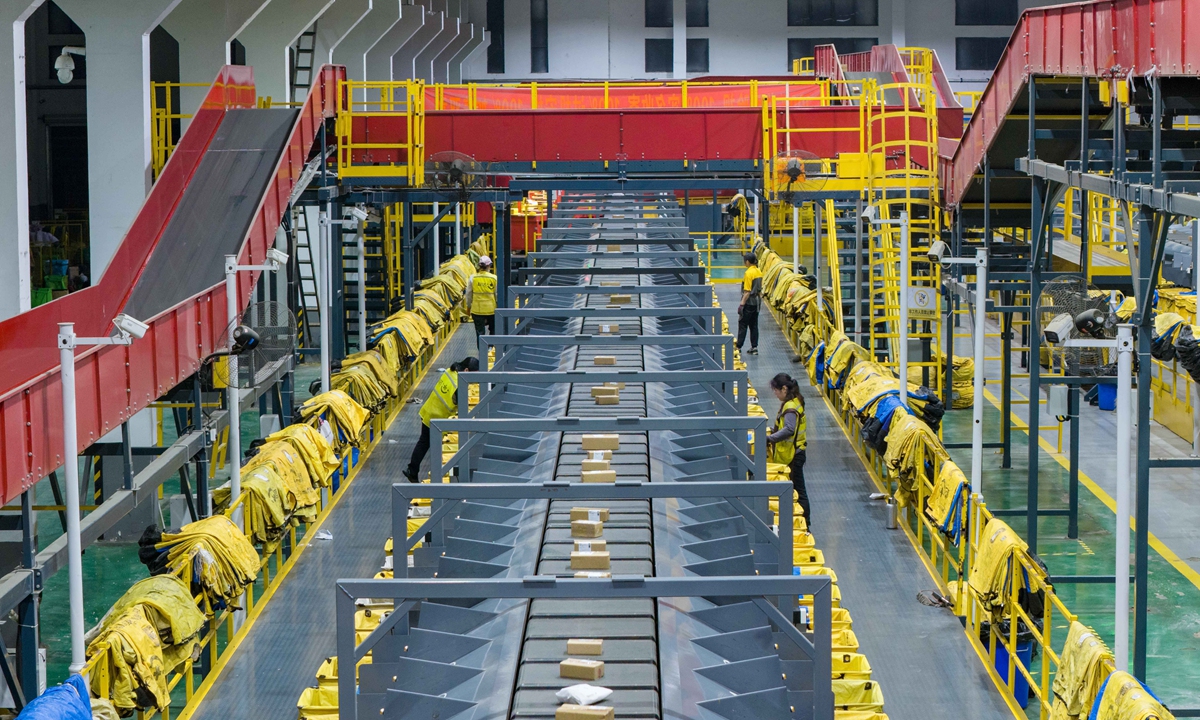
Workers at an express delivery company's grid warehouse sort parcels on an intelligent express delivery line in Xinghua, East China's Jiangsu Province on May 20, 2026. Data released by the State Post Bureau shows that from January to April, the postal industry handled 70.16 billion parcels, a year-on-year increase of 4.1 percent. Among them, express delivery volume reached 64.57 billion parcels, a year-on-year increase of 5.1 percent. Photo: VCG
China's e-commerce logistics index extended its recovery in May, pointing to stronger industry activity and improving market vitality, according to data released by the China Federation of Logistics and Purchasing on Saturday.
The China E-commerce Logistics Index stood at 111.0 points in May, up 0.4 points from the previous month. Among the major sub-indices, the total business volume index for e-commerce logistics rose 0.4 points month-on-month to 128.3. Meanwhile, demand in the rural e-commerce logistics market rebounded across the board, with the rural e-commerce logistics business volume index returning to growth after a decline, led by the strongest increase in western China, according to the data.
Policies promoting green consumption in rural areas and fostering new quality productive forces in agriculture have boosted spending in county-level regions, Liu Yuhang, director of the China Logistics Information Center, said.
He noted that China has largely established a three-tier rural logistics network covering counties, townships and villages, supporting rural revitalization and consumption upgrading.
On the supply side, the express delivery service system performed steadily in May, with overall service quality and operational efficiency improving. The inventory turnover index rebounded after a decline, indicating faster destocking and improved circulation efficiency. Meanwhile, the cost index fell 0.5 points month-on-month to 113.3, easing operational pressure on businesses and further improving the industry's development environment.
Total e-commerce logistics business volume grew by more than 20 percent year-on-year in May. Supported by holiday spending during the May Day holiday and early inventory stocking and order promotions ahead of the "618" shopping festival, domestic consumer demand continued to recover steadily.
The China E-commerce Logistics Index has now risen for three consecutive months, while total e-commerce logistics business volume posted strong year-on-year growth.
In May, both total e-commerce logistics business volume and rural e-commerce logistics business volume grew by more than 20 percent year-on-year. Demand remained stable for traditional essentials such as apparel and beauty products, while seasonal fresh produce including cherries and lychees saw strong sales. Smart home devices and wearable technologies also remained popular, reflecting a broader shift toward smarter and higher-quality consumption. Emerging sectors such as outdoor sports and the pet economy continued to gain momentum, becoming new drivers of market growth.
Consumer demand was fully unleashed in May, supported by strengthened trade-in programs for consumer goods and increased promotional efforts by major e-commerce platforms, which effectively boosted spending willingness, Cui Zhongfu, chief economist at the China Federation of Logistics and Purchasing, said.
The market was characterized by steady demand for traditional products, strong growth in tech-related goods and robust expansion in emerging sectors, he noted.
The China Federation of Logistics and Purchasing also said that China's international breakbulk logistics sector maintained steady growth. Breakbulk cargo refers to goods handled and transported as individual units rather than in containers, including bagged grain, large-scale engineering equipment, wind turbine blades and vehicles.
China's breakbulk international logistics sector maintained steady growth in 2025, with its overall service capacity improving significantly, according to a report released by the China Federation of Logistics and Purchasing on Friday.
Exports of major breakbulk goods, including overseas engineering project materials, power equipment, construction machinery and agricultural machinery, exceeded $295 billion in 2025, up 12 percent year-on-year, driving substantial growth in international breakbulk logistics. Electromechanical equipment accounted for the largest share of exports, at around 30 percent.
Global Times
RELATED ARTICLES