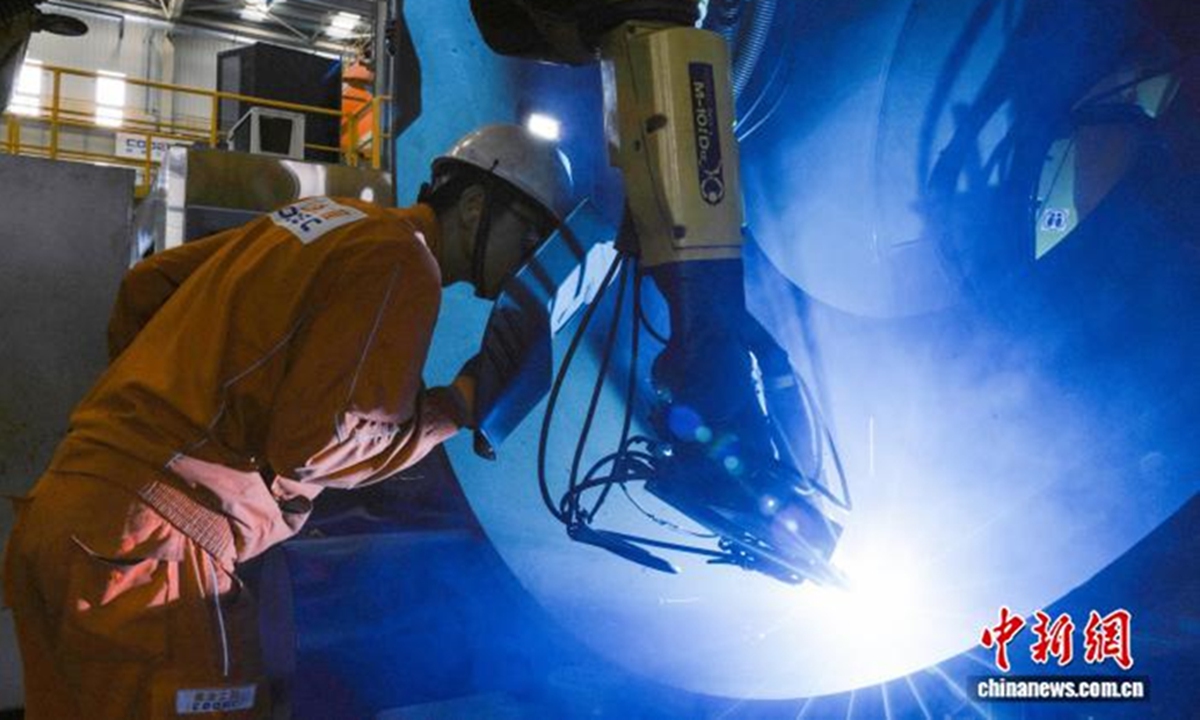
China puts into operation its first domestically developed intelligent welding robot system for flexible manufacturing in marine engineering in Tianjin on June 14, 2026. The photo shows an engineer conducting on-site spot checks on the welding robot's operational performance. Photo: Screenshot from chinanews.com.cn
China has put into operation its first domestically developed intelligent welding robot system for flexible manufacturing in marine engineering in Tianjin, providing equipment support for cultivating new quality productive forces in the marine energy sector, the Xinhua News Agency reported on Sunday.
The system, developed by Offshore Oil Engineering Co, China National Offshore Oil Corp, was specifically developed for highly challenging, customized heavy welding scenarios in offshore oil and gas platforms, such as module nodes, deepwater jacket strengthening rings, and buckle rings.
It has a designed service life of 20 years, a maximum load capacity of 30 tons, and features 100 percent domestically developed core software and process libraries. The system offers high environmental adaptability and operational flexibility, effectively addressing issues such as poor accessibility and difficult precision control in complex spatial welding of large marine engineering structures, the report said.
According to Xinhua, integration of the system was completed last August, and the testing and acceptance phase began. After nearly 10 months of on-site debugging and engineering validation, all performance indicators met design requirements, achieving industrial deployment.
Chen Xin, head of the research project of flexible manufacturing intelligent robotics, said that the project team achieved more than 10 technological innovations, such as artificial intelligence visual weld seam recognition, 3D laser vision intelligent alignment, and multi-layer multi-pass intelligent welding path planning. The robot can be started with a single command and automatically complete component welding, with functions including intelligent weld trajectory correction and intelligent root pass sealing.
During the debugging period, the team conducted intensive testing and validation around on-site equipment and typical welding scenarios, completing nearly 1,000 sets of welding experiments. The system can handle steel up to 70 millimeters thick, with a first-pass qualification rate exceeding 98 percent and overall efficiency improved by more than 40 percent compared with traditional welding methods, Xinhua said.
Liu Ruifeng, head of a workshop at the company's Tianjin intelligent manufacturing base, said that an independently developed intelligent grinding robot was also put into service simultaneously. The robot has already completed grinding on more than 500 steel sections, achieving a 15 percent increase in grinding efficiency thanks to intelligent visual positioning and real-time force control compensation technology, chinanews.com.cn reported on Sunday.
Global Times
RELATED ARTICLES