Chinese rocket sends 8 satellites into orbit; commercial space sector seeks increasing payload capacity, lower costs: expert
By Tao Mingyang and Published: Jun 15, 2026 01:13 PM

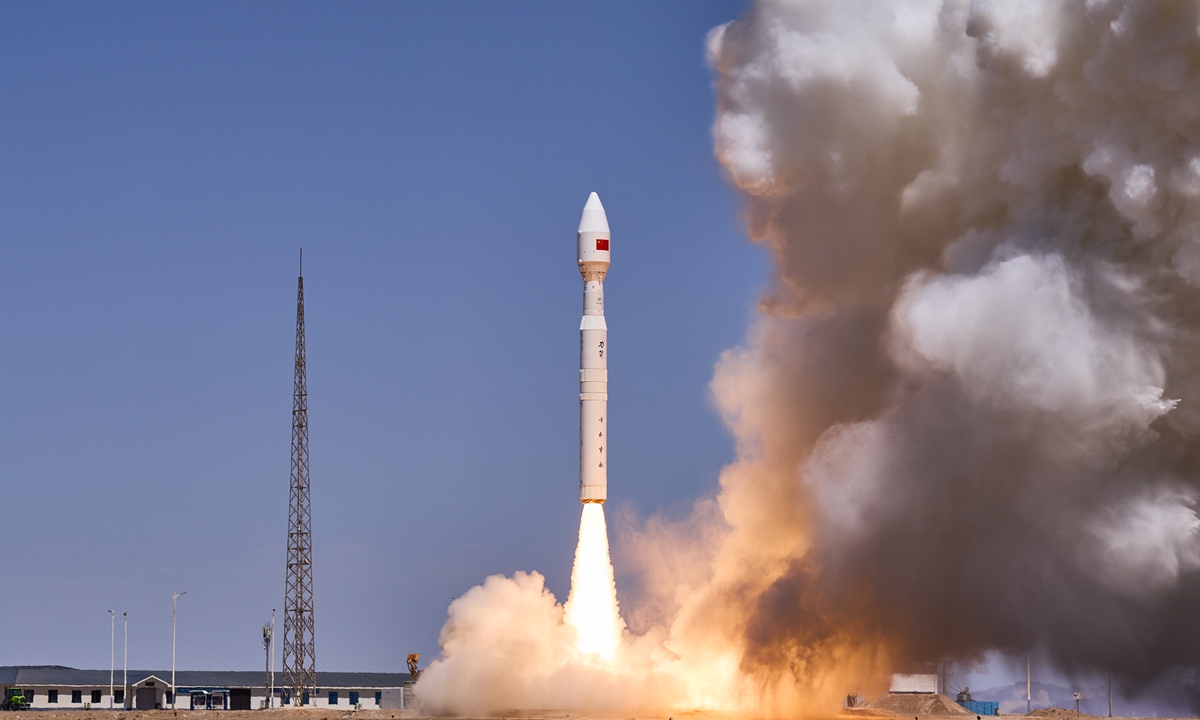
CAS Space's Kinetica-1 Y14 carrier rocket blasts off at 11:44 am from Northwest China's Dongfeng space innovation pilot zone on June 15, 2026. Photo: Courtesy of CAS Space
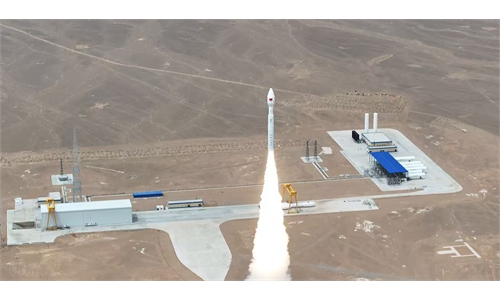
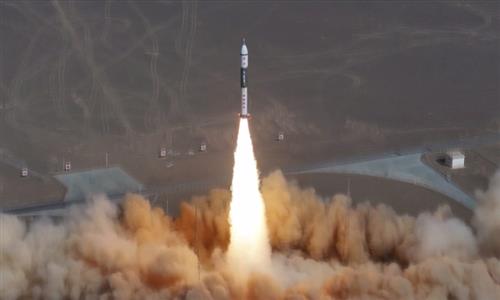
Chinese private space company CAS Space's Kinetica-1 Y14 carrier rocket blasted off at 11:44 am on Monday from Northwest China's Dongfeng space innovation pilot zone, sending eight satellites into pre-set orbits. The mission was announced a success, with the launch vehicle becoming the first commercial rocket model in China to have delivered more than 100 satellites into space, CAS Space told the Global Times on Monday.
The milestone indicates that China's commercial space sector has largely completed its first-stage goal of achieving reliable launch and orbital insertion capabilities, and is now entering a new phase focused on increasing payload capacity and reducing launch costs, Wang Yanan, editor-in-chief of Beijing-based Aerospace Knowledge magazine, told the Global Times on Monday.
The Monday mission marked the 14th flight of the Kinetica-1 rocket. To date, the solid-propellant launch vehicle has successfully sent a total of 105 satellites into orbits, with a cumulative payload mass exceeding 15 tons, the company said.
The launch also completed Kinetica-1's third consecutive mission in the second quarter of 2026, as the company accelerates efforts to carry out a high-frequency launch schedule this year. CAS Space said the rocket continues to rank first in China's commercial launch services market in terms of market share.
The company independently developed the launch testing and control software, and a universal flight control software platform. The former coordinates the entire ground-based testing and launch process, while the latter manages intelligent in-orbit operations, enabling real-time precise control of the rocket's attitude, trajectory and propulsion systems.
All eight satellites launched in Monday's mission are high-resolution optical remote-sensing satellites featuring ultra-high resolution, high integration and intelligent capabilities. The satellites are expected to provide highly accurate and multidimensional imaging data to support a range of remote-sensing applications and related industries, said the company.
Among them, the "Wenwu-01" satellite, jointly developed by the National Cultural Heritage Administration (NCHA) and Chang Guang Satellite Technology Co, is China's first customized remote-sensing satellite dedicated to cultural heritage protection.
The satellite will link with over 130 Jilin-1 constellation satellites to provide high-precision, time-series remote-sensing data and significantly improve nationwide, high-frequency, full-coverage monitoring of cultural heritage sites, according to a social media post by the National Cultural Heritage Administration.
Beijing-based commercial aerospace firm LandSpace's Zhuque-2E Y6 rocket successfully launched two satellites into orbit from the Dongfeng space innovation pilot zSone on Tuesday, placing two communications satellites into orbit. One of the satellites belongs to the SPACESAIL Constellation, which announced several days ago that the number of satellites in the constellation had surpassed 200.
Data showed that the number of commercial space enterprises in China had exceeded 600 by the end of 2025. In terms of financing, the sector raised approximately 18.6 billion yuan ($2.75 billion) in 2025, up 32 percent year-on-year. China's STAR Market has listed commercial space as a key area of support, and more than 10 companies across the industrial chain have launched IPO plans in 2026, according to a report by CCTV News on Monday.
Wang said commercial capital serves as an important catalyst for the development of the commercial space industry. Given the sector's long research and development cycles, substantial investment requirements and high technological barriers, sustained support from capital markets is essential.
At the same time, Wang noted that China's commercial space sector is expected to enter a phase of market consolidation, in which companies with core technologies and strong engineering capabilities will gain greater development opportunities, while short-term speculative capital is likely to be gradually phased out by the market.
RELATED ARTICLES