Authorities release typical cases in crackdown on online rumors, including faking police officers with AI, fabricating ‘Myanmar scam compounds’ videos
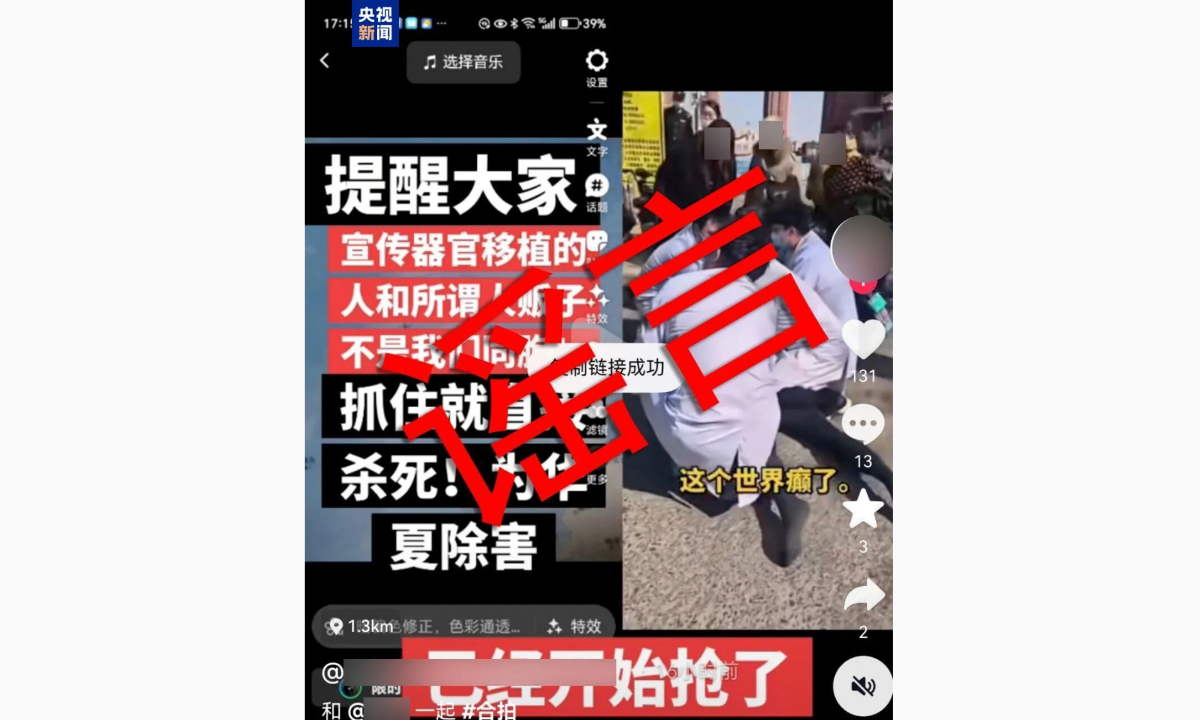
Photo: Screenshot from website of CCTV
The cybersecurity bureau of China's Ministry of Public Security released on Monday typical cases of online rumormongering, including impersonating police officers, defaming healthcare professionals, and spreading false information about so-called "Myanmar scam compounds," China Central Television (CCTV) reported on Monday.
In one case, an internet user surnamed Huang from South China's Guangxi Zhuang Autonomous Region used AI-generated content to impersonate the image of public security officers in promotional videos for commercial gain. Investigation shows that Huang sought to attract online traffic and promote business by using AI tools to create fabricated interview videos of "persons" dressed in police uniforms. Huang also published the content and distributed it online.
Huang's conduct not only involved the fabrication and spread of false online information, but also the unauthorized use of police officers' public image, seriously undermining the credibility of public security authorities, disrupting cyberspace order, and causing negative social impact. The local public security authority has imposed administrative penalties on Huang.
In another two cases, two internet users from South China's Hainan Province and Southwest China's Sichuan Province respectively were administratively punished for spreading fabricated claims about organ harvesting.
A netizen surnamed Chen from Wenchang, Hainan fabricated the rumor that "people were posing as medical staff and abducting individuals on the street to harvest and sell their organs" in order to gain attention and increase online traffic.
Another netizen surnamed Ji from Panzhihua, Sichuan, posted on a short-video platform a photo of medical personnel performing emergency treatment on a patient, which however was captioned "they have already started harvesting organs." The shocking claim distorted the reality of medical workers saving lives. It was accompanied by further malicious remarks which defamed the image of healthcare professionals, attracted widespread online attention, and caused severe negative social impact.
In another case, cybersecurity authority in Wanzhou district, Southwest China's Chongqing, discovered that an internet user surnamed Yu had frequently posted on online platforms a series of so-called "Myanmar scam compound" videos accompanied by sensational captions such as "despair in the compound" and "small dark room in the compound," attracting widespread attention and discussion among netizens and causing negative social impact.
Through investigation, the authorities found Yu had arbitrarily edited unrelated online video materials and stitched them together, attached fabricated captions, thereby creating false information about "Myanmar compounds" and disrupting public order. The local police have imposed administrative penalties on Yu.
The cyber police warned that the cyberspace is not beyond the reach of the law and fabricating and spreading false information related to casualties, traffic safety, and food security can easily trigger public panic, disrupt social order, and cross legal boundaries. The public security authorities vowed to strictly crack down on illegal fabrication and distribution of false information in accordance with the law. The authorities urged the public not to create, spread or believe rumors and help maintain a clean and orderly online environment.
Global Times
RELATED ARTICLES