ARTS / CULTURE & LEISURE
Writer Wan Fang: The power of believing in love
By Published: Jun 15, 2026 09:42 PM

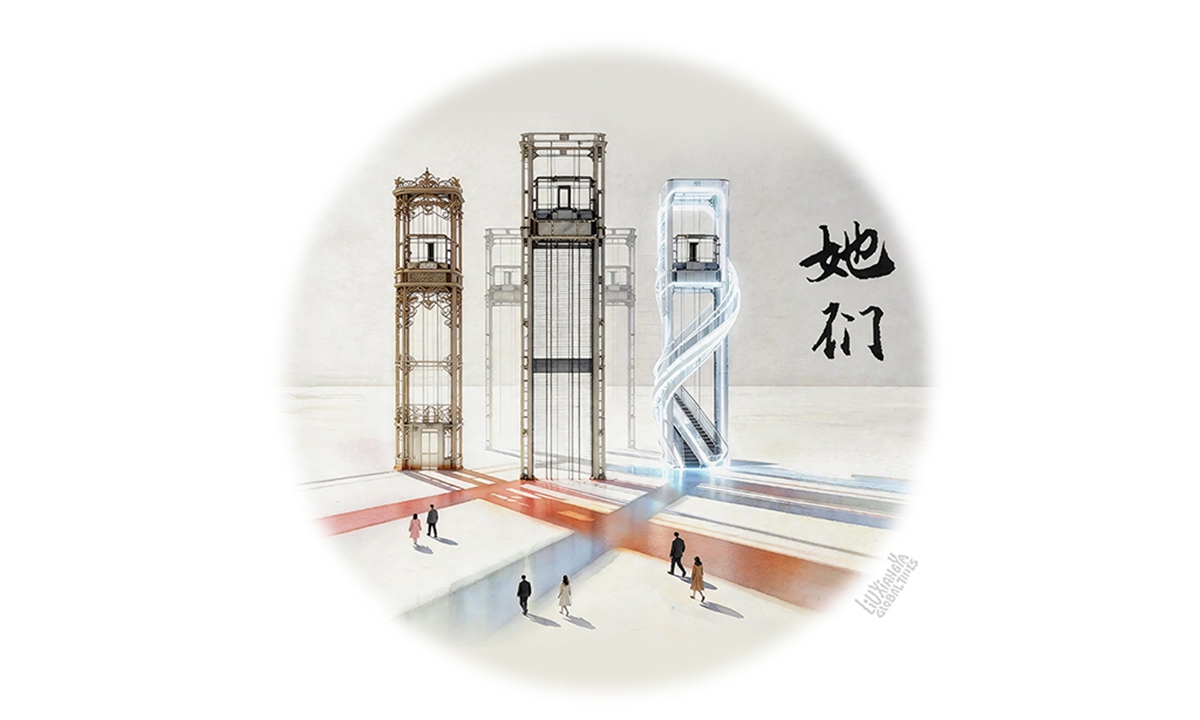
Illustration: Liu Xiangya/GT
With only five days remaining before the premiere of her Her Becoming, a Magnificent Culture production in Tianjin, playwright and writer Wan Fang is fully immersed in rehearsals.The scheduled evening interview on Sunday with the Global Times gave way to a more authentic exchange: Voice messages sent between late-night rehearsals and brief moments of quiet. The fragmented format suited Wan as it was unhurried, reflective, and free of formal stiffness.
"I'm a woman, and this is the truest background color of my writing," she said plainly in one message, her voice calm and unadorned.
As the daughter of renowned playwright Cao Yu, Wan has carved her own literary path. Her works often explore the inner lives of women, emotional landscapes and the enduring complexities of human relationships.
Her latest stage work, Her Becoming, directed by Wang Keran and starring Li Qinqin, Wang Jing, Wang Lejun and Zhang Yanqi, weaves together three women from vastly different eras, connected by an invisible thread of longing, commitment, and the eternal questions surrounding romance.
Among the characters are Li Xiang, a woman who departed her hometown in years past; Lan Gui, who dedicates her life to keeping a promise; and a contemporary wife caught in the perplexities of modern marriage. Despite being divided by different eras, they are united by a profound longing for love - each holding her own distinct perspective on marriage and relationships between men and women.
"These three characters have lived in my heart for decades," Wan revealed. An earlier novella idea about a woman leaving home fascinated her with the sense of destiny it carried, a motif she later carried into the play.
In today's material-driven, digitally connected age, the essential pursuit of emotional truth often feels obscured, said the 74-year-old writer. Yet women's understanding of emotion, she said, remains fundamentally different from men's.
When asked why she writes, Wan paused during a longer voice message, reflecting on a period of self-doubt during the creative process. "I kept asking myself, what is the meaning of this play? The more I thought, the more I doubted and couldn't write. Later I realized 'meaning' is a terrifying word. In the end, it wasn't me choosing the meaning - the meaning chose me. You write first, you feel it, and the meaning emerges on its own," she said.
This philosophy echoes her decade-long labor on the 2020 non-fiction book You and Me, which intimately chronicles the emotional world of her parents, her father Cao Yu and her mother Fang Rui. Wan, a woman from a prominent family, followed her father out of love and cherished their love as a treasure capable of illuminating an entire lifetime. Wan only fully understood the depth of their bond after poring over their preserved letters. "Writing about them was also a way of understanding myself," she said softly. "The origins of my awareness of women's emotional lives perhaps lie right there."
Wan's voice grew more relaxed as the conversation turned to reading. During her youth as a playwright when serving in the army, she gained rare access to a locked library. Hiding under the covers with a flashlight, she devoured Fyodor Dostoevsky's The Insulted and Humiliated - a banned book at the time.
"My writing wasn't mature yet, but the subtlety of human nature stayed with me. What influenced me later wasn't technique, but a view on life." Literature has remained her anchor amid darkness. While her husband battled cancer, the Tibetan Book of Living and Dying became a lifeline. "It's not religious, but it allowed me to breathe when I felt suffocated, to see a bit of light." Over time, her reading has shifted toward biographies and history, yet she returns repeatedly to certain women writers. Nobel Prize laureate Alice Munro is one such constant.
She expressed palpable excitement when discussing Annie Proulx, the author of Brokeback Mountain. "Her writing has such power," Wan said. "She can dissect those subtle, almost ungraspable feelings beneath the current of everyday life with such precision. It's exquisite."
As our interview continued, Wan mentioned her new novel Lady Fan Yi, which was published in Harvest magazine's 2025 winter long-fiction volume and forthcoming in book form. Fan Yi is the iconic tragic heroine in her father Cao Yu's masterpiece Thunderstorm, a passionate and defiant woman trapped in a suffocating marriage who dares to pursue forbidden love, ultimately descending into madness. Wan's new work expands this complex character from passionate girlhood to old age, blending fiction and non-fiction to reimagine her inner life beyond the original play.
Wan previously wrote After Thunderstorm for Magnificent Culture, focusing on the survivors after the tragedy. "Fan Yi represents an extreme longing for love," she explains. Writing the character helped resolve some of her own questions. Literature does not provide answers, especially on topics like love and women's existence, she noted. The dilemmas persist, merely changing form.
"Take love - I still wonder today, 'To what extent do we need love like Fan Yi did?' Perhaps not with the same lifelong, unwavering pursuit, because we have other pleasures and more pressures now. But writing Fan Yi made me realize: The pursuit and desire for love is eternal, undying. Love is both pain if you cannot obtain it, and joy if you do. Today we derive pleasure from many sources, but the life experience and profound impact on thought and emotion that love provides remain difficult to match by other means."
When asked what she hopes audiences will take from her new play, her response was modest and open as ever: "Opinions will differ. If you choose this play and are moved by it, gaining some insight, that is enough for me."
The author is a reporter with the Global Times. life@globaltimes.com.cn
RELATED ARTICLES