NEA to boost new-energy integration, consumption amid surging demand
By Published: Jun 16, 2026 09:28 PM

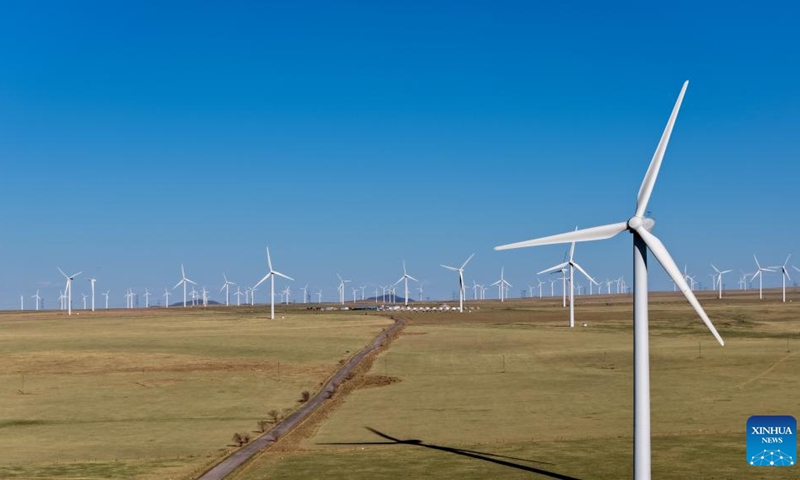
An aerial drone photo taken on May 7, 2026 shows a view of the Huitengliang wind farm in Xilinhot City, Xilingol League, north China's Inner Mongolia Autonomous Region. (Photo: Xinhua)
China's National Energy Administration (NEA) has called for further efforts to enhance new-energy grid integration and consumption to ensure a solid start to the 15th Five-Year Plan (2026-30) period, noting that the role of renewable energy in ensuring energy supply and promoting the energy transition has become increasingly significant.
As power demand is expected to reach new heights with more use of household air conditioners and the continued rise of the artificial intelligence sector, enhancing the dynamic adaptability of the power system to fluctuations in renewable energy output has become more important, a Chinese analyst said.
Based on scientific planning and orderly construction, the NEA aims to comprehensively improve five key capabilities - power grid connection, regulation, dispatching, forecasting, and cross-regional mutual support - through multiple measures to boost the level of new-energy integration and consumption, according to a post on the NEA's official WeChat account on Tuesday.
The decision was announced as the NEA held a monthly video operation meeting on the development and construction of renewable energy power. At the meeting, it was revealed that China's renewable energy development maintained generally positive momentum in the first four months of this year.
As of the end of April, the installed capacity of renewable energy power exceeded 2.4 billion kilowatts, accounting for 60.5 percent of the country's total installed power capacity. Newly added capacity from renewables reached 75.16 million kilowatts, representing 70.7 percent of all newly added installations. Renewable power generation amounted to 1.2 trillion kilowatt-hours, making up 36.4 percent of total electricity consumption.
Of this total, the cumulative grid-connected installed capacity of wind and solar power reached 1.911 billion kilowatts, with total power generation of 805.2 billion kilowatt-hours, accounting for 24.1 percent of total electricity consumption, according to the NEA.
The NEA proposed actively promoting the local and nearby consumption of new energy and urged continued efforts to advance large-scale wind and solar power base projects, expedite pre-construction procedures, and arrange construction schedules reasonably to ensure project progress.
The authority also called for accelerating the improvement of market mechanisms suited for a high share of new energy. This requires both adherence to market price fluctuation rules to ensure stable revenues for new-energy enterprises, and the establishment of appropriate price differentials to drive energy storage development through price signals, with a view to supporting the achievement of carbon peak and carbon neutrality goals.
At a press conference in April, the NEA estimated that the country's peak power load this summer could top out in the range of 1.575 to 1.6 billion kilowatts, with an increase of up to 90 million kilowatt from peak levels seen in 2025. In case of persistent large-scale heat waves, the maximum power load could even top 1.6 billion kilowatt.
As new-energy power sources play an increasingly prominent role in ensuring summer energy supply, the authority is expected to strengthen the coordinated dispatch of power generation, grid, load and storage and improve the ability to predict renewable energy power output and extreme weather, Sun Chuanwang, a professor at the School of Economics at Xiamen University, told the Global Times on Tuesday.
Sun said that coordinated development of high-energy-consuming scenarios such as data centers with areas rich in new-energy sources will be prioritized so as to increase the local consumption ratio of green electricity.
According to CCTV News, incremental electricity demand from China's economic growth was for the first time fully met by green power last year, according to the China Renewable Energy Development Report, which was released on June 12.
In 2025, the newly installed capacity of renewable energy in China reached a record high, accounting for more than 60 percent of the global total. It is estimated that in 2026, about 300 million kilowatts of new wind and solar capacity will be installed in the country, and renewable energy will continue to be the main driver of the country's green and low-carbon energy transition.
RELATED ARTICLES