SPORT / MISCELLANY
Hong Kong gymnasts’ Beijing training reflects broader future for Chinese gymnastics
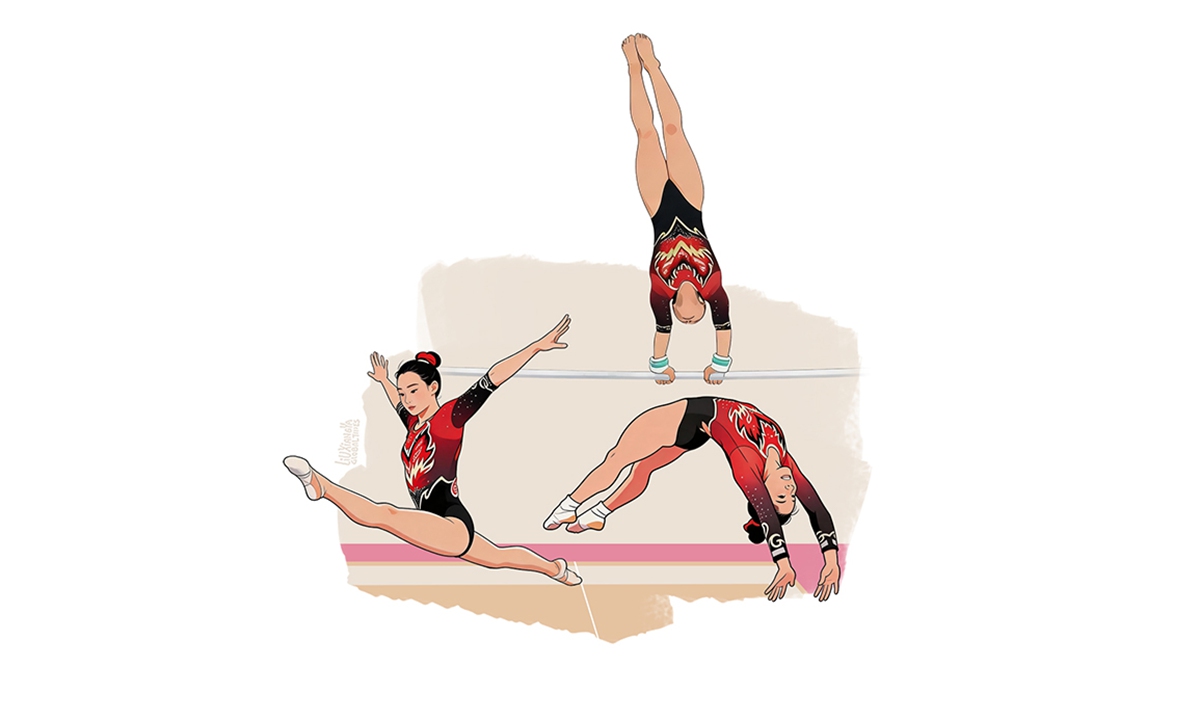
Illustration: Liu Xiangya/GT
With the 2026 Asian Artistic Gymnastics Championships just days away, the Chinese women's gymnastics team recently conducted an internal test event in Beijing under competition conditions. It was a routine pre-tournament assessment designed to identify weaknesses and fine-tune preparations before athletes head to Zunyi, Southwest China's Guizhou Province, where Asia's top gymnasts will gather later this month.Among those taking part were two young athletes from China's Hong Kong Special Administrative Region, Chen Hoi-yuen and Wong Tim-ching, who completed all four apparatus alongside members of the Chinese mainland team. Their participation represents the value of openness and mutual development.
In many ways, the training hall in Beijing provided an early preview of the Asian Championships. The Hong Kong SAR athletes were not observers; they competed, adjusted and reflected just like everyone else of the mainland team. More importantly, they were treated as teammates rather than outsiders.
The national team gymnasts cheered for the two Hong Kong athletes during the test. Such scenes may appear small, but they reveal something meaningful about the current culture of Chinese gymnastics. Success in modern sport is no longer built solely through internal competition. It increasingly depends on creating environments where athletes can learn from one another and push each other forward.
Such exchanges are not a one-way process in which one side simply receives knowledge from another, they're mutually beneficial. Chen also noted after the test that the mainland and Hong Kong athletes regularly discuss areas that need improvement.
Elite gymnastics is a sport decided by details. A pointed toe, a straighter knee, cleaner body alignment or improved rhythm can separate medalists from the rest of the field. In such an environment, learning opportunities emerge from every training session and every conversation. Different athletes bring different strengths, experiences and perspectives. Sharing those experiences can elevate everyone involved.
The Hong Kong gymnasts reflected after the test that they focused on development rather than immediate results. Chen expressed satisfaction at successfully incorporating high-difficulty elements from training into her routines. With about a week remaining before the Asian Championships, she hopes to continue adjusting her form and making her performances more stable.
The reflections echoed those of many other athletes that the purpose of a test event is not to celebrate success but to expose problems while there is still time to fix them. That mindset was equally evident among members of the national team.
Chinese mainland gymnast Zhang Qingying acknowledged that a fall from the uneven bars during the test served as a warning sign ahead of a major competition. Meanwhile, world champion Qiu Qiyuan noted that routine completion is no longer her primary concern; instead, she is concentrating on execution quality and reducing deductions.
This year's Asian Championships carry particular significance. The competition will not only determine continental honors but will also play an important role in the qualification pathway toward the 2026 World Championships in Rotterdam. The stakes are therefore considerably higher than those of a typical regional tournament.
The mainland women's team will seek to defend its position among Asia's strongest programs, while athletes from Hong Kong hope to achieve breakthroughs in individual events.
Yet the most valuable takeaway from the Beijing test may have little to do with medals. When asked about the upcoming Asian Championships, Chen did not focus solely on results. Instead, she expressed excitement about competing against many outstanding gymnasts from across Asia.
"There are many excellent athletes," she said. "I can observe their difficulty and their artistic qualities and learn from them."
Her answer reflects a perspective that is sometimes overlooked in discussions of elite sport. More than platforms for winning, major competitions are also opportunities for observation, exchange and growth. That is especially true in gymnastics, where innovation often spreads through direct interaction. Technical standards rise because competitors continually challenge one another. The same principle applies within Chinese mainland gymnastics.
As sports systems around the world become increasingly interconnected, the sharing of high-level training resources has become an important factor in athletic development. The participation of Hong Kong athletes in national team training camp is therefore about far more than helping two individuals prepare for a competition. It represents a practical example of collaborative development within Chinese gymnastics.
For young athletes, exposure to higher-level training environments can accelerate growth. For established athletes, new training partners can introduce fresh perspectives and competitive stimuli. Everyone benefits from a stronger ecosystem.
Ultimately, the number of medals awarded at the Asian Championships will remain limited. Not every athlete will stand on the podium. But if more young gymnasts emerge from such exchanges with improved skills, broader horizons and stronger friendships, then Chinese gymnastics will have gained something even more valuable than a medal tally.
The author is a reporter with the Global Times. life@globaltimes.com.cn
RELATED ARTICLES