Illustration: Xia Qing/GT
Western media outlets have been hyping the EU's trade deficit with China, peddling the narrative that the bloc is on the "losing side" in cooperation with China. Yet, such rhetoric rests on an incomplete and irresponsible reading of the bilateral economic relationship.The latest example is an article from The Guardian, which reported on Monday that the EU's trade deficit with China reached a record 1 billion euros ($1.16 billion) a day in April, according to the EU statistics body Eurostat, fueling concerns over the future of Europe's "industrial backbone."
The figure, which comes as European leaders prepare to meet on Thursday to discuss, among other topics, the future of EU-China economic relations, appears to lend public support to trade protectionism. But the fundamental flaw in such a narrative is that it judges the respective gains and losses of EU-China economic cooperation solely on the basis of the goods trade surplus or deficit - a metric that is neither comprehensive nor objective.
If we turn to services trade, the EU has long maintained a substantial surplus with China. According to the Mission of China to the European Union, China's deficit in services trade with the EU reached $48.3 billion last year. The EU was the largest source of China's services trade deficit, accounting for 41.6 percent of China's total external services trade deficit. These are real, sizable, and recurring flows of income.
Yet they have long been absent from Western media discussions of "trade imbalances." To talk only about the goods deficit while ignoring the services surplus is an unfair and subjective double standard - one that happens to serve certain political discourse.
Furthermore, a large part of China-EU goods trade is generated by European companies operating in China, creating a situation in which the trade surplus is recorded on the Chinese side while the profits largely accrue to the European side. European companies with local operations in China not only supply products to the Chinese market but also export approximately 40 percent of their output to Europe and other parts of the world.
From the perspective of customs statistics, these sales to Europe are counted as part of China's trade surplus with the EU. In reality, however, most of the profits flow back to European companies. This profit reality is also absent from the West's lament over trade deficits.
It is also important to note that the EU-China trade landscape is shifting alongside industrial upgrading and evolving comparative advantages on both sides. China's growing manufacturing strength and supply-chain efficiency have boosted exports - notably in electric vehicles, solar panels and lithium batteries - precisely the products Europe needs for its green transition.
Equally important, nearly half of bilateral trade is in intermediate goods, which directly underpins the EU's industrial competitiveness. Far from undermining Europe's interests, China's cost-effective supply chain has actively supported the bloc's industrial upgrading and its decarbonization efforts.
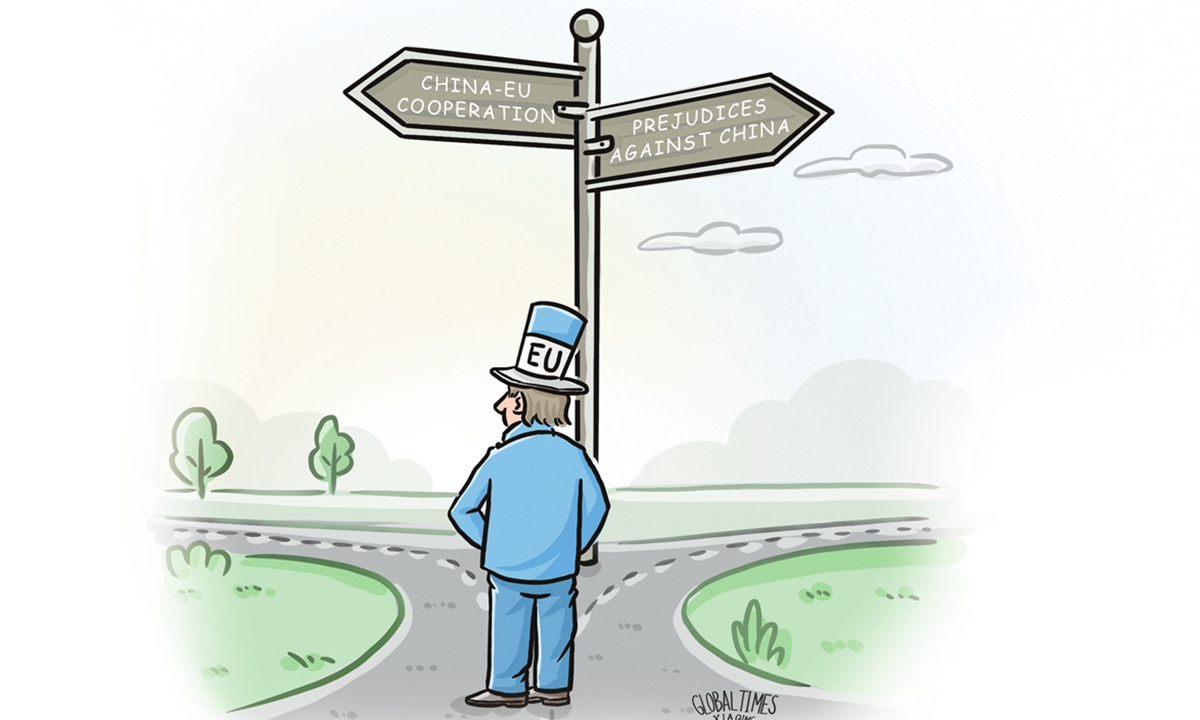
Putting it all together, China-EU economic cooperation has delivered enormous benefits to both sides, with mutual benefit and win-win results serving as the essence of this relationship. The relationship is never a zero-sum game, but an interdependent partnership where neither side can afford to decouple from the other. China possesses a supersized market and a complete industrial system, while the EU holds advanced technologies and high-end manufacturing capabilities. Their cooperation potential in green transformation, the digital economy and high-end equipment remains far from fully tapped.
Moreover, China's per capita GDP is expected to exceed $14,000 this year, and with the implementation of the 15th Five-Year Plan (2026-30), the living standards of the Chinese people are expected to improve significantly, and demand for services in areas such as healthcare, financial and insurance services, culture and entertainment, and leisure and tourism is poised to grow rapidly. That momentum offers a prime opportunity for China and the EU to deepen their services trade partnership.
China has consistently shown sincerity by actively expanding imports, hosting the China International Import Expo annually, improving its business environment, and continuously lowering tariff and non-tariff barriers. By contrast, the EU's high-tech products account for a considerable part of its trade with China, yet its export controls on such goods to China have curbed its own export potential.
What truly deserves attention is not whether the EU is "losing out," but a comprehensive understanding of China-EU economic relations. Only on that basis can both sides work together toward the deepening of their trade and economic cooperation.
RELATED ARTICLES