US reportedly pauses plan to blacklist DeepSeek, CXMT and more than 100 other firms, ‘a positive signal to help further stabilize ties’: expert
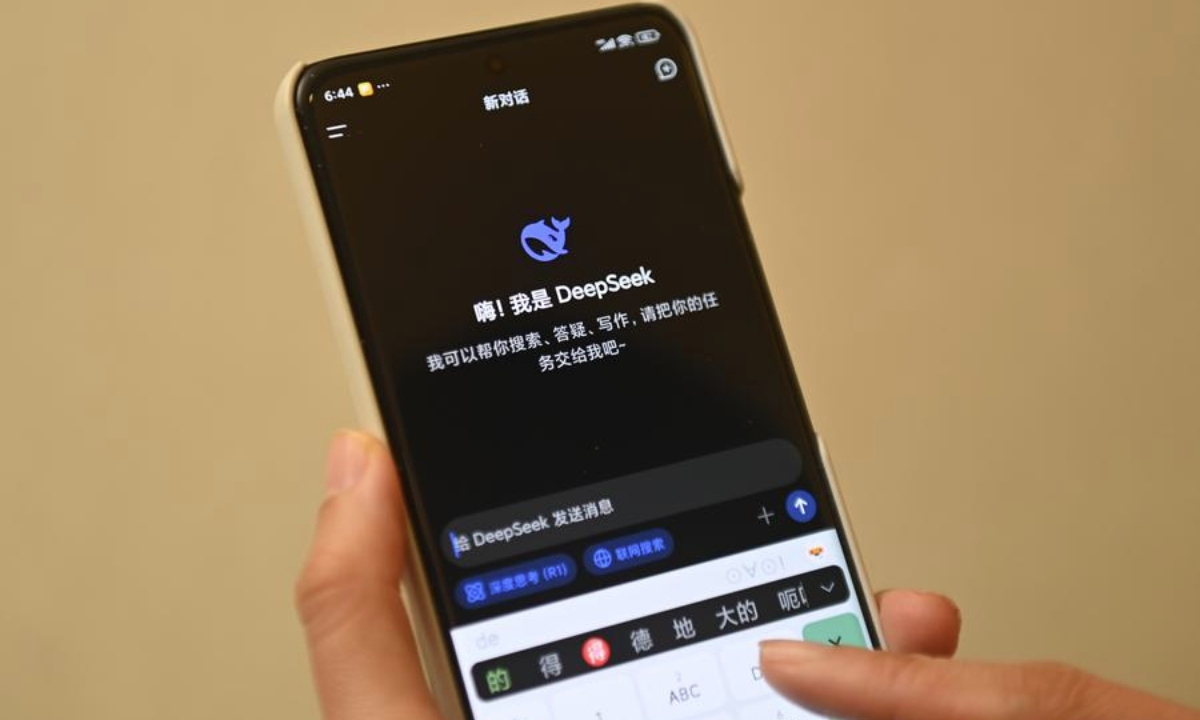
A person uses DeepSeek app on a mobile phone on Feb. 17, 2025. (Xinhua/Huang Zongzhi)
China consistently opposes the US overstretching the concept of national security, abusing its entity list and other export controls, and suppressing Chinese enterprises, Lin Jian, a spokesperson of China's Foreign Ministry said at a regular press conference on Wednesday.
The remarks were made responding to a media inquiry for comment regarding a foreign media report that the US Commerce Department has held off on adding numerous Chinese companies including DeepSeek and a major chip maker to its restrictive Entity List in order to avoid escalating tensions with China.
Speaking at the press conference, Lin said the US should stop politicizing, instrumentalizing and weaponizing trade and tech issues.
The US has reportedly held off adding China's AI startup DeepSeek, memory chipmaker CXMT and more than 100 other companies flagged as so-called national security risks to a trade blacklist, according to a Reuters report, citing two people familiar with the matter, as the Trump administration tries to avoid escalating tensions with Beijing.
DeepSeek, CXMT and other companies were reportedly approved by an interagency committee last year for addition to the Commerce Department's Entity List, which is being reported for the first time, according to Reuters.
"If the reported move to hold off on blacklisting of corresponding Chinese companies were true, it is a positive signal to help further stabilize bilateral ties as it comes at a crucial moment when China-US relations have shown signs of stabilization following recent high-level engagements. Both sides, particularly the US side, have a responsibility to prevent bilateral ties from slipping back into a cycle of uncertainty and escalation," Hu Qimu, a professor at the Maritime Silk Road Institute of Huaqiao University, told the Global Times on Wednesday.
In this context, refraining from imposing additional restrictive measures on Chinese companies could help sustain the current momentum for dialogue and cooperation, while further contributing to the stabilization of bilateral ties, the expert said.
AI and semiconductors have become key areas of competition between China and the US, with both countries leveraging their respective strengths and innovative companies. "However, competition should not be equated with containment or confrontation. Time and again, history has shown that measures such as export controls and so-called Entity List restrictions have had limited effectiveness in slowing China's technological advancement. Instead, such measures tend to accelerate efforts by Chinese companies to strengthen indigenous innovation and reduce reliance on US technologies," said Hu.
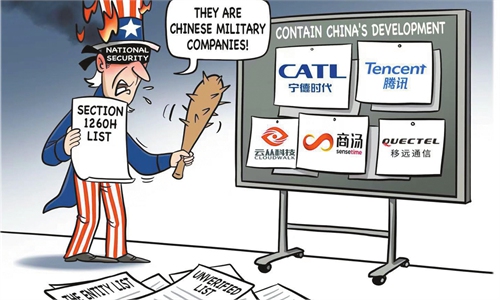
The report came less than two weeks after the US added Chinese e-commerce giant Alibaba, internet search provider Baidu and automakers BYD and NIO to a list of companies to a so-called "military-linked" company list, according to a separate report by Reuters on June 8.
Responding to media inquiries for comment regarding the US' move, Chinese Foreign Ministry spokesperson Lin Jian said at a regular press conference on June 9 that China firmly opposes the US overstretching the concept of national security and formulating various types of discriminatory lists to go after Chinese businesses.
We urge the US to correct its wrongdoings and stop the unwarranted suppression of Chinese businesses, said Lin, noting that China will do what is necessary to firmly protect their legitimate and lawful rights and interests.
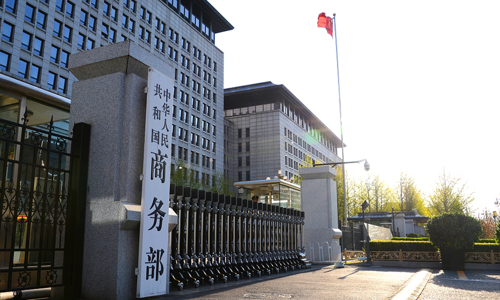
China's Ministry of Commerce (MOFCOM) also expressed strong dissatisfaction and firm opposition after the US Department of Defense added several Chinese companies to its so-called "Chinese Military Companies" list, urging Washington to immediately reverse discriminatory and unjustified measures.
Overstretching the concept of national security and the frequent use of export controls and sanctions not only increase operating costs for companies, but also disrupt the stability of global supply chains, ultimately harming the interests of all parties, including US companies and consumers, Gao Lingyun, a research fellow at the Chinese Academy of Social Sciences, told the Global Times on Wednesday.
At present, the development of the tech sector increasingly relies on global innovation resources and supply-chain collaboration, Gao said, noting that China and the US should not fall into a "zero-sum game" in the technology field. "Both countries have broad complementarities in basic research and global markets. Cooperation remains the key pathway to mutual benefit and win-win outcomes," the expert said.
RELATED ARTICLES