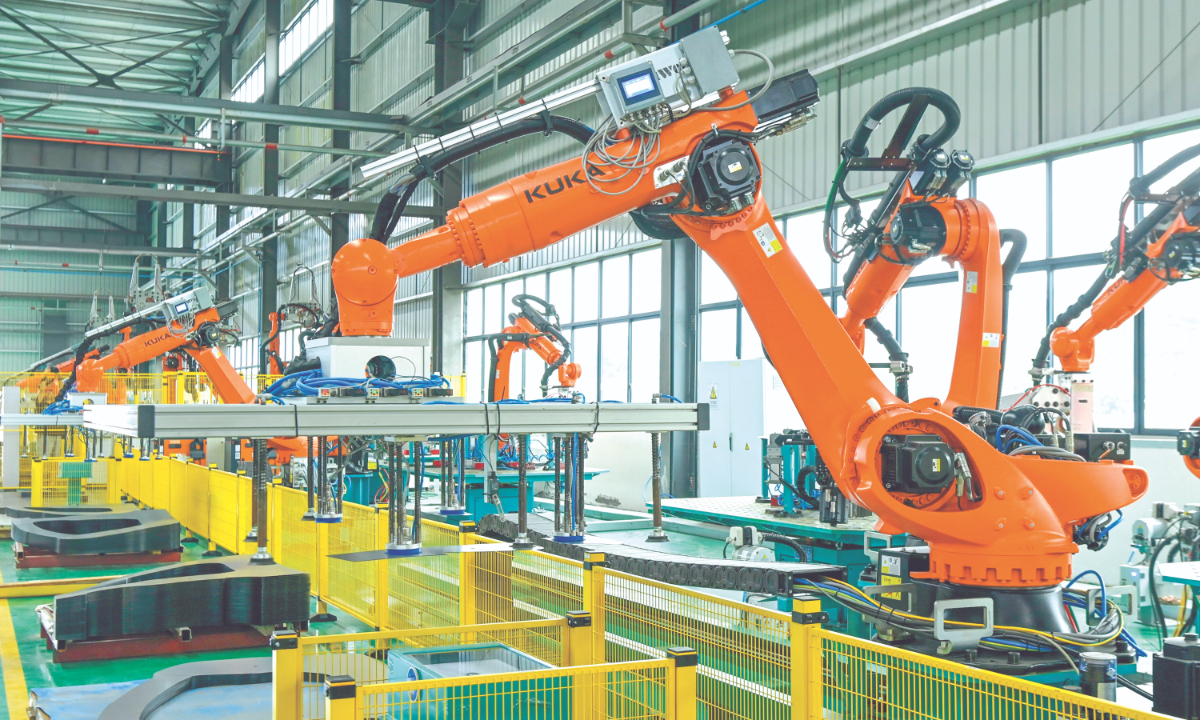
Robotic arms operate at an auto parts factory in Southwest China's Chongqing Municipality, on June 5, 2026. Photo: VCG
The fourth China International Supply Chain Expo (CISCE), to be held in Beijing from June 22 to 26, has evolved into a key platform for industrial cooperation and a barometer of global supply chain trends. By facilitating coordination across upstream, midstream, and downstream industries and fostering engagement between domestic and foreign companies, the event is drawing growing international attention.
As the world's first national-level exhibition dedicated to supply chains, the CISCE's growing significance reflects a broader reality: at a time when geopolitical tensions, protectionism, and economic uncertainty are reshaping global supply chains, China remains a critical source of stability in the world economy.
China is deeply integrated into global industrial and supply-chain networks and has become an indispensable hub for manufacturing collaboration and innovation. Through continued industrial upgrading and high-level opening-up, the country has helped maintain the smooth functioning of global production systems while providing businesses worldwide with a degree of predictability that is increasingly valuable.
One of the clearest indicators of this role is China's position as the world's largest exporter of intermediate goods for 12 consecutive years. Intermediate products, from electronic components to industrial machinery parts, form the backbone of modern manufacturing. Their uninterrupted flow is essential not only for China's factories but also for production lines across Asia, Europe, the Americas, and beyond.
China's strength in intermediate goods is rooted in a unique structural advantage: The world's most comprehensive industrial system. With 41 major industrial categories, 207 medium-level categories, and 666 subcategories, China is the only country that with all categories recognized by the United Nations industrial classification system. This complete industrial ecosystem enables firms to source components, coordinate suppliers, and expand production with unmatched efficiency.
The CISCE serves as a showcase for this ecosystem. More than a trade exhibition, it functions as a marketplace for industrial collaboration, bringing together suppliers, manufacturers, logistics providers, and technology firms from around the world. In this sense, it offers a window into how modern supply chains operate, not as isolated transactions, but as interconnected networks of production and innovation.
China's upgraded logistics infrastructure further reinforces this connectivity. From the automated terminals of Yangshan Port in East China's Shanghai Municipality to inland transportation hubs such as Zhengzhou in Central China's Henan Province and large-scale logistics parks in Jiaxing in East China's Zhejiang Province, the country has built an integrated network linking factories, ports, warehouses, and consumers. The coordinated development of sea ports, land ports, air hubs, and inland waterways has created one of the world's most extensive logistics systems, enabling goods to move efficiently across regions and borders.
Equally important is China's growing capacity for rapid technological development. As manufacturing becomes increasingly digitalized, design, production, procurement, payment, and delivery are increasingly coordinated through digital platforms, allowing companies to respond to changing market conditions with unprecedented speed.
This responsiveness has become a defining feature of China's manufacturing ecosystem. Whether in drones, new-energy vehicles, smart devices, or advanced electronics, firms are able to shorten development cycles and bring innovations to market more rapidly. The market itself acts as a powerful signal mechanism, directing investment and resources toward emerging opportunities.
Far from weakening China's role, ongoing global supply-chain restructuring is highlighting the importance of China's advantages. As manufacturing becomes more intelligent, digital, and green, demand for reliable suppliers, integrated industrial ecosystems, and efficient logistics networks is likely to increase. These are precisely the areas where China possesses strong comparative strengths.
Looking ahead, the next stage of development will not simply be about producing more goods. It will involve moving further up the value chain through advanced manufacturing, producer services, digital platforms, green technologies, and innovation-driven growth. By strengthening these capabilities, Chinese firms can deepen their participation in global industrial upgrading while creating new opportunities for international cooperation.
Amid global economic uncertainty, the significance of China's supply-chain connectivity extends beyond the industrial sphere. Its industrial capacity, logistics networks, and innovation ecosystem help keep goods, technologies, and opportunities flowing across borders. That connectivity has become an important source of certainty for global growth, and a reminder that deeper cooperation remains one of the most effective ways to build resilience in the world economy.
The author is a professor at the School of Economics of Peking University. bizopinion@globaltimes.com.cn
RELATED ARTICLES