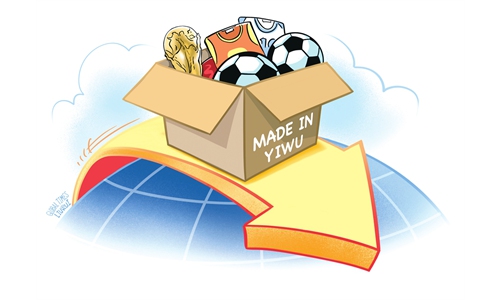
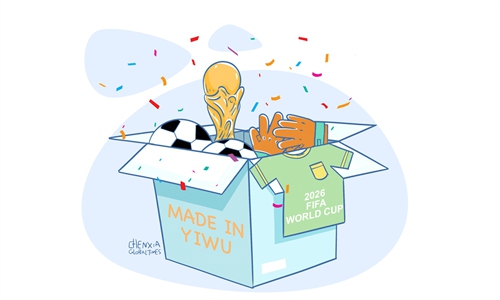
Chinese manufacturing rides World Cup 2026 boom, with global sporting event underscoring China-made products as a key player in global supply chains
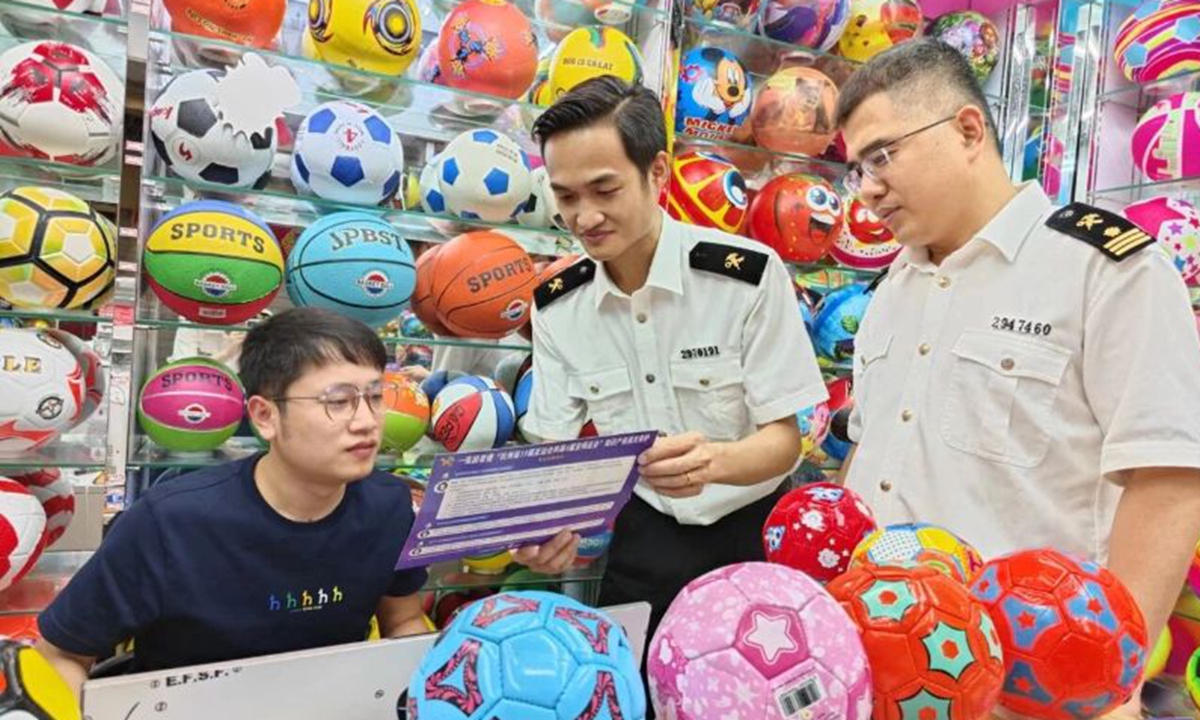
Customs officials talk with a merchant in Yiwu, the world's supermarket in East China's Zhejiang Province, ahead of the 2026 FIFA World Cup. Photo: Courtesy of Yiwu Customs
Chinese manufacturers are riding the boom in the sports economy, with goods ranging from footballs to sports shirts and hats as well as vehicles ramping up sales in the international market ahead of the 2026 FIFA World Cup, which is scheduled to kick off on June 11.
In a global mega-event of this scale, Chinese manufacturers have become a highly competitive and, in many product categories, indispensable supplier base, supported by advantages in production capacity, product quality, and cost efficiency, a Chinese analyst said.
Driven by the upcoming 2026 World Cup in the US, Canada, and Mexico, exports of sports-related goods have seen a notable surge this year. According to data that Yiwu Customs provided to the Global Times on Tuesday, from January to April this year, Yiwu exported 3.77 billion yuan ($554 million) worth of sports goods and equipment, up 7.9 percent year-on-year.
At the world's "supermarket," Yiwu in East China's Zhejiang Province, some merchants are still working around the clock as international clients rush to place final orders, with the World Cup just about half a month away.
"Large batches of products started being shipped gradually from January this year, and most were delivered before the Spring Festival... After the holiday, we received repeat orders," said Tao Yang, CEO of Yiwu kivibear Household Products Co Ltd on Tuesday.
The Yiwu merchant told the Global Times that most of the containers of goods were shipped out by April. "What is being shipped now is mainly cross-border e-commerce orders, or urgent orders sent by air freight," she said.
This is the first time she has produced World Cup-related products, and it allowed her to see the huge potential demand in the market.
Tao began receiving World Cup-related orders as early as October last year, including thermos cups, plastic water cups, hats, and fans featuring national flag elements from countries such as Mexico, the US, and Colombia.
"Our thermos cups already have a large customer base in North and South America. Last year, we started developing World Cup-themed extensions, such as football-themed designs, and also produced many customized products featuring different national elements," Tao said.
Customized products are becoming a new trend in the World Cup, reflecting a broader shift toward personalization in global sports merchandising, the Global Times learned from industry insiders.
Another merchant in Yiwu is already very familiar with the World Cup. Wen Congjian, general manager of Yiwu Danas Import and Export Co Ltd, has been engaged in the fan apparel export business for 19 years. During the 2022 Qatar World Cup, his Danas-branded fan jerseys achieved global sales of more than 2 million units.
Driven by the frenzy surrounding the 2026 World Cup in the US, Canada, and Mexico, the company's order volume has increased by two to three times compared with normal levels since June 2025, with products covering more than 50 countries and regions.
"When designing Mexico's World Cup fan jerseys, we used red, white, and green—the colors of the Mexican flag—as the main palette, and incorporated cactus patterns, a representative local plant, as subtle fabric motifs," Wen told the Global Times.
Taking into account the passionate cultural characteristics of South America, the company also specially designed cheerleader uniforms. To meet the market demand for "family viewing," it launched children's jerseys and customized mini jerseys for pets. "When watching matches, owners also want their pets to feel the festive atmosphere at home," Wen said.
In recent years, while leading his team in developing new products, Wen has also strengthened attention to intellectual property protection. The company holds 39 patents and 32 trademarks, and its range of independently designed products continues to expand.
According to incomplete statistics, the foreign trade dividends from officially licensed products and related merchandise for this World Cup have spread across more than 10 provinces and regions in China. Among them, the most closely watched and frequently trending topic is Yiwu, China City News reported.
According to estimates by the Yiwu Sporting Goods Association, after the 32 teams for the previous Qatar World Cup were confirmed, "Made in Yiwu" products accounted for nearly 70 percent of the World Cup-related merchandise market.
In response to the growing demand ahead of the 2026 World Cup, Yiwu Customs has stepped up measures to facilitate trade.
"Driven by the 2026 World Cup in the US, Canada, and Mexico, exports of sports-related products have increased significantly this year," He Wenshuai, head of a supervision division at Yiwu Customs, told the Global Times.
To ensure rapid overseas shipments of sports-related orders, Yiwu Customs launched a second-level customs clearance smart gate system and an automatic sealing system, enabling automated and real-time transit operations. "We have also optimized inspection procedures for consolidated cargo, reducing customs clearance time for such goods by more than 50 percent," said He.
In addition to small commodity suppliers in Yiwu, some other Chinese companies have also stepped up their layouts for the upcoming World Cup. According to a document that Chinese bus producer Yutong Bus Co shared with the Global Times, its new-energy buses will serve as the main vehicles for fan transportation in Mexico City, host of five games at the 2026 FIFA World Cup. The company's pure electric buses already hold a 60-70 percent market share, making it the leading brand in the local market.
Mexico City is one of the world's most densely populated cities, and its public transport system will face significant pressure during the World Cup, but it will also serve as another opportunity to test Chinese transportation products and services, according to the company.
This trend of Chinese products and services empowering the World Cup underscores the adaptability of China's manufacturing sector, Hu Qimu, a professor at the Maritime Silk Road Institute of Huaqiao University, told the Global Times on Tuesday, noting that in global events of this scale, Chinese manufacturers have emerged as a highly competitive and in many product segments an essential supplier base, supported by strengths in production capacity, product quality, and cost efficiency.
"This is particularly the case within small commodity clusters, which are leveraging well-established supply chains and the rapid growth of cross-border e-commerce channels to efficiently respond to short-cycle, event-driven demand such as that generated by the World Cup," said Hu.
It also reflects a broader shift toward more flexible, fast-turnover production models, where manufacturers are increasingly able to integrate design, customization, and export logistics into a highly responsive system aligned with global seasonal consumption peaks, the expert said.
RELATED ARTICLES