IN-DEPTH / IN-DEPTH
GT investigates: Behind gunfire and bloodshed, how is the Middle East situation being turned into a social media farce?
When AI becomes a weapon
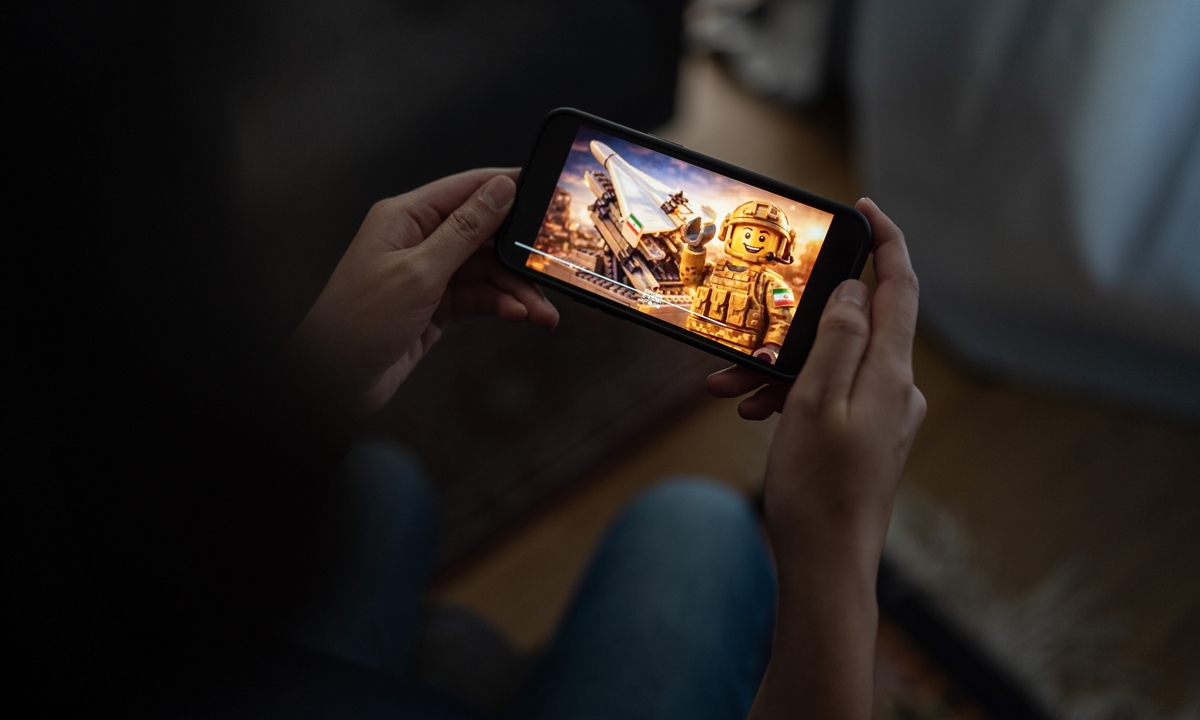
A person watches a Lego-style video about the US-Israeli strikes on Iran. Photo: VCG
More than three months have passed since the US-Israeli strikes on Iran erupted on February 28. Over the past weekend, the US and Iran reportedly to have reached an agreement to end fighting and reopen the Strait of Hormuz, with a formal signing ceremony scheduled for Friday in Switzerland. Yet substantial progress, at least to date, has yet to be achieved.
While beyond the smoke and fury in the Persian Gulf and the standoff in the Strait of Hormuz, the situation on another "front" appears to have grown increasingly intense and complex.
Since the conflict started, the White House, according to reports, has posted on social media platforms AI-generated videos, some of which pair footage of US airstrikes with popular short-video effects in an apparent effort to underscore US military dominance. The videos were widely criticized by media outlets and netizens for using AI to commodify, and even make light of, the Middle Eastern battlefield and its victims.
"[I've watched] a little bit [of the videos the White House shared]. And what would be disturbing to me is if it's perceived as a gaming kind of event," said US Army veteran Karee White in a PBS program in March. "And I don't like to see it reduced to some sort of a gaming strategy type of event, if that's been in fact what's happening..."
When virtual effects dilute the brutality of artillery fire and meme culture obscures the human cost of conflict, how has the smoke of this digital battlefield spread? In this AI-driven information war of manufactured narratives, what dazzling "tactics" have both the US and Iran deployed? And what deeper dangers lie beneath this new form of public opinion confrontation?
An 'entertainmentized' contest
"Generative AI has made it cheap and easy to produce polished propaganda at scale, ...packaging war in the visual language of entertainment makes conflict propaganda more likely to spread, regardless of who made it," Renée DiResta, an associate research professor at Georgetown University whose work focuses on how influence operates in the digital age, said in a TIME article published on April 2.
DiResta's concern was vividly borne out in the information warfare that has unfolded alongside the US-Israeli strikes on Iran. As generative AI has rapidly proliferated and low-cost, highly shareable AI-generated content has become an important weapon in the battle for public opinion. Some scholars observed that the US and Iran have turned to AI-generated memes, animated re-edits and game-style mashups to wage narrative offensives and counteroffensives, rendering the war in the Middle East, in virtual space, into what increasingly resembles an "entertainmentized" contest.
Since early March, the White House has frequently posted visually striking videos on social media, many of which have drawn heavily on iconic scenes from Hollywood blockbusters and kill-focused video games.
A video the White House posted on X on March 6 with the caption "justice the American way," for instance, included clips from superhero movies, as well as clips from films Top Gun and Braveheart, with electronic tunes underneath before clipping to video of strikes on Iran. It ends with a voiceover saying, "flawless victory" - audio from the video game Mortal Kombat, reported ABC News the following day.
More startling still, in a video that went viral after being released on X by the White House on March 6, footage of a US strike on Iranian targets was followed by a scene of cartoon image "SpongeBob SquarePants," asking: "do you want to see me do it again?"
A brutal military assault was packaged as a kind of "visual spectacle" through these videos, which, blurring the line between the virtual and the real, the entertaining and the grave, has drawn widespread criticism. "Has the White House account been hacked or are you guys really that immature and depraved?" an X user wrote under this post. "This is embarrassing," wrote another.
In response, Explosive Media, an account described by the BBC News as known for generating Lego-style satire videos against the US and Israel, has posted a series of rough-edged but highly imaginative Lego animations. Some of these videos use Lego figures to dramatize scenarios in which Israeli and US leaders collude to wage war and deflect domestic political pressure, while interspersing images of soaring oil prices and burning US dollars.
In an April interview, a representative of Explosive Media told the BBC that "the Iranian government is indeed a 'customer' of his company," and ahead of that, he said "his operation had been directly commissioned for multiple projects by Iranian officials," according to a BBC story on April 12.
Also in April, YouTube shut down the Explosive Media's account, reported Al Jazeera. On June 11, it was announced on X that the account was "officially back on YouTube."
Nevertheless, the company's AI-generated videos have given Iran enormous visibility on social media. According to a research by think tank Institute for Strategic Dialogue in April, by posting and forwarding such AI satire videos, in the first 50 days of the conflict, posts from Iranian embassy and official accounts collectively gained approximately 900 million views and 22 million likes - a 30-fold increase in likes compared with the preceding 50 days. "If Iran could manufacture destructive missiles at the speed with which it produces cutting memes, US Central Command would be coming out with its hands up by now," quipped an opinion piece by The Guardian on April 15.
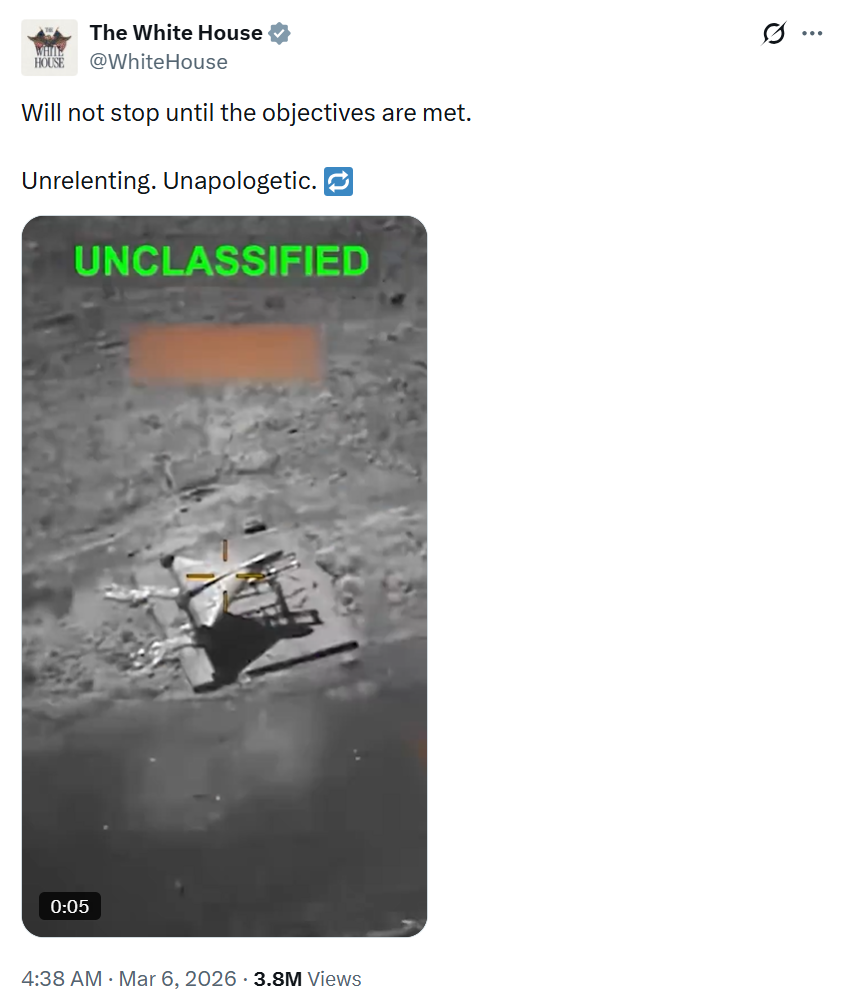
A video released on X by the White House on March 6, showing a US strike on Iranian targets, was followed by a scene featuring the cartoon character SpongeBob SquarePants asking: "do you want to see me do it again?" Photo: Screenshot from the White House X account
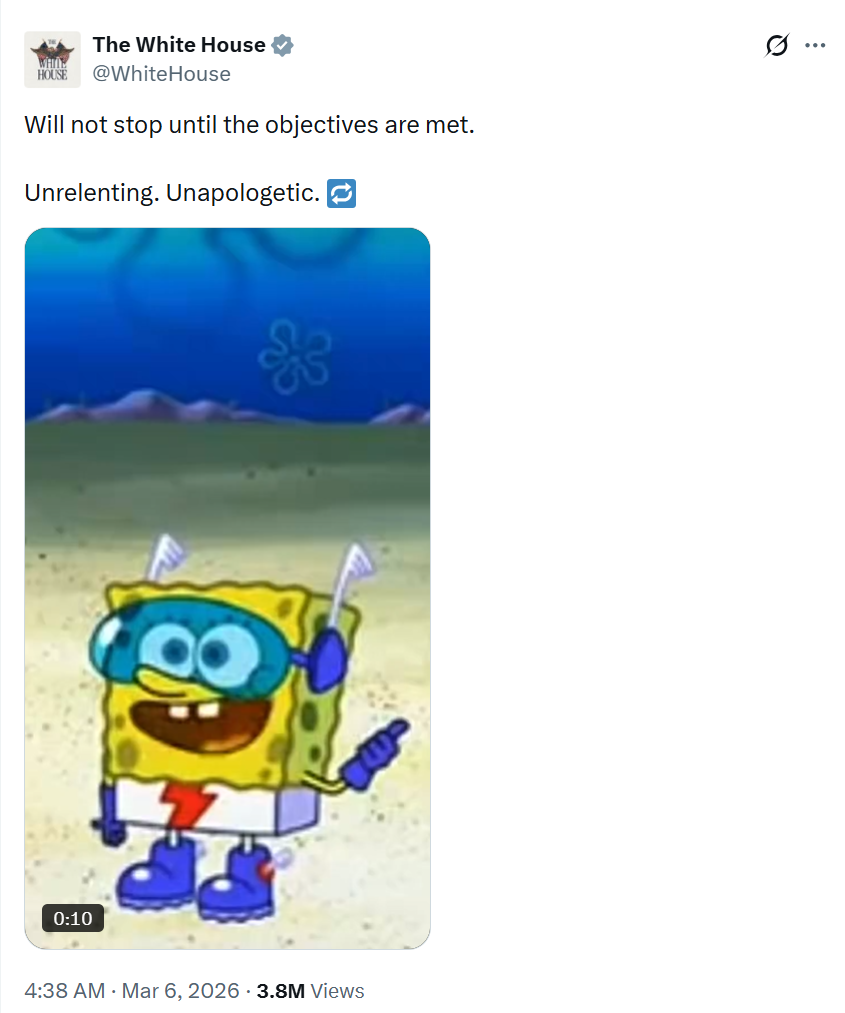
A video released on X by the White House on March 6, showing a US strike on Iranian targets, was followed by a scene featuring the cartoon character SpongeBob SquarePants asking: "do you want to see me do it again?" Photo: Screenshot from the White House X account
'Slopaganda'
In many foreign media reports on this AI information conflict involving the US, Israel and Iran, it has been linked to "slopaganda."
The term "slopaganda" was coined by philosopher Michał Klincewicz of Tilburg University in Netherlands, together with his collaborators. In their paper Slopaganda: The interaction between propaganda and generative AI, they describe how AI is giving propaganda a dangerous new face. The concept refers to AI-generated slop that serves propagandistic purposes.
The slopaganda aims to influence viewpoints or ideologies, altering the informational environment en masse to reach a desired aggregate change in decision-making at the group level, said the paper.
The core of this model lies in prioritizing quantity over quality and being driven by emotion. It uses AI tools to rapidly generate low-cost, highly shareable visual content, creating an information deluge across social media platforms. Compared with traditional propaganda, this approach abandons any defense of truth and instead pursues instantaneous emotional triggers, such as excitement, mockery and fear, making it extremely effective at capturing attention, Wang Peng, an associate researcher at the Beijing Academy of Social Sciences, told the Global Times.
"Both the US and Iran are leveraging AI to compensate for their respective resource or image disadvantages, though their approaches differ significantly," Wang said.
The US strategy seems to focus on demonstrating military strength and sowing division. Through the use of high-intensity, adrenaline-fueled mashup videos, Washington seeks to showcase its hard power and project technological superiority. It also produces targeted video content aimed at driving a wedge between the Iranian people and their government, a form of visual hegemony that seeks to achieve a technological "overmatch," said Wang.
In contrast, the expert said, Iran's strategy centers on asymmetric counterattacks and desacralization. Tehran employs absurdist formats such as Lego-style models to deflate the seriousness of US political deterrence. Using low-cost AI-generated memes, Iran responds to US threats, relying on meme culture to break through its disadvantaged position in the information battlefield.
AI has enabled Iran and others to communicate directly with Western audiences more effectively than ever before. They are using tools largely trained on Western data, making them ideal for creating "culturally appropriate" content, Emma Briant, a propaganda expert, was quoted by BBC as saying.
Despite their different tactics, both sides share a common goal: consolidating domestic public support while flooding the information space with massive amounts of distracting content, thereby making it difficult for the other side to establish a unified international narrative. And regardless of which side has the superior data, the sheer volume of information dissemination from both parties is impossible to ignore, Wang added.
Give rise to more problems
Though labeled as "slop," slopaganda is not uniformly low-quality. Experts told the Global Times that this promotional tactic has been adopted by various countries and entities alike.
Zhang Zheng, a deputy dean of the School of Journalism and Communication at Tsinghua University, told the Global Times that slopaganda delivers certain positive value by lowering the barriers to public communication.
Through slopaganda, complex topics can be quickly presented in visual forms, and knowledge concerning international politics, history, economics and military affairs can be explained more intuitively via animations, memes and short videos, according to Zhang.
Nevertheless, slopaganda has given rise to more problems than benefits. Zhang likened slopaganda to drone swarms in information warfare. "Slopaganda seizes control of public opinion and cognitive domains by flooding platforms with massive, emotion-driven and fact-free deepfake content. While it can counter opponents' propaganda campaigns, it also fosters public cynicism, leaving people with the mindset that 'everything is fake.'"
"More dangerously, it transforms propaganda from an attempt to persuade people into a means of polluting the information environment, wearing down the audience's patience for judgment and eroding their ability to focus," Zhang added.
Slopaganda may also lead to a depletion of empathy, as war is simplified into a consumable entertainment product, said Wang.
To address the side effects of slopaganda, scholars have put forward three countermeasures. They stressed that the public should become more digitally literate, learn to spot traces of AI-generated content in texts, images and videos, and always verify sources instead of merely reading headlines or snippets. Meanwhile, audiences should proactively block sources that repeatedly spread disinformation, rather than judging individual pieces of content in isolation.
In their paper Slopaganda: The interaction between propaganda and generative AI, philosopher Klincewicz and other scholars also call for collaborations between universities and industry, collaborations between universities and governments. One of the technological interventions to counter harmful content on online platforms is content moderation.
But these technological interventions are only likely to succeed if they are released in a salubrious environment, which the current state of global affairs does not seem to embody, the paper warned.
"For this reason, we think that more fundamental interventions may be warranted. The solution to epistemic problems such as misinformation, disinformation, propaganda and slopaganda may not themselves be primarily epistemic," read the paper. "Instead, what may be needed are interventions at the level of economic and political institutions that have been corroded and corrupted over the course of decades."
RELATED ARTICLES