Indian media focus on Bangladesh PM's Malaysia-China trip as inaugural visit bypasses India; Chinese expert rejects viewing Dhaka's outreach through geopolitical prism
By Published: Jun 21, 2026 01:50 PM

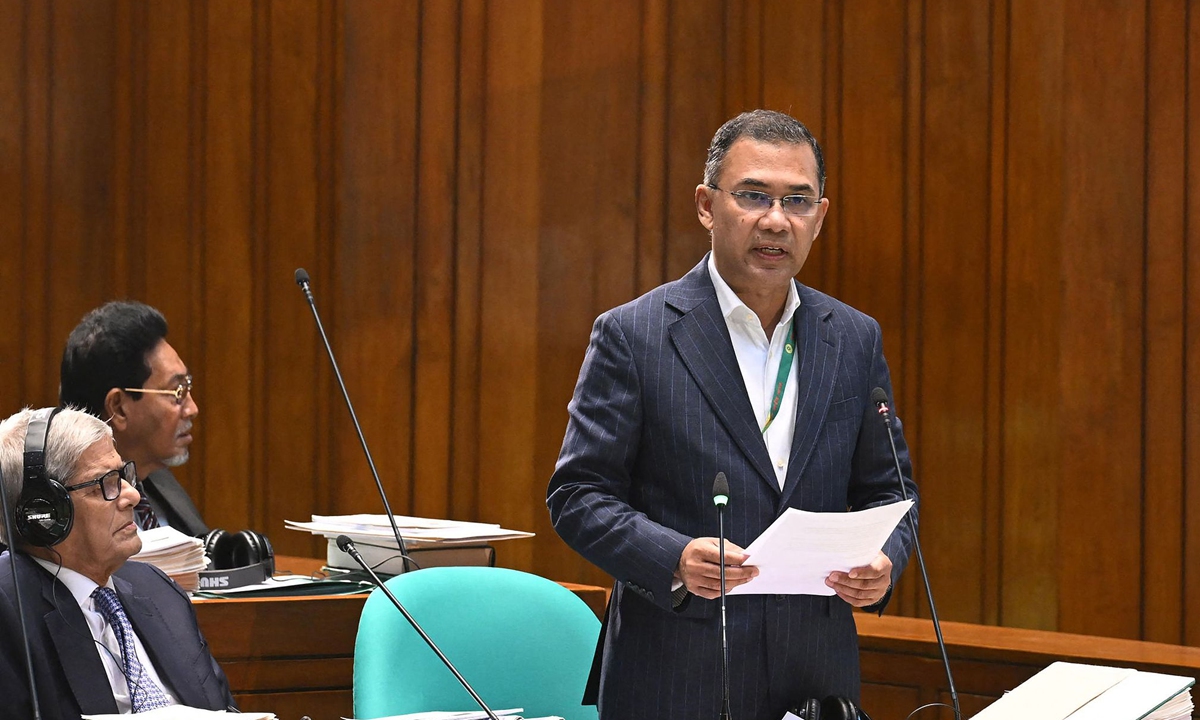
This handout photo released by Bangladesh's Press Information Department (PID) on March 12, 2026 shows Prime Minister Tarique Rahman speaking during a parliamentary session in Dhaka. Photo: VCG
Bangladesh Prime Minister Tarique Rahman is set to visit Malaysia and China starting Sunday on his first overseas trip since taking office in February, according to media reports. The news has sparked discussion in Indian media, which views Rahman's outreach to China as a signal of his foreign policy priorities, as he bypasses India, which has traditionally been the destination of such inaugural visit.
The twin-country trip kicks off in Malaysia on Sunday, Bangladesh's Foreign Secretary Asad Alam Siam said at a media briefing in Dhaka on Saturday, according to Bloomberg.
Rahman will hold bilateral talks with Prime Minister Anwar Ibrahim in Malaysia from Sunday to Monday, where Dhaka plans to press Kuala Lumpur to absorb more Bangladeshi expatriate workers, per Bloomberg.
Rahman will arrive in China on Monday night from the Malaysian capital, Kuala Lumpur, for a five-day visit, according to Bangladesh media Prothom Alo.
Bangladeshi officials state that during the Prime Minister's upcoming visit to China, discussions will focus on Chinese financing and cooperation across projects in various sectors, Prothom Alo reported.
Rahman's visit has not yet been confirmed by the Chinese Foreign Ministry as of press time.
China is willing to carry forward traditional friendship with Bangladesh, enhance political mutual trust, deepen practical cooperation, and be the most reliable partner in Bangladesh's national development process, said Chinese Foreign Minister Wang Yi in May during talks with Bangladeshi Foreign Minister Khalilur Rahman in Beijing, per Xinhua.
Bangladesh appreciates the long-term support and assistance from China, looks forward to further deepening all-round friendship and cooperation, elevating the comprehensive strategic cooperative partnership between the two countries to a new level, and boosting its own economic and social development, the Bangladeshi Foreign Minister said.
Bangladesh welcomes Chinese enterprises to invest in Bangladesh and is ready to provide a stable, sound and predictable business environment, he added.
Indian media have been closely following Rahman's trip. The Hindustan Times reported on Sunday that Rahman has chosen "Malaysia and China for his first foreign visit to expand overseas employment opportunities and drum up investments, signaling his foreign policy priorities by bypassing India, which has traditionally been the destination for such trips."
India media the Hindu also reported that Rahman is set to visit Malaysia and China on his first trip abroad since assuming office, "bypassing neighboring India as his inaugural destination."
In March, Rahman has written to Indian Prime Minister Narendra Modi accepting his invitation to visit India, while signaling a broader effort to reset bilateral ties after a period of strain, according to the Indian Express.
Indian media's close attention to the visit reflects the evolving state of India-Bangladesh relations. For a long time, India has been Bangladesh's most important neighbor, and the two countries maintained close cooperation across a wide range of areas. However, bilateral ties have encountered setbacks since the fall of former Prime Minister Sheikh Hasina 's government and are still undergoing a period of adjustment, with relations yet to return to a more stable footing, Qian Feng, director of the Research Department at Tsinghua University's National Strategy Institute, told the Global Times.
Qian said some voices in India's media and strategic circles continue to view regional affairs through the lens of India's traditional leadership role in South Asia, leading to concerns that closer China-Bangladesh ties could diminish New Delhi's influence, particularly in Bangladesh.
However, China-Bangladesh cooperation is not directed at any third party and should not be viewed simply through the prism of geopolitical competition, Qian noted.
During a meeting with Bangladeshi Foreign Minister Khalilur Rahman in Beijing in May, Wang said that China's development of relations with Bangladesh and other South Asian countries does not target any third party, nor should it be affected by any third party, according to Xinhua.
RELATED ARTICLES