Major diaper producers deny formamide claims as safety dispute awaits official test
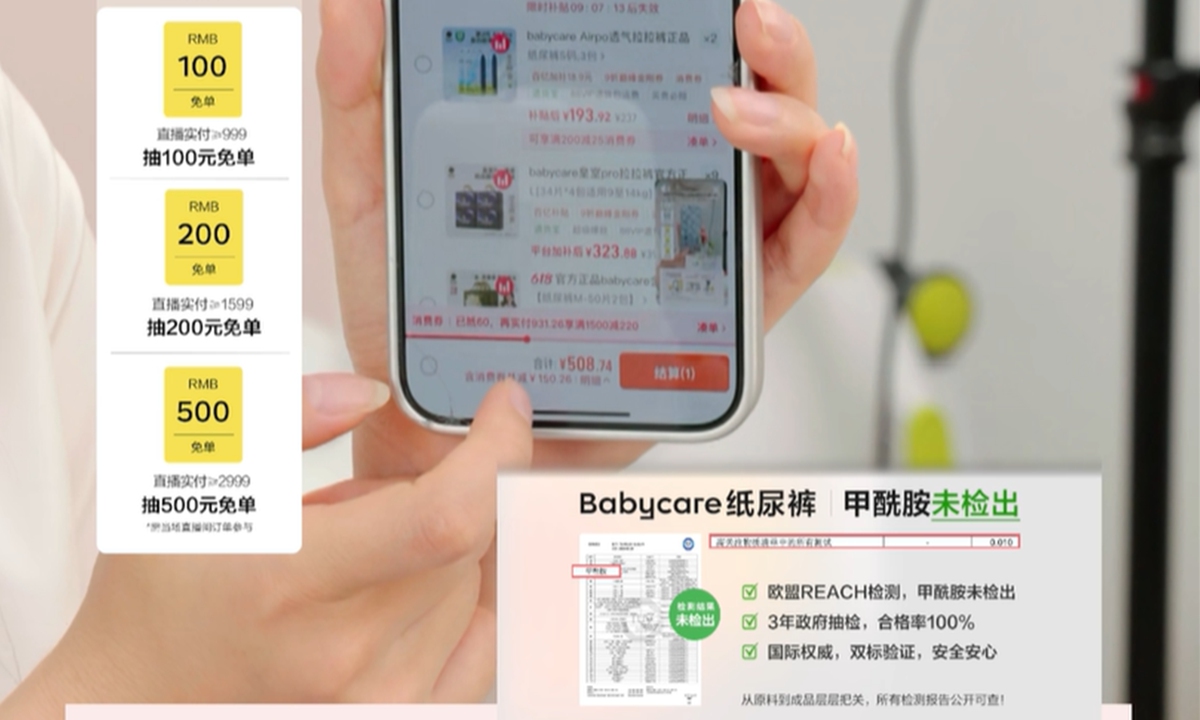
Babycare's livestreaming channel shows a notice, stating that formamide was not detected in the related products, on June 21, 2026. Photo: Screenshot from Babycare's Tmall shop
Three baby diaper brands at the center of a formamide safety controversy in China issued a second round of public responses on Sunday, saying their latest third-party tests showed no trace of the substance in the products in the products covered by the disclosed reports, as market regulators in several cities continued official sampling checks.
The latest responses from Babycare, Huggies and Bibabebe came after days of intense public concern triggered by a Thursday investigative report by the Economic Information Daily, which said some diaper products from the three brands had tested positive for formamide, a toxic substance.
The report quickly drew attention from parents, pushed the companies into repeated public clarifications, prompted local market regulators to open checks, and led to a wider dispute over testing procedures, sourcing and disclosure.
Babycare was the first to issue a second statement, saying in an update post on Sina Weibo early Sunday that its full range of diaper products had been tested under the EU REACH regulation's substances of very high concern framework, while 23 products had also undergone additional testing under China's standards for amide organic solvents in textiles. All disclosed results showed formamide was "not detected," the company said.
Babycare also said it had completed traceability checks on raw materials and production equipment, and had reported what it described as false online information to public security authorities.
Huggies said in a Sunday update that third-party reviews and retesting of its full diaper product range had been completed, with disclosed reports on finished products and raw materials showing formamide was not detected. It said it was cooperating with independent sampling by local market regulators and would release the official results once available.
Bibabebe also said on Sunday that it had released urgent test reports for the products involved, with the disclosed results showing they met relevant safety standards and that formamide was not detected, according to the company.
The case spread quickly because maternal and infant products are highly sensitive in public opinion, Liu Dingding, a veteran internet industry observer, told the Global Times on Sunday. Baby diapers are basic products used by almost every family with infants, and parents tend to have little tolerance for any safety doubts involving children's products, Liu said.
The case began on Thursday, when the Economic Information Daily reported that it had commissioned laboratory testing after receiving consumer complaints about infants developing repeated diaper rash or skin damage after using some diaper products. The report also said formamide had been found in some infant blood and urine samples.
Formamide is classified in the EU as a Category 1B reproductive toxicant and listed by the European Chemicals Agency as a substance of very high concern, while China has banned its addition to cosmetics. For infants, the report said, the potential risk deserves particular scrutiny because of their higher vulnerability.
The three brands had already issued initial responses on Thursday. Bibabebe said it was arranging third-party retesting and reviewing production, raw materials and warehousing, while asking the media outlet for details on the sample source, testing environment and testing process cited in the report. Babycare and Huggies also denied product safety problems on the same day.
The dispute over the report's evidence chain intensified on Friday. Media reports said the clinical institution referenced in the Economic Information Daily article denied conducting research that linked infant blood and urine test results to diaper products.
On the same day, China Technical Association of Paper Industry also questioned the report's testing process, saying it did not disclose key information such as detected values, testing institutions, standards, equipment and methods. But the reporter behind the original investigation pushed back by releasing audio material, saying the denial statement by the expert quoted in his original report had been signed under pressure.
Market regulators also stepped in. Authorities in cities such as Hangzhou, Huzhou, Shanghai, Nanjing and Tianjin conducted inspections or sampling checks involving the three brands, covering company sites, production links, raw materials and products on sale, according to media reports. No official test results had been released as of Sunday.
"The controversy has also been prolonged by conflicting accounts from the media, the companies, the industry body and cited sources. For ordinary consumers, the core concern is not the precise gap between laboratory results, but which testing process and which conclusion can be trusted," Liu said.
Public opinion remains divided. Some online users have questioned the reporter's evidence chain and voiced support for the companies' right to defend their reputation if false information caused damage. Others say company-commissioned tests are still self-verification and cannot by themselves resolve concerns over infant-product safety.
A mother surnamed Zhang, whose child is under 2 years old, told the Global Times on Sunday that "We may not understand all the testing terms, but for baby products, we need a clear and authoritative answer. Company tests are useful, but I would feel more reassured only after market regulators publish their results."
Liu said official regulatory sampling is now the clearest way to move the dispute from online argument back to factual verification, as tests conducted by market regulators carry stronger procedural safeguards and public authority than either media-commissioned testing or company-commissioned retesting.
The incident also shows that the maternal and infant products industry needs a more transparent compliance and quality-verification system that the public can understand and trust, Liu noted.
RELATED ARTICLES