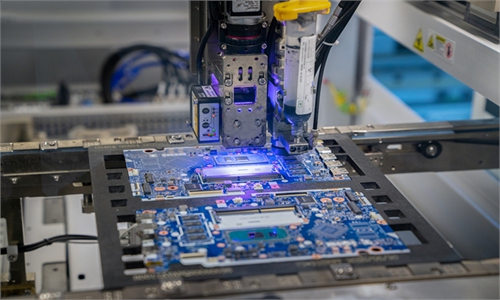
chip Photo:VCG
Japan's top five manufacturers of chipmaking equipment posted a 10 percent decline in combined sales to China for the financial year ended on March 3, Japanese media outlet Nikkei Asia reported on Sunday.
The report noted this was the first-ever decline, while attributing it to Beijing's efforts to promote its domestic industry. Chinese experts said that Japan's tighter chip curbs are increasingly backfiring, while China's drive for semiconductor self-reliance is helping domestic firms rapidly capture market share voluntarily relinquished by some foreign competitors.
Tokyo Electron, Advantest, Screen Holdings, Disco and Kokusai Electric reported 1.47 trillion yen ($9.19 billion) in combined sales in China, down 12 percent from fiscal 2024, according to the Nikkei Asia report.
At Tokyo Electron, Chinese sales accounted for 27 percent of the total in the January-March quarter, down 7 percentage points from a year earlier, it said, adding that the figure plunged from 50 percent in the April-June quarter of 2024.
The declines were especially sharp for companies making equipment for the front-end process of forming circuits on silicon wafers. Tokyo Electron, Screen Holdings, and Kokusai saw combined China sales fall almost 20 percent from the previous year.
China and Japan have long maintained a highly integrated semiconductor supply chain, with extensive cooperation across upstream and downstream segments, making the relationship fundamentally one of mutual benefit, Ma Jihua, a veteran tech analyst, told the Global Times on Sunday.
However, after Japan aligned with US-led restrictions on China's semiconductor sector, Chinese firms had to accelerate their innovation and localization efforts. He noted that years of investment and technological breakthroughs have significantly strengthened China's capabilities in semiconductor equipment and materials, reducing reliance on Japanese suppliers — a clear sign that such measures are backfiring on Japan's own industry.
According to a Reuters report, Japan said in 2023 that it would restrict exports of 23 types of semiconductor manufacturing equipment, aligning its technology trade controls with a US push to curb China's ability to make advanced chips.
On April 26, 2024, Japan announced plans to impose export controls on a range of semiconductor-related and other sensitive items, and launched a public consultation on the proposed measures. On April 3, 2025, the Japanese government formally imposed export controls on more than a dozen semiconductor-related items.
China has repeatedly stated its position on Japan's semiconductor-related export control measures.
Commenting on Japan's April 3, 2025 decision to impose export controls on more than a dozen semiconductor-related items, a spokesperson for China's Ministry of Commerce said that the semiconductor industry is highly globalized. Over the past few years, certain countries have overstretched the concept of national security and abused export control measures to suppress China's semiconductor and other industries, seriously undermining the stability of global semiconductor supply chains, the spokesperson said, adding that China firmly opposes such moves.
The spokesperson stressed that Japan's export control measures would severely disrupt normal business exchanges between companies and harm the interests of enterprises in both countries.
Ma said that Japan's declining semiconductor exports to China largely reflected China's growing domestic capabilities in key technologies and production. Instead of slowing China's progress, the restrictions have accelerated efforts by Chinese firms to develop their own alternatives and strengthen their technological self-sufficiency.
Conversely, Japan's semiconductor industry is highly dependent on the Chinese market, and export curbs could ultimately hurt Japanese companies more than their Chinese counterparts, Ma said, adding that as Chinese firms increasingly turn to domestic suppliers and reduce reliance on imported equipment and materials, Japanese companies could find themselves losing ground in one of their most important overseas markets.
RELATED ARTICLES