Rare urban nesting of protected kestrels atop 30-meter-tall telecommunications tower draws crowds, impromptu science lessons in Beijing
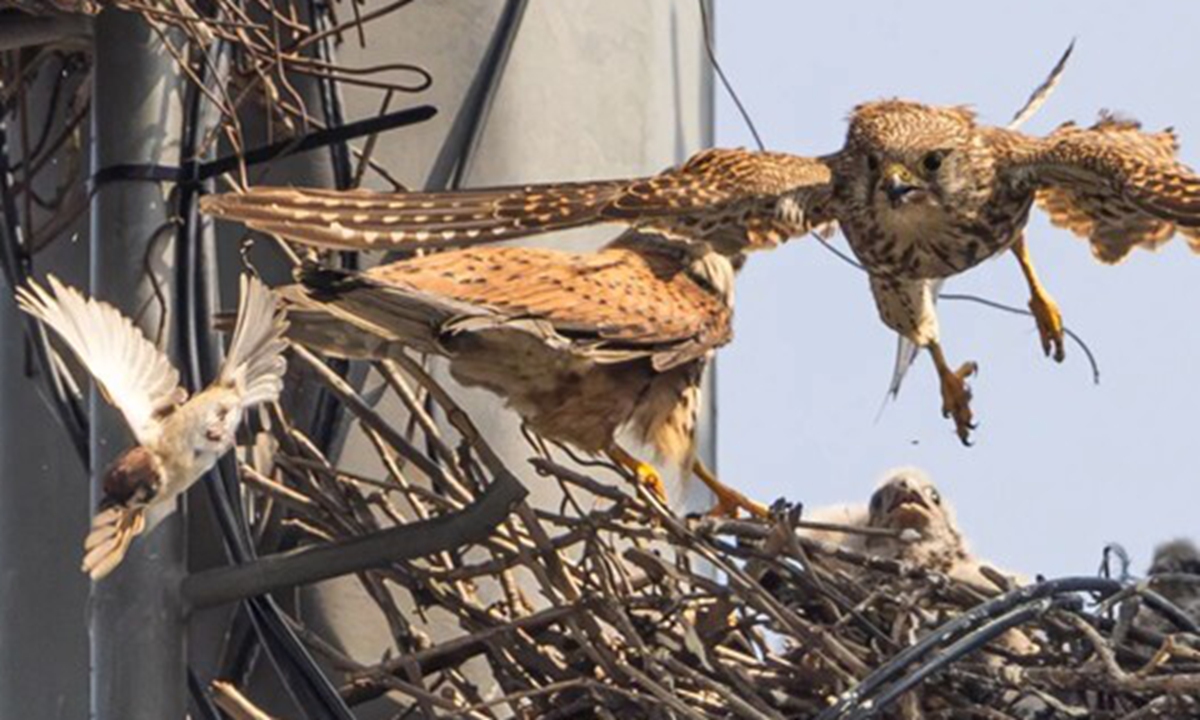
Two adult kestrels and a brood of chicks in a nest atop a roughly 30-meter-tall telecommunications tower outside a commercial building in Beijing Photo: People's Daily
Two adult kestrels, a national second-class protected species which are rarely seen in urban areas, have built a nest atop a roughly 30-meter-tall telecommunications tower outside a commercial building in Beijing and recently hatched a brood of chicks, attracting crowds of residents and prompting bird-watching enthusiasts to offer impromptu science lessons on the street, People's Daily reported.
The chicks are still unable to fly independently and can occasionally be seen flapping their wings inside the nest. On the sidewalk below, more than a dozen photography enthusiasts have set up cameras and binoculars, keeping their eyes fixed on the birds' every move. Passersby have also stopped to join the impromptu birdwatching gathering, many taking out their phones to capture the unusual scene.
"The kestrels have already been here for about half a month, and several chicks have hatched," one nearby resident said.
As interest grew, experienced birdwatchers began offering spontaneous explanations about the species' habits, conservation status and proper bird-watching etiquette.
"This is a kestrel, a national second-class protected wild animal and a type of raptor that many people would simply refer to as an eagle," Huang Cheng, a student at China University of Petroleum, told onlookers. "These birds are usually found in natural environments with abundant vegetation, and it is relatively rare for them to nest in urban areas, and this is a sign that our ecological environment is improving," he said, according to the report.
The informal street-side science sessions have been well received by local residents, with many parents bringing their children specifically to observe the birds and learn about nature.
"I used to think birds of prey only lived deep in forests and mountains. I never imagined we could see them right outside our neighborhood. My child is very excited," a parent who brought a sixth-grade student to watch the birds said.
Kestrels are a relatively common raptor species in Beijing and play an important role in urban ecosystems. With strong flying abilities, they mainly feed on large insects, small birds and rodents, serving as "natural cleaners" that help maintain ecological balance, according to the report.
"Kestrels used to be migratory birds, but in recent years some have started nesting in parks and gradually become resident birds. Even so, nesting in densely populated urban areas remains uncommon," a staff member said, noting that the phenomenon also reflects the continuous improvement of Beijing's ecological environment.
According to the staff member, Beijing is now home to 531 bird species, earning the city a reputation as a true "bird-friendly habitat."
As of April 2026, more than 300 species of wild birds had been recorded in Beijing's Changping district alone, including over 60 nationally protected species. Rare birds such as the relict gull, white-naped cranes, and yellow-breasted bunting have also been spotted frequently in recent years.
Officials said that expanding urban green spaces and growing public awareness of wildlife conservation have provided more habitats for wild animals to thrive.
They also noted that kestrels tend to adhere to the same nesting site. If an environment remains safe and relatively undisturbed, they often return to the same location to breed for several consecutive years.
Authorities have reminded residents to keep an appropriate distance if birds nest near their homes or workplaces, avoid disturbing them and refrain from feeding them.
"Kestrels obtain sufficient moisture from the blood contained in the prey they catch themselves. Improper feeding may instead harm their health," the staff member said.
People's Daily - Global Times
RELATED ARTICLES