Illustration: Xia Qing/GT
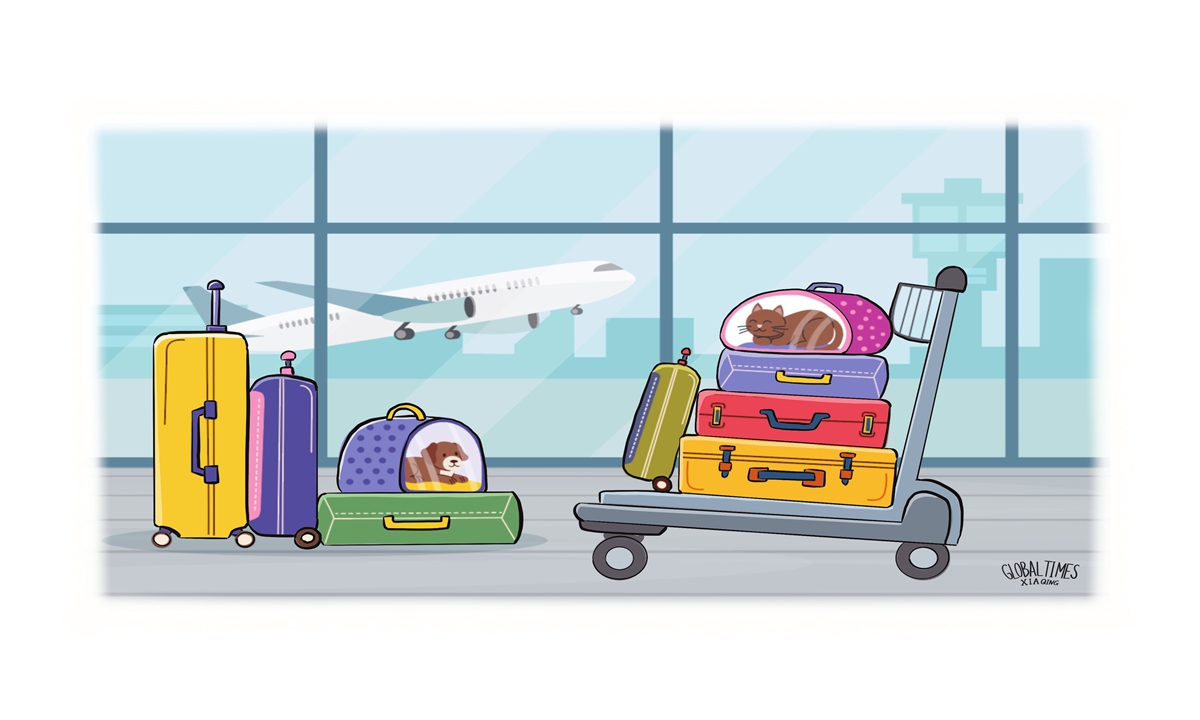
The recent Dragon Boat Festival holidays brought into view an increasingly familiar practical question: when pet-owning households travel during holidays, who takes care of their pets? According to a report by CCTV.com, one response that has begun to emerge in China is to bring pets along on flights, as air travel with pets gradually becomes an additional option for households with domestic animals.This trend is being described as part of a broader and increasingly routine set of consumer needs. Seen in this light, it offers a small but telling window into China's expanding pet-related economy, a segment that is steadily consolidating across a range of services and consumption behavior, and one that is likely to open up a widening set of commercial opportunities for both domestic and international providers.
According to the Economic Information Daily newspaper, the 2026 China Pet Industry White Paper (Consumer Report) showed that China's pet consumption market reached 312.6 billion yuan ($46.2 billion) in 2025, covering multiple segments including breeding, food, supplies and healthcare. Industry insiders are broadly optimistic about the sector's prospects, viewing the mark of 300 billion yuan as a new starting point for market upgrading, with the market expected to expand to 405 billion yuan by 2028.
Rapid market expansion has fueled increasingly premium consumption trends, with demand shifting toward smarter, more specialized and higher-end products. As younger consumers become the dominant force among pet owners, they are more willing to try new products and place greater emphasis on quality, creating broad opportunities in the market.
Take pet grooming as an example. This fast-growing market is, to some extent, beginning to mirror the evolution of the human personal care sector - not only in its product range, but also in its underlying logic. Five to 10 years ago, pet grooming was relatively straightforward: demand centered on deodorizing and basic cleanliness. Today, however, an increasing number of consumers are paying attention to skincare benefits, low-allergen formulations, and even fragrances designed to influence pets' moods.
Among some younger pet owners, purchasing decisions are no longer driven purely by cleaning needs. Greater weight is being placed on natural botanical ingredients, imported formulations, and more design-led packaging.
This is only one facet of China's pet-related economy, but it points to a broader and increasingly visible logic: the sector is expanding rapidly, and both the potential scale of demand and the boundaries of the market are widening.
Some overseas commentary has claimed that consumption in China is weakening. That is not supported by the evidence. The pet-related economy offers one lens through which to observe the emergence of new areas of demand and commercial opportunity. Businesses, for their part, have tended to respond quickly to these developments.
Driven by rising demand, the number of market players has continued to grow. Data from Chinese business information platform Tianyancha showed that the total number of pet-related companies surged more than 44 times over the past decade, from more than 184,200 in 2015 to more than 8.335 million in 2025.
Vendors of imported products are also seeking to keep pace with this wave of consumption. According to the Xinhua News Agency, the number of overseas pet brands entering cross-border e-commerce platform Tmall Global doubled ahead of this year's "618" shopping festival.
This trend is visible in several recent developments. For instance, the 8th China International Import Expo in 2025 marked the first collective appearance of a dedicated pet industry delegation. Foreign companies from countries including France showcased products such as pet food, seeking to capitalize on the opportunities created by China's expanding and increasingly open market.
Against the backdrop of more uncertain global trade conditions, China's expanding pet-related economy is creating new opportunities for international suppliers. Growth in services, products and retail channels points to a depth of domestic demand that is often underappreciated in some foreign media reports.
The pet-related economy remains at an early stage of development and, like any fast-expanding sector, is likely to face adjustment pressures. But rapid growth of this kind tends to generate its own momentum, as new business models, consumer preferences and types of services emerge.
Let us return to pet-friendly travel. Pets are now more frequently seen on flights. Such changes are easy to miss when viewed through broad aggregate indicators. Yet at the level of household behavior, they point to a consumer market in China that is becoming more varied in practice, with its boundaries gradually widening.
The author is a reporter with the Global Times. bizopinion@globaltimes.com.cn
RELATED ARTICLES