ARTS / CULTURE & LEISURE
Chinese film ‘Dear You’ sparks global emotional resonance
A grandmother’s letters unveil a shared history
By Published: Jun 21, 2026 10:02 PM


Photo:Courtesy of the Weibo account of Dear You
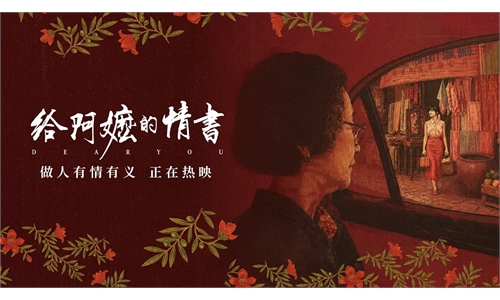
As of Sunday, the rating for Chinese film Dear You on review platform Douban had reached a 9.3/10, up from its previous 9.2/10, with more than 860,000 reviews. This marks the third time the film's score has increased since its release. Meanwhile, Dear You also continued expanding overseas with a premiere in London on Saturday. Many in the audience at the premiere said the film brought back shared memories and strong feelings for Chinese living abroad. The movie has also been warmly received in Southeast Asian countries like Malaysia and Singapore.Shi Wenxue, a film director and critic, pointed out that this surprise box-office hit will soon be shown in Australia, New Zealand, the US, Canada, and many other countries and regions.
"The international screening plan shows how influential and popular this film has become. It is a good example of a recent successful Chinese cultural product going global," Shi told the Global Times on Sunday.
Dear You mainly focuses on Chaoshan regional culture. With the precious medium of qiaopi (letters and remittances sent home by earlier generations of overseas Chinese) as its storytelling thread, the film tells a subtle story about homesickness and the deep bond between family members. With a simple and restrained style, the movie depicts the emotional ties that cross mountains and oceans, as well as family and national connections.
At the London premiere, many viewers were moved to tears. At the end, the screening received warm applause, and the audience lingered in their seats, according to the Xinhua News Agency. Liu Shiyi, who grew up in Chaozhou, South China's Guangdong Province, and later moved to the UK to study, shared after the screening that his parents found decades-old qiaopi letters at home after watching the film in China. "Qiaopi, these family records, help overseas Chinese understand their roots and maintain a link with their hometowns," Liu said in an interview with Xinhua.
In Malaysia, one moviegoer said the film's details about qiaopi reminded him of how his grandfather used this method to send money to relatives in China. "I am from the Chaoshan region myself. The movie described perfectly how Chinese people value their roots and family. The theme of loyalty and affection was very moving," he told the Nanfang Daily.
At the Singapore premiere, one viewer told the same news outlet that this marked the second time that she had seen the film, the first time being in Beijing. "Dear You tells the story of our ancestors moving to Southeast Asia. I truly relate to their feelings, especially the homesickness. Watching it overseas made the experience even more meaningful," she said.
The report said that on Tuesday, Dear You held pre-sales for eight special Chaoshan-dialect screenings in Singapore. All 4,800 tickets sold out in just 1.5 hours. In Singapore, a total of 24 out of 26 cinemas will show the film, mostly in Putonghua (Standard Chinese), but organizers are trying to add more Chaoshan-dialect screenings due to high demand. According to the film's Malaysian distributor, the movie is playing in at least 550 theaters daily nationwide, and screenings are still increasing.
"The strong response to this film across the world, especially in Southeast Asia, is not a coincidence. It comes from the merging of culture, history, and emotional resonance," Shi said.
He emphasized that Dear You touches audiences most with its themes of loyalty and kindness. The movie explores romantic love, kinship, and homesickness - all universal emotions that touch every moviegoer.
Shi also noted that the success of Dear You can help to change stereotypes that some international audiences have about Chinese cinema. In the past, many foreign viewers mainly thought of Chinese films as historical epics or martial arts blockbusters. Dear You can break away from this model, proving that stories full of humanity and universal emotion can be even more powerful than pure visual spectacle. He added that as the film travels abroad, it presents a real and warm image of China, helping to build stronger emotional connections with global audiences.
RELATED ARTICLES