IN-DEPTH / IN-DEPTH
GT investigates: Deep political divisions and structural economic imbalances are fueling a historic reverse migration out of the US
America’s outward exodus
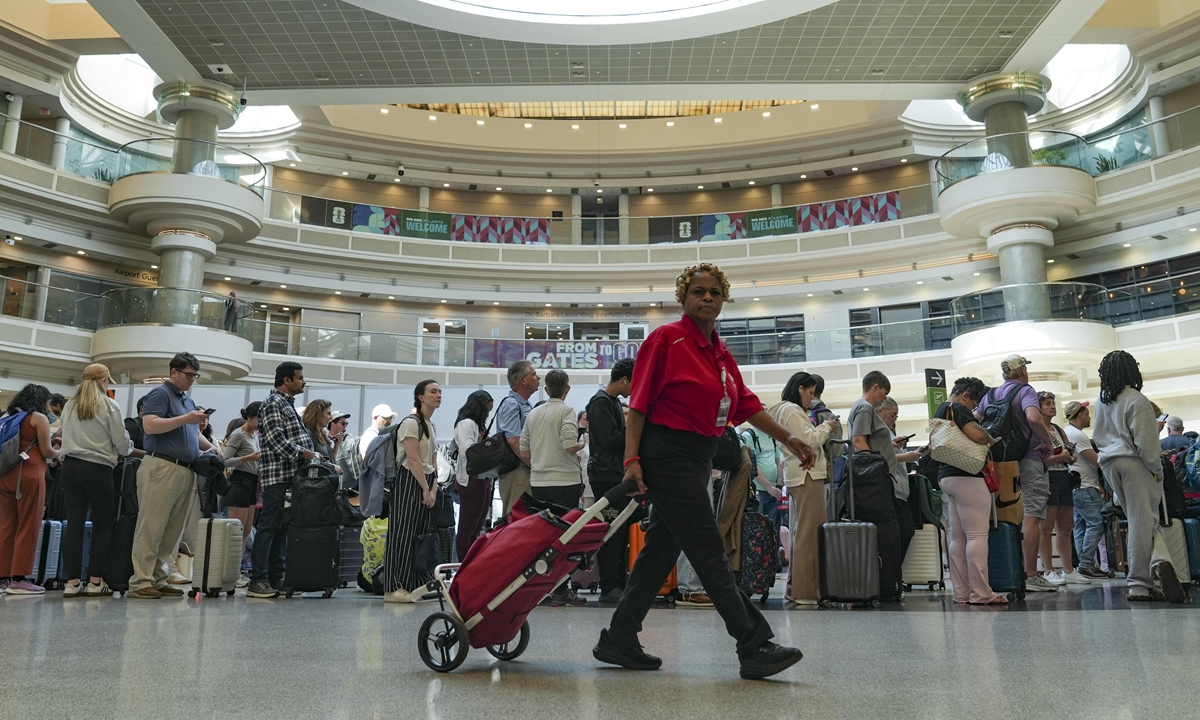
Travelers stand in long lines at Atlanta Hartsfield-Jackson International Airport in Atlanta, the US, on March 22, 2026. Photo: VCG
Editor's Note:As the US approaches its 250th birthday, its "nation of immigrants" label may need to be re-examined. Research shows that in 2025, the US experienced a net migration outflow of approximately 150,000 people - the first "reverse migration" wave since the Great Depression of the 1930s - and this trend is expected to intensify further in 2026 and 2027. Scholars point out that this historic population reversal is rooted in imbalances in the US economic structure and issues with social governance, reflecting profound economic and political restructuring in the country, and signaling a decline in its economic vitality, social cohesion and global appeal.
Migration outflow of about 150,000 people in 2025
On May 9, 41-year-old Jesse Derr and 45-year-old Jess Yeastadt, drove five hours from Phoenix, the capital of Arizona, to the Hard Rock Hotel in San Diego, California. This couple was not on vacation. They had joined hundreds of other Americans at the second annual Move Abroad Conference organized by the relocation company Expatsi to learn how to move from the US to Mexico, the CNBC reported.
The couple represents potential participants in the US "reverse migration" wave. A report released by the Brookings Institution in January indicates that the net migration outflow for the US in 2025 ranged between 10,000 and 295,000. Analysis by the Wall Street Journal of the relevant data states that the US experienced a net migration outflow of about 150,000 people in 2025, marking the first "reverse migration" phenomenon since the 1930s.
The US government attributes this phenomenon to its policies of strengthening the deportation of illegal immigrants and tightening visa regulations. According to information released by the US Department of Homeland Security in January, nearly 3 million "illegal immigrants" left the US in 2025. However, behind the surface of this population movement seemingly driven by immigration policy, there lies a less-noticed structural reversal: US citizens are leaving their country at an unprecedented rate.
According to the Wall Street Journal, data on residency permits, overseas property purchases and student enrollments from more than 50 countries show that Americans are "voting with their feet." In nearly every one of the EU's 27 member states, the number of Americans arriving to live and work has reached record highs and continues to rise.
Americans' willingness to leave their country is also reflected in applications to renounce US citizenship. According to immigration firms, applications to renounce US citizenship surged 48 percent year-over-year in 2024, and 2025 is likely to exceed that level. A Gallup poll in November 2025 showed that for two consecutive years, about one in five Americans said they would permanently move to another country if given the opportunity.
Violent crime, cost of living and political turmoil
The US has long been viewed by the outside world as a "nation of immigrants," a label widely popularized by former US President John F. Kennedy. In 1958, when he was still a US Senator, Kennedy published the book A Nation of Immigrants. He argued that immigration is the foundation of the US and called for open immigration policies. According to the BBC, the US was founded as a colony, and with the exception of Native Americans, all Americans are immigrants or descendants of immigrants.
However, in 2025, the number of people leaving the US exceeded the number entering the country. In response, the Brookings Institution's analysis states that the US government's restrictive immigration policies and deportation actions played a certain role. Nevertheless, the Wall Street Journal, in dozens of interviews, found that Americans moving abroad described their reasons for leaving as an interplay of economic problems, lifestyle preferences and disappointment with the direction of America's development. They mentioned the spread of violent crime, rising living costs and intensifying political turmoil.
Sun Lin, a researcher at the American Studies Center of Shanghai International Studies University, told the Global Times that this historic "population reverse flow" in the US is the result of the interaction of multiple complex factors, including imbalances in economic structure and issues with social governance.
Among these, the increasingly stark wealth gap is a key deciding factor for people leaving the US. Data from the Pew Research Center in 2024 showed that in 1971, 61 percent of Americans lived in middle-class households, but by 2023, the share had fallen to 51 percent.
If economic factors represent chronic erosion, then political reasons constitute a direct and strong push for the US "reverse migration." At the Move Abroad Conference held by Expatsi in May, the company's co-founder, Jen Barnett, conducted a sample survey of 218 attendees. She told the CNBC that the survey showed 89 percent of respondents indicated they wanted to leave the US for political reasons. Derr is one of them. He said that US policies in recent years affecting reproductive rights - such as the Supreme Court's decision to overturn federal constitutional protection for abortion rights - and rulings that weakened the Voting Rights Act are signals that the US is "going backwards." Derr said that their family's moving timeline will depend on the results of the 2026 US midterm elections. If the Democrats win control of both the House and Senate and take action to reverse the destructive decisions made by the current administration, they may change their moving plans.
In addition to domestic dynamics, changes in the global landscape have provided a macro-level backdrop to the net outflow of immigrants from the US. The reshaping of economic structures in a multipolar era has eroded America's unique edge as the premier destination for global talent and capital. The rise and development of Global South nations, along with more attractive talent policies and more robust social welfare systems in developed countries such as Canada and Australia, have created a diversion effect, drawing migrants who might otherwise have headed for the US.
Recent data from Indeed, a globally recognized online recruitment company, shows that foreign job seekers' interest in US jobs has dropped sharply since 2024, plummeting to 1.4 percent in April, the lowest level since 2020.
What would the US look like without immigrants?
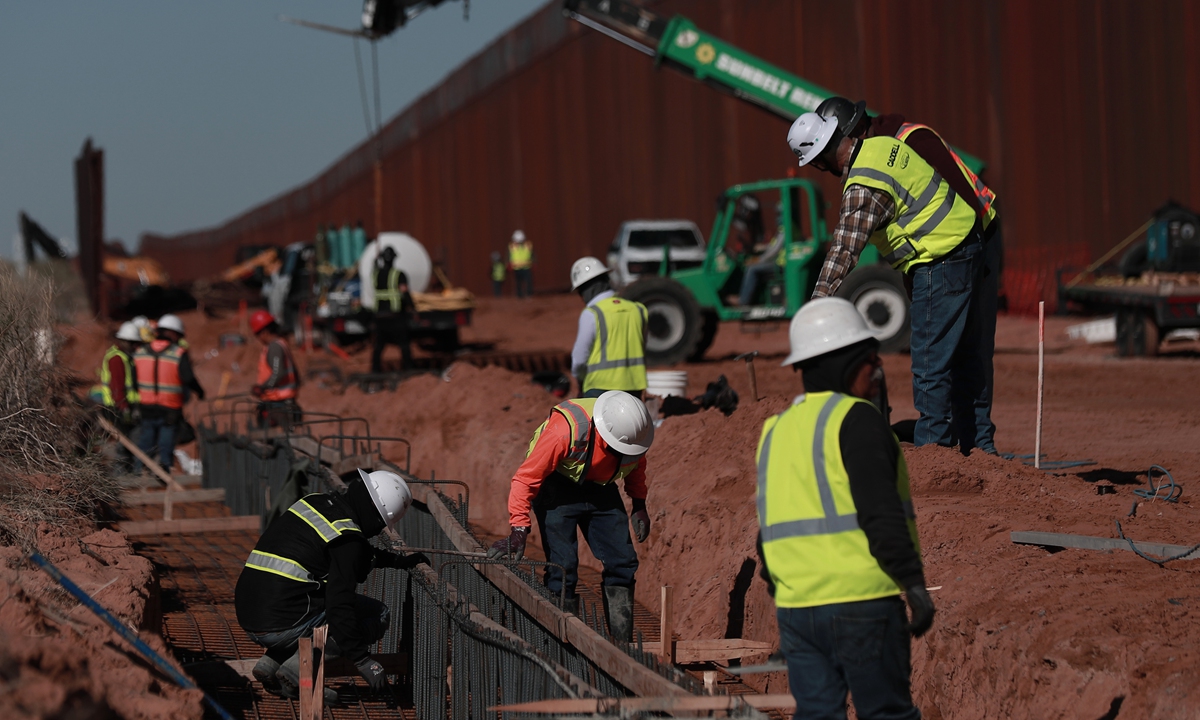
Workers install cement bases and steel rods as part of the ongoing project to reinforce the barrier between Santa Teresa, the US, and Ciudad Juarez, Mexico, on March 11, 2026. Photo: VCG
Immigrants have long underpinned US economic growth and social vitality, becoming deeply woven into the fabric of American life - from classrooms to hospital wards, from city parks to concert halls, from corporate boardrooms to factory floors. The US labor market's reliance on immigrants is far greater than most people imagine. According to the Bureau of Labor Statistics, nearly 31 million foreign-born workers were employed in the US in 2024, accounting for 19.2 percent of the US workforce. The net outflow of immigrants seen in 2025 has prompted many Americans to ask: What would America look like without them?The New York Times addressed that question in a report last December. About a year into the White House's immigration enforcement policies, the article said, construction companies in Louisiana were scrambling to find carpenters, hospitals in West Virginia had lost doctors and nurses they had planned to recruit from overseas, and a community soccer league in Memphis could no longer field enough teams because the children of immigrant families had stopped showing up.
A decline in immigration would first hit the US economy. According to a Brookings Institution article published in March, a reduction in net immigration would weigh on US GDP growth. A research report from the think tank showed that the drop in immigration between 2024 and 2025 could slow US GDP growth by 0.19 to 0.26 percentage points and reduce consumer spending by $40 billion to $60 billion in 2025.
Justin Gest, professor of Policy and Government at George Mason University's Schar School, has noted that the concern lies not only in how many people are leaving, but also in who they are. After the current administration cut research funding for various academic institutions, a Nature analysis of jobs board data found that US-based scientists submitted 32 percent more applications to positions abroad between January and March in 2025 compared to the same period in 2024. Decades of research have shown that many immigrants are not only young and highly educated, but also highly entrepreneurial. When these most dynamic individuals begin to choose to leave, the US loses not just labor numbers, but the core engine of innovation and long-term economic growth.
A rising crisis of confidence?
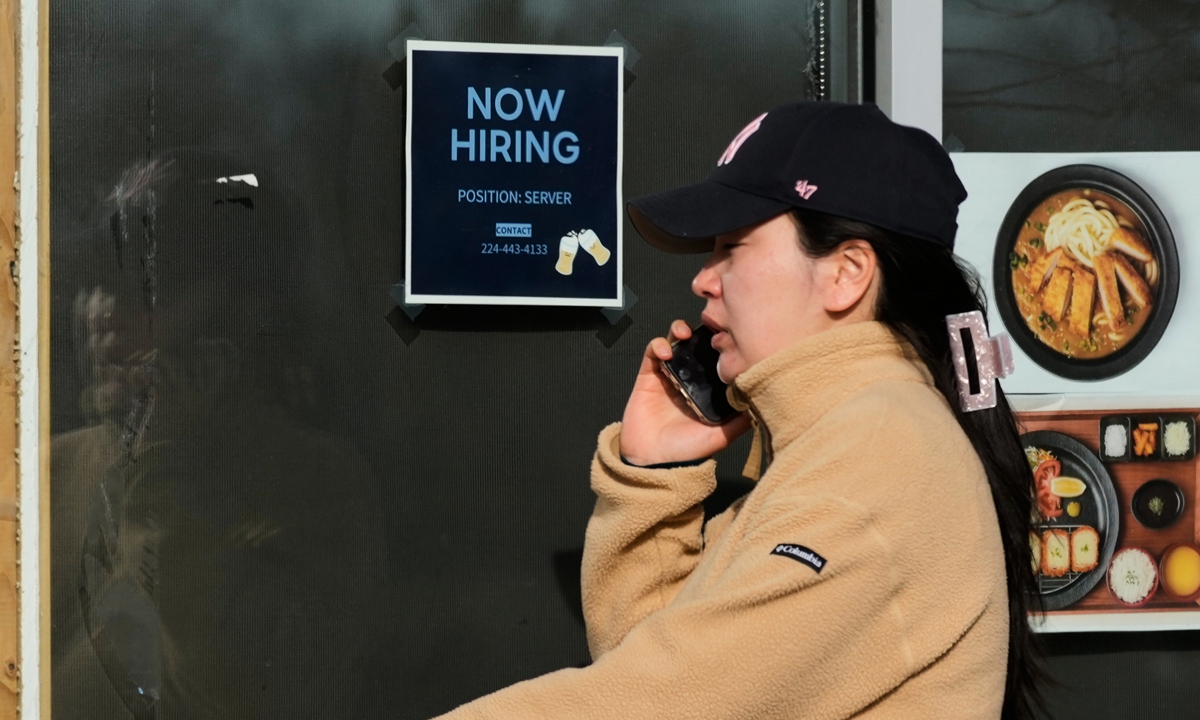
A pedestrian walks past a hiring sign displayed outside a restaurant in Illinois, the US, on April 7, 2026. Photo: VCG
The impacts of net emigration stretch well beyond economics, challenging American exceptionalism and national identity. The US has long defined itself as a nation of immigrants, viewing its allure to newcomers as a core feature of its uniqueness. Brookings Institution scholars noted that while the US has often fallen short of its stated ideals in practice, its national identity is rooted in pluralism, openness and the rule of law. Today, efforts to roll back fundamental principles, including immigrant citizenship rights and birthright citizenship, "strike at the core of what has made America exceptional."As the US marks the 250th anniversary of the country's founding, reverse migration poses a fundamental question to the self-proclaimed nation of immigrants: does this trend signal fading global confidence in America's future and its way of life?
"It undercuts this American exceptionalism, 'we have the best quality of life, we're the best country in the world, everyone wants to move here,'" Caitlin Joyce, researcher at Temple University, told the Wall Street Journal. She and her colleague have studied this migration trend for years.
The US government's immigration policies have also upended the traditional definition of what it means to be American. A nation built by immigrant labor is now closing its doors to newcomers. Academics warn that framing Americans and immigrants as opposing groups is eroding the very definition of national belonging.
A Gallup survey of more than 144,000 adults across 140 countries and regions in 2025 found that global willingness to move permanently to the US has fallen to a near 20-year low, with only 15 percent of adults worldwide naming it as their preferred destination, down from 24 percent between 2007 and 2009.
RELATED ARTICLES