Chinese summer products heat up in European market amid heatwaves, powered by localization and innovation
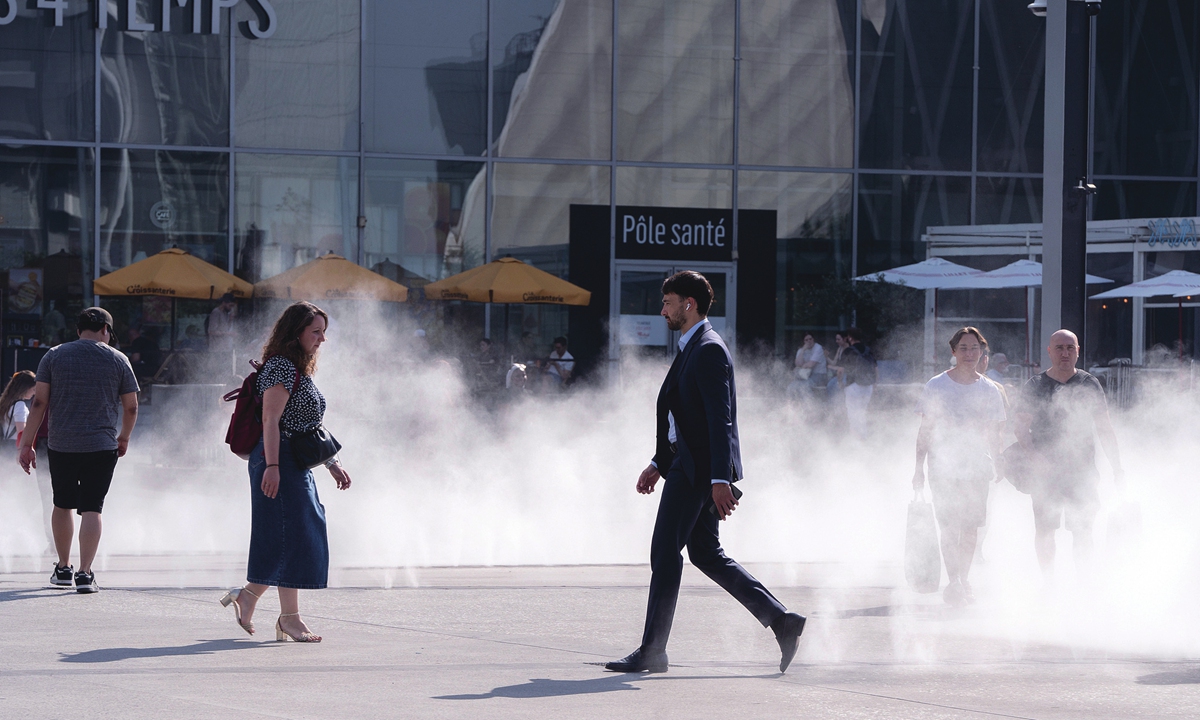
Workers cool themselves in water misters during high temperatures in the La Defense business district of Paris, France, on May 28, 2026. Photo: VCG
Outdoor review videos featuring fan-equipped sun hats have gone viral on TikTok amid scorching heat in Europe, with many users asking where to buy them. A large number of the trending products are manufactured in Yiwu, East China's Zhejiang Province.
As extreme heatwaves are sweeping across Europe this summer, countries including Italy, Spain and the UK have issued high-temperature alerts. From fan-equipped sun hats and sun-protection gear to portable fans and mobile air conditioners, a wide range of Chinese-made cooling products is entering peak sales season. Once seen by some European households as "non-essential" appliances, cooling devices are increasingly becoming important tools for coping with rising temperatures.
This development not only reflects the profound impact of climate change on European consumer behavior, but also opens up new market opportunities for many Chinese companies. From small commodity factories in Yiwu to large home appliance manufacturers, Chinese firms are leveraging cross-border e-commerce and supply chain advantages to bring more innovative cooling products to overseas consumers.
Orders surge
Fan-equipped sun hats from Yiwu are a typical example of China's cooling products going global. Jiang Yongtao, factory director of Senwai Hat Industry, told the Global Times that the product has gone viral on overseas platforms and is among the company's flagship exports, with strong demand in Europe driven by rising heatwaves and outdoor consumption.
Orders have continued to rise over the past two years. With Europe entering the peak summer sales season, previously placed orders are being shipped and entering local markets, said Jiang, whose company mainly supplies cross-border e-commerce sellers on platforms such as Amazon and TikTok Shop, as well as retail buyers in Europe.
Jiang added that the company's electric fan hats are priced at around $20 to $60 depending on style and sales stage. He noted that the company also bundles other products, including handheld mini fans and sun-protection sleeves, which have also sold well.
"Some European buyers are currently placing additional orders, with shipments being sent by air freight," he said.
"We have also felt the impact of heat waves, as our exports to Europe have notably increased this year," Chen Jianping, manager of Jinyang Daily Use Products Factory, a manufacturer of electric mini fans in Yiwu, told the Global Times on Sunday.
Public feedback further highlights the growing popularity of Chinese cooling products. Chinese social media platform Xiaohongshu has seen posts from students in London, the UK recommending China-made handheld fans, with some saying store staff told them the products were "so popular they are already sold out."
Beyond portable cooling products, Chinese air conditioners are also gaining traction in Europe. Cynthia Li, a 26-year-old office worker in the UK, told the Global Times that some of her friends in London have been purchasing China-made cooling appliances on Amazon during the summer, including standing fans from brands such as Midea and Xiaomi.
Chinese air conditioner manufacturer Midea said that late-May heat waves significantly boosted sales in Germany, the UK and the Benelux countries, with some PortaSplit models selling out. Sales through German e-commerce channels rose about 37 percent year-on-year in May, while shipments in Spain and France jumped 108 percent, the company told the Global Times in a statement.
China exported $27.2 billion worth of air conditioners in 2025, accounting for nearly 40 percent of global exports, according to OEC data, underscoring the country's dominant position in the global cooling equipment supply chain. Between March and April in 2026, China's air conditioner exports increased by $166 million (5.99 percent), from $2.77 billion to $2.93 billion, it said.
Localized R&D
Behind the surge in orders, China's cooling product research and development (R&D) is becoming more localized and technologically advanced, experts said.
Jiang said his company is improving battery life and working with universities to commercialize research. The new-generation hats retain cooling functions while becoming lighter and foldable, making them easier to carry and ship, with ongoing collaboration to further enhance user experience, he said.
"When we design our products, we take the specific needs of different countries and regions into account. For example, European consumers tend to prioritize functionality, while consumers in countries like South Korea place more emphasis on style and coordination. This allows us to develop products that better suit local tastes and habits," Chen said.
Midea told the Global Times that it is using artificial intelligence to better understand European consumer demand and guide product development. In Europe, where the installation of air conditioners can cost over 1,000 euros and take months due to old building structures, the company — together with its Germany R&D center — developed a tool-free model that can be installed in five minutes, focusing on façade protection and easy installation rather than hardware specs, with some units even commanding resale prices above their original retail price.
The innovation has quickly been felt by consumers. Xiao Jing, a Xiaohongshu user based in France, told the Global Times that Midea's portable air conditioner "Comfee" is very popular in France due to its high cost-effectiveness ffectivenand smart efficiency. She said the 250 euros device can be controlled via a mobile app and cools rooms quickly when placed in the bedroom.
Industry observers said the growth of China's refrigeration equipment exports is no longer driven solely by price advantages, but increasingly by more precise localized R&D capabilities. Companies are adjusting product specifications to European building structures, electricity costs and climate conditions, addressing unmet demand for portable cooling solutions in the region.
Liu Dingding, an internet commentator, said that European home appliance makers have been relatively slow in transitioning in the portable cooling segment, while Chinese companies are gaining advantages in niche markets through technological innovation and rapid iteration. In his view, the shift from "low-cost exports" to "green exports and technology-driven exports" is becoming an important path for upgrading China's global competitiveness in the home appliance industry.
China's manufacturing competitiveness in global markets is increasingly reflected in a combined advantage of quality, smart features and cost performance, he said. "Chinese products remain highly competitive on price, while accelerating product iteration and technological innovation, particularly through the application of emerging technologies such as AI, which continues to enhance functionality and user experience," Liu said.
RELATED ARTICLES