BYD production push, Geely tech certification show cooperation, not trade barriers, is practical path for Europe: expert
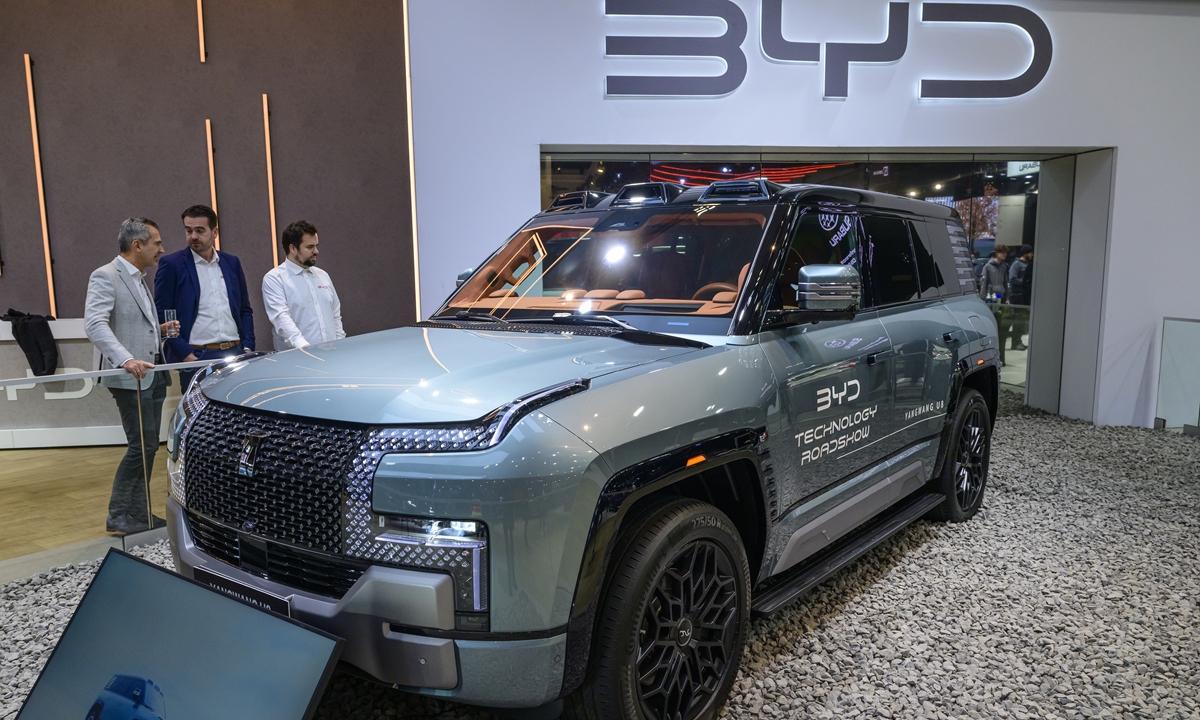
BYD YangWang U8 luxury plug-in hybrid SUV on display at the AutoSalon press preview in Brussels, Belgium, on January 09, 2026. Photo: VCG
Chinese automakers' latest progress in Europe - from BYD's localized production push in Hungary to Geely's EU-certified driver-assistance system - shows that industrial cooperation, rather than politically driven trade barriers, remains the more practical path for Europe to secure investment, jobs, technology options and consumer benefits, analysts said.
BYD will start assembling cars at its new plant in Hungary in the fourth quarter of this year, Reuters reported on Wednesday, citing BYD Executive Vice President Stella Li. Speaking at the company's UK headquarters in west London, Li said Hungary is now BYD's "number one priority," while the company has paused work on its previously announced plant in Turkey as it focuses on production in Europe.
The report said BYD's planned factory in Szeged, southern Hungary, will be the Chinese automaker's first passenger car plant in Europe. After Hungary, Li told Reuters, BYD's "second priority" will be finding a second production facility in Europe.
The Hungary project has drawn close attention because it marks a shift from exporting Chinese-made cars to Europe to building a local manufacturing base inside the EU, offering a concrete example of China-Europe industrial cooperation despite rising trade frictions, analysts said.
In another sign of deeper value-chain integration, Geely said its self-developed driver-assistance system had been certified for use in the EU, making it the first Chinese auxiliary driving system to meet such standards, Reuters reported on Tuesday.
The system has met the United Nations' UN R171 regulatory certification standards, clearing a key requirement for high-level Driver Control Assistance Systems to be used on European roads, according to the report. Geely expects to launch the first model equipped with the system in Europe in 2026.
The two developments came as China-made battery electric vehicles (BEVs) face additional EU countervailing duties and foreign automakers come under growing regulatory scrutiny in Europe.
The localization trend shows that corporate demand for China-Europe cooperation in the new-energy vehicle industrial chain remains strong, despite the EU's tougher rhetoric and restrictive measures toward China, Sun Yanhong, director of the European Economic Research Office at the Institute of European Studies, Chinese Academy of Social Sciences, told the Global Times on Wednesday.
"Some European nations are aware that their EV transition faces constraints from legacy auto structures, high costs, technology gaps and insufficient infrastructure, Sun said. "Cooperation with Chinese companies is not an optional choice, but a path that is difficult to bypass in its real-world transition," she noted.
BYD and Geely's latest moves are part of a broader localization push by Chinese automakers in Europe, spanning plant investment, production cooperation, technology certification and R&D expansion.
SAIC Motor is planning to build its first industrial project in Europe in Galicia, northwestern Spain, according to the regional government of Galicia on June 1. The project includes an industrial zone, which is expected to create 1,000 direct jobs, an official news release said.
An official with the Galician regional government described the project as "a major economic and industrial opportunity" for the region. If approved, construction is expected to begin in 2027, with the factory set to become operational in 2028, according to the release.
Chery is also expanding in Europe through a partnership with Spain's EBRO at a former Nissan plant in Barcelona, where it plans to start production by late 2026 or early 2027, Reuters reported in May. EBRO's target of producing up to 30,000 vehicles this year could include Chery models, according to the report.
Meanwhile, Germany's beleaguered carmakers are seeking solutions for underused factories, including possible tie-ups with Chinese manufacturers or weapons makers, as weak demand and a choppy transition to EVs have left many European auto plants operating well below capacity, AFP reported on Sunday.
Chinese automakers and supply-chain companies entering Europe are not merely selling products, Sun said. "Their greater value lies in helping Europe build a local NEV industrial ecosystem, from batteries to intelligent driving systems, worker training and upstream and downstream support."
EU protectionism is also becoming more visible in the auto sector. The bloc has already imposed anti-subsidy duties on China-made EVs, while debate over the proposed Industrial Accelerator Act has raised concerns about possible "Made in EU" requirements. Under reported draft provisions, an EV would need 70 percent of the cost of its non-battery parts to be manufactured within the bloc to qualify for EU subsidies, according to Reuters.
Europe should move beyond excessive protectionist thinking and provide a more open, stable and predictable environment for Chinese investment and cooperation, Sun said, adding that more security reviews and restrictive measures would only weaken corporate confidence and hurt Europe's own industrial upgrading.
Trade protectionism is against the laws of economics and serves no one's interests, a spokesperson for the Chinese Foreign Ministry said last week, calling on the European side to view China-EU trade ties in an objective and rational manner, and work with China to shorten the list of problems and make the pie of cooperation bigger for win-win results.
RELATED ARTICLES