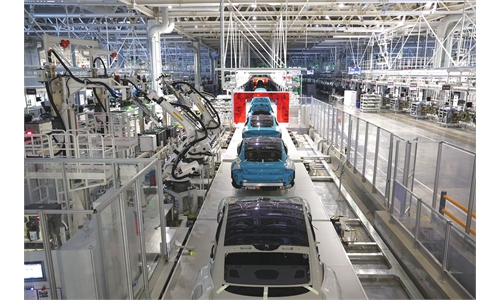
An ID.UNYX 08, the first model co-developed by Volkswagen Group China and XPENG, rolls off the production line in Hehei, East China's Anhui Province. Photo: Volkswagen Group
China-Europe economic relations are at a sensitive moment, but they are also full of possibility. We should not allow the current atmosphere of tension to obscure the larger truth: Europe and China have built one of the most important economic relationships in the world, creating growth, jobs, innovation and prosperity on both sides.
There is no doubt that the international environment has become more difficult. Protectionist tendencies are increasing and companies are often confronted with political uncertainty. That is precisely why Europe and China must preserve the spirit of dialogue.
Europe is advancing policy and trade tools that could significantly affect China-EU economic ties. From an industry perspective, the essential question is how these instruments are applied. Europe has the right to protect sensitive infrastructure and define clear standards for security, transparency and fair competition, but such measures must remain proportionate, predictable and open to dialogue.
If regulation becomes too broad or too political, it can create uncertainty for companies, especially in areas like ICT, digital infrastructure, energy systems, batteries, solar technologies and cloud-related services, where supply chains are deeply international and cooperation has often helped accelerate innovation.
Companies need clear rules on what is permitted, what standards apply and how trust can be built. If European and Chinese companies can work under transparent and reliable frameworks, cooperation can continue even in sensitive sectors. The alternative would be separate technological spaces, higher costs and slower innovation ― an outcome that would not serve Europe, China or the global economy.
My hope is that Europe will combine security awareness with openness: protect what is genuinely sensitive, but not lose the ability to cooperate where cooperation brings progress. Digital infrastructure, green technology and industrial modernization are too important to be governed by mistrust alone.
In fact, the benefits of EU-China cooperation have been profound. For European industry, China has been one of the great growth stories of the past decades, offering German and European companies in automotive, machinery, chemicals, electronics, logistics, energy and services a market of extraordinary scale and ambition. Many companies became more global, more competitive and more innovative because they were present in China.
China has also contributed to the efficiency and affordability of many global industrial value chains. European companies have benefited from China's manufacturing depth, infrastructure, logistics and increasingly advanced supplier networks, helping them serve global markets more effectively.
Consumers in Europe have also benefited directly, with many products becoming more affordable and more widely available through cooperation with China. In the green transition, Chinese solar panels, batteries and clean technologies have helped reduce costs and accelerate deployment.
The most important benefit today is inspiration through innovation. China's speed in electric mobility, digital services, renewable energy and industrial applications has become a powerful catalyst for Europe, reminding us that competitiveness is not inherited. Cooperation with China has brought not only products and markets, but also a sense of urgency, dynamism and future orientation.

Michael Schumann Photo: Courtesy Michael Schumann
Openness matters
That is why a more restrictive approach would carry real costs. If cooperation with Chinese partners becomes too restricted or politicized, Europe would risk weakening itself, as many European industries depend on open international partnerships, global supply chains and access to major growth markets.
The first consequence would be higher costs. From renewable energy to industrial components and consumer goods, Chinese production capacities have helped make technologies more affordable; if access becomes more difficult, European companies and consumers may pay the price.
It could also slow Europe's green transition. Europe has ambitious climate goals, but ambition alone does not build solar panels, batteries, electric vehicles or grid technologies at scale; cooperation with China can help Europe move faster and at lower cost.
There is also the risk of losing industrial momentum. European companies need to be present where innovation is happening. If they are less engaged in China, they may miss important technological and market developments.
The same is true beyond industry. Economic cooperation creates channels of understanding, bringing entrepreneurs, engineers, researchers, students and institutions together. Europe should remain confident enough to cooperate, and strong enough to do so on the basis of its own interests and values.
Looking ahead, the greatest value lies in the great transformation fields of our time: green energy, electric mobility, batteries, hydrogen, artificial intelligence, industrial automation, health technology, biotechnology, critical raw materials and modern infrastructure. These are areas where no single country or region can succeed alone.
China has scale, speed and powerful industrial ecosystems. Europe has strong engineering traditions, high standards, sophisticated regulation, excellent research and globally respected companies. Germany, in particular, has a special role because its economy is deeply industrial and export-oriented. When German and Chinese companies cooperate, they often do so with seriousness, technical depth and long-term commitment.
German-Chinese business cooperation can serve as a stabilizing force because it is practical, rooted in factories, laboratories, ports, supply chains, training programs, investments and personal relationships.
What we see today is a more mature phase of cooperation. German companies know that China is no longer only the "workbench of the world," but also a technology partner, an innovation laboratory and a demanding market shaped by highly sophisticated consumers. This creates new opportunities, especially where German quality, precision and engineering culture meet Chinese dynamism, scale and implementation strength.
The BWA has always believed that business cannot solve every political question, but it can keep doors open, create trust where politics has become tense, and show that cooperation is not naive, but necessary.
In this sense, Germany, Europe and China should use their economic relationship not only to manage present difficulties, but to shape a better future. The task is not to look back nostalgically at the old globalization, but to build a more balanced, more sustainable and more respectful form of cooperation for the years ahead.
Michael Schumann is Chairman of the Board of the German Federal Association for Economic Development and Foreign Trade (BWA) and Chairman of China Bridge, a Berlin-based public diplomacy platform advancing more constructive engagement with China in Europe. bizopinion@globaltimes.com.cn
RELATED ARTICLES