The power of win-win cooperation: What does the wave of China’s NEVs bring to the world?
What does the wave of China’s NEVs bring to the world?
By , Chen Zishuai, Ni Hao and Published: Mar 04, 2026 12:30 AM


Editor's Note:
The 2026 Chinese Spring Festival holidays had just ended when German manager Ronny Buechner, in an early morning, drove into the core area of Hefei Economic and Technological Development Zone in Hefei, East China's Anhui Province. The area is home to Volkswagen's smart manufacturing base in Anhui, as well as the research and development (R&D) headquarters in China, which is also Volkswagen's largest R&D center outside Germany.
The Volkswagen headquarters in Germany is located in Wolfsburg, a German name that literally translates into "Wolf Castle." As a result, the R&D center in Hefei is affectionately nicknamed the "Oriental Wolf Castle" within the industry. Inside the campus, production lines glow brightly around the clock. Chinese and German engineers are collaborating closely, intensely focused on debugging and iterating the next round of new-energy vehicle (NEV) technologies.
Buechner currently serves as the government affairs manager at Volkswagen (China) Investment Co Anhui Branch. He has been working in China for over a decade.
Nowadays, Buechner speaks fluent Chinese. After work, he occasionally joins colleagues for barbecue skewers on Hefei's European-style street; on weekends, he enjoys taking his family on trips around the Yangtze River Delta. His story is not merely an extension of industrial chains across Asia and Europe - it is a vivid, real-life illustration of Chinese and foreign automakers joining hands and achieving win-win outcomes amid the NEV wave.
The Global Times launches a series of special reports on China's evolution into an automobile powerhouse. This is the third installment.
Openness forges strength toward global win-win cooperation
The story of the "Oriental Wolf Castle" vividly illustrates that China's NEV development has been forged through open competition and strengthened through global collaboration. Competing on the same stage with international competitors has created a "catfish effect," awakening competitive awareness across the entire industry and accelerating rapid technological iteration within the domestic supply chain. Facts have proven that this strategy was both precise and resolute.
The story of win-win cooperation between China's NEVs and the world is entering an even more exciting chapter. Most notably, China is no longer merely the world's factory or consumer market; it has become a source of technological output and a core hub of innovation ecosystems. As Chinese automakers undertake the responsibility of "full-stack" systematic export, they bring not only high-quality products but also capital, technology and management expertise. In doing so, Chinese automakers are transforming from "guests" into partners in jointly building a shared "home," turning once-unfamiliar markets into a community with a shared future.
When all parties unite as one, their strength multiplies. In the era of tackling climate change and advancing green transformation, competition is by no means a zero-sum game. Only through cooperation can the pie grow larger; only through complementary advantages can a shared future be realized.
As China's circle of "partners" continues to expand, there is every reason to believe that this spirit of openness, inclusiveness, and mutual benefit will drive the global automotive industry toward a greener and smarter tomorrow.
Buechner joined Volkswagen Anhui in 2021 and has personally participated in building systems and capabilities "from the ground up." By the end of 2025, the Phase III project of Volkswagen Group China Technology Company (VCTC) was successfully put into operation in Hefei.
This R&D center holds direct product decision-making authority and release rights, marking the first time in Volkswagen's history that it can complete the full development process of a new vehicle platform - "from concept to market readiness" - outside of Germany. Since becoming operational, it has directly shortened the vehicle development cycle by approximately 30 percent and optimized development costs by about 40 percent.
From 'master-apprentice' to 'partners'
The rise of the "Hefei experience" has given Buechner a profound appreciation for the deeper logic behind Sino-foreign cooperation. He told the Global Times that against the backdrop of a rapidly-evolving Chinese NEV industry, the role of foreign automakers in China's NEV transformation has evolved from "one-way knowledge transfer" to "two-way co-creation."
Buechner's story is far from an isolated case - over the decades, automotive professionals from around the world have together crafted a rich industrial narrative of mutual learning, mutual inspiration, and win-win cooperation between Chinese and foreign carmakers. In this process, there has been a two-way dynamic marked by role reversals, fierce competition where each side demonstrates its strengths, and fruitful outcomes of mutually beneficial cooperation in the new era.
Sun Xiaohong, secretary-general of the automotive branch of the China Chamber of Commerce for Import and Export of Machinery and Electronic Products, told the Global Times that the continued advancement of global cooperation is the fundamental driving force behind China's rise to become the world's largest automobile producer, as well as its transformation from "following" to "keeping pace with" and even "leading" in the construction of NEV industrial systems, supply chain support, and independent R&D capabilities. Global cooperation also serves as the profound underlying impetus that accelerates the iterative progress of global NEV technologies, drives the green transformation process, and benefits hundreds of millions of households worldwide, Sun noted.
Chinese President Xi Jinping, also general secretary of the Communist Party of China Central Committee and chairman of the Central Military Commission, made an inspection to GAC Aion New Energy Automobile Co in April 2023. Stressing the significance of the real economy and self-reliance for a country as big as China, Xi said core technologies in key fields should be based on independent research and development while international cooperation is also welcomed.
China adheres to the dialectical unity of an open policy and independent innovation, which has laid a solid foundation for deep cooperation between Chinese and foreign automakers. Driven by China's rapid pace of innovation and iteration efficiency, a path of "reverse innovation" is quietly taking shape: an increasing number of multinational corporations have been relocating their decision-making hubs and innovation centers to China, partnering deeply with local software and technology companies, and integrating themselves into China's innovation industrial chain.
In this wave of multinational automakers "looking East," global technological cooperation has also been deepening continuously.
Thomas Ulbrich, Chief Technology Officer (CTO) of Volkswagen Group China, told the Global Times that Volkswagen is currently engaged in in-depth cooperation with a number of Chinese companies, including Horizon Robotics and XPeng, with a focus on intelligent connected vehicles and system-level chips. "China is at the forefront of global innovation, particularly driving progress in electric and intelligent vehicle technologies. The pace of change in China is faster than anywhere else," Ulbrich said.
Feng Shiming, executive director of Shanghai Minghua Youdao Business Consulting Co, told the Global Times that in the past, cooperation between Chinese and foreign automakers was more like a "master-apprentice relationship," where foreign companies provided technology and brand strength, while Chinese companies mainly served as production bases and sales channels.
"Today, the cooperation has evolved much closer to a true 'partner model.' For example, the German side can share its scientific development processes, automotive-grade standards, and rigorous testing methodologies, while the Chinese side can contribute advanced new energy technologies, ultra-low costs, and enormous supply chain advantages. The result naturally achieves 1+1 > 2. In some cases, the roles even reverse - the Chinese side becomes the teacher, and the foreign side the apprentice," Feng noted.
From 'in China, for China' to 'in China, for the world'
In March 2024, the moment Xiaomi's EV factory in Beijing's Yizhuang district was unveiled, it instantly captured global attention across the automotive industry. According to a report by the Wall Street Journal, Ford's CEO Jim Farley had a Xiaomi SU7 specially shipped to the US and spent six months driving it. He said that the maker of the sporty sedan, Xiaomi, was "the Apple of China."
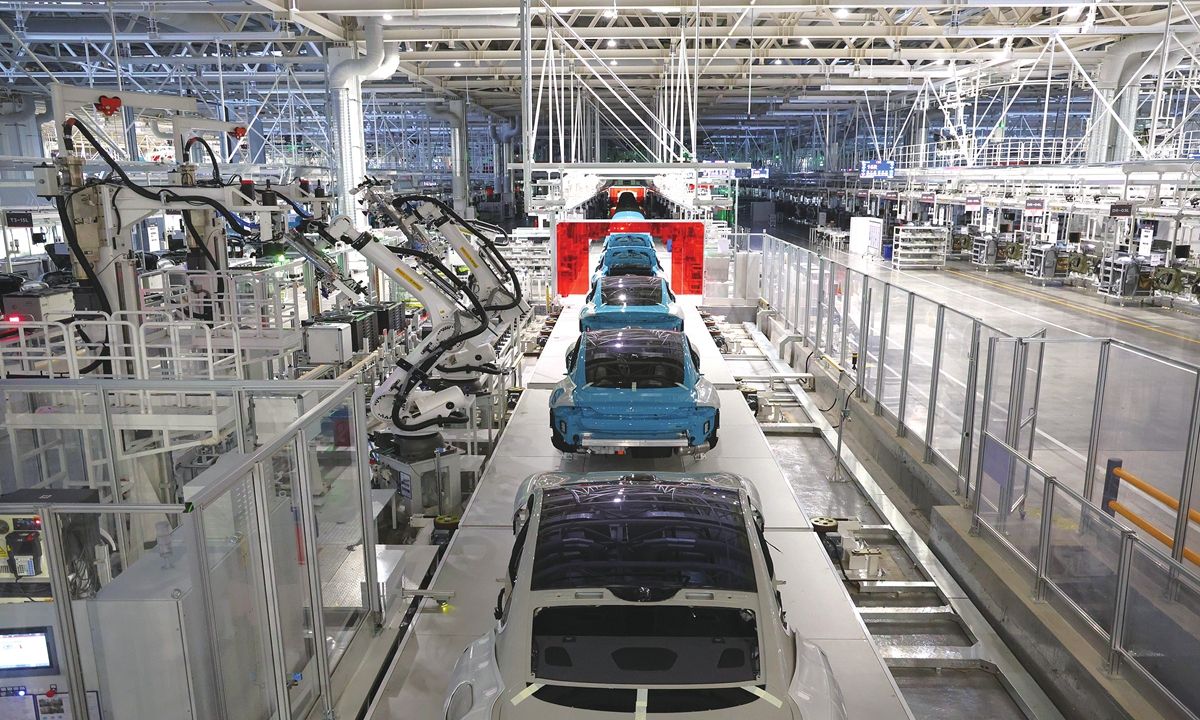
In Xiaomi's EV factory, a new vehicle rolls off the production line every 76 seconds. Over 700 robots work in coordinated harmony, achieving 100 percent automation across key processes including large-scale die-casting, stamping, body joining, body assembly, painting, and final assembly.
Ma Lan, general manager of the comprehensive management department at Xiaomi Yizhuang, told the Global Times that since production began, industry professionals from around the world - especially from traditional automotive powerhouses - have flocked to the factory to exchange ideas, "learn from the experience," and in many cases, sign orders or discuss cooperation deals on the spot.
Helga Zepp-LaRouche, founder of the Schiller Institute based in Germany, told the Global Times that German and other automotive investors in China are benefiting from the rapid pace of innovation in China's industrial chain. An increasing number of multinational automakers are beginning to view China as a key pivot for leveraging their global business, harnessing the technological advantages and manufacturing capabilities accumulated in China to feed back into and strengthen their worldwide markets.
According to media reports, the CEO of Mercedes-Benz Group Ola Källenius said that "China is a home away from home" and "a key player in global innovation." He added that the company is shifting strategy from "in China, for China" to "in China, for the world."
With regards to the feedback effect, Ulbrich said that the Volkswagen Group is continuously reassessing and strengthening China's role within its global system, not only to serve local demand, but also to explore how capabilities developed in China can support other regions.
From single-vehicle sales to 'full-stack' exports
In 2020, the General Office of the State Council issued the NEV Industry Development Plan (2021-2035). In Chapter 7 titled "deepening open cooperation," the document explicitly stated that China would promote the formation of an open, transparent, and inclusive international market environment for NEVs and build new platforms for international cooperation.
Six years on, this plan has been transformed into tangible industrial momentum and global influence.
Ma, who works at the Xiaomi factory, has a profound sense of this shift. Ma shared an interesting observation with the Global Times: nowadays, when senior executives from foreign automakers visit Xiaomi's EV factory, the questions they ask most frequently include the timeline for exporting vehicles, the composition of suppliers and the domestic-to-international ratio, domestic pricing, as well as how Xiaomi managed to achieve a full auto supply chain layout in just three years.
Many foreign visitors, after touring the factory, are particularly eager to know one thing: "When will Xiaomi cars come to my country?"
Data from the China Passenger Car Association showed that China's NEV exports surged to 3.43 million units in 2025, nearly doubling in just three years. What's even more noteworthy than the sheer numbers is the qualitative transformation: Chinese NEVs are advancing toward a comprehensive, "full-stack" systematic export model - one that localizes production and coordinates the industrial chain.
Feng told the Global Times that the 2.0 version of Chinese NEV companies' overseas expansion wave officially entered an acceleration phase in 2025. While NEV makers intensively launched factory projects in emerging markets such as Southeast Asia and Latin America, they simultaneously accelerated localized deep cultivation in mature markets like Europe, achieving a dual-track coordinated layout between emerging and mature markets.
According to a Reuters report, BYD's plant in Szeged, southern Hungary, will start mass production in 2026. István Joó, Government Commissioner and CEO of the Hungarian Investment Promotion Agency pointed out that BYD has chosen Hungary also as the location for its European headquarters and R&D center, helping the economy to move toward higher value-added activities.
In the upstream, BYD has arrived; in the midstream and downstream, CATL has come, joined with EVE Battery, Sunwoda, and other Chinese players. Piece by piece, the footprint of China's new energy giants has been steadily embedding itself into Hungary's industrial landscape.
Today, the historic auto manufacturing hub in Central and Eastern Europe along the Danube is riding the momentum of China's new energy industrial chain, ushering in a fresh wave of electrification-driven industrial upgrading.
According to industry insiders, Chinese companies' "full-stack" exports to Hungary not only fill gaps in the European supply chain and provide stable new energy battery supplies for major European automakers, but also bring advanced manufacturing processes, intelligent production expertise, and supply chain management models - which directly reshape Hungary's industrial foundation.
More than forty years ago, the first Sino-foreign joint venture automobile enterprise was set up in Beijing, opening the door to cooperation between China and foreign countries in the auto industry.
Forty years on, the NEV sector in China's expansive market continues to witness endless tales of mutual pursuit and win-win collaboration - from multinational giants evolving their strategy from "in China, for China" to "in China, for the world," to Chinese enterprises that are pursuing a comprehensive upgrade in their global expansion. All point to one profound truth: cooperation is the right way to tackle global challenges and drive industrial upgrade. Cooperation is the way forward.
Sun believed that China has steadfastly pursued opening-up, maintained low tariff levels, prioritized open cooperation, and minimized administrative interference - thus fostering a "stable, sustainable, and predictable" environment for Sino-foreign collaboration. As China enters the 15th Five-Year Plan period (2026-2030) and further expands high-level opening-up, it is providing countries around the world with a clear list of opportunities for shared development.
The 2026 Chinese Spring Festival holidays had just ended when German manager Ronny Buechner, in an early morning, drove into the core area of Hefei Economic and Technological Development Zone in Hefei, East China's Anhui Province. The area is home to Volkswagen's smart manufacturing base in Anhui, as well as the research and development (R&D) headquarters in China, which is also Volkswagen's largest R&D center outside Germany.
The Volkswagen headquarters in Germany is located in Wolfsburg, a German name that literally translates into "Wolf Castle." As a result, the R&D center in Hefei is affectionately nicknamed the "Oriental Wolf Castle" within the industry. Inside the campus, production lines glow brightly around the clock. Chinese and German engineers are collaborating closely, intensely focused on debugging and iterating the next round of new-energy vehicle (NEV) technologies.
Buechner currently serves as the government affairs manager at Volkswagen (China) Investment Co Anhui Branch. He has been working in China for over a decade.
Nowadays, Buechner speaks fluent Chinese. After work, he occasionally joins colleagues for barbecue skewers on Hefei's European-style street; on weekends, he enjoys taking his family on trips around the Yangtze River Delta. His story is not merely an extension of industrial chains across Asia and Europe - it is a vivid, real-life illustration of Chinese and foreign automakers joining hands and achieving win-win outcomes amid the NEV wave.
The Global Times launches a series of special reports on China's evolution into an automobile powerhouse. This is the third installment.
Openness forges strength toward global win-win cooperation
The story of the "Oriental Wolf Castle" vividly illustrates that China's NEV development has been forged through open competition and strengthened through global collaboration. Competing on the same stage with international competitors has created a "catfish effect," awakening competitive awareness across the entire industry and accelerating rapid technological iteration within the domestic supply chain. Facts have proven that this strategy was both precise and resolute.
The story of win-win cooperation between China's NEVs and the world is entering an even more exciting chapter. Most notably, China is no longer merely the world's factory or consumer market; it has become a source of technological output and a core hub of innovation ecosystems. As Chinese automakers undertake the responsibility of "full-stack" systematic export, they bring not only high-quality products but also capital, technology and management expertise. In doing so, Chinese automakers are transforming from "guests" into partners in jointly building a shared "home," turning once-unfamiliar markets into a community with a shared future.
When all parties unite as one, their strength multiplies. In the era of tackling climate change and advancing green transformation, competition is by no means a zero-sum game. Only through cooperation can the pie grow larger; only through complementary advantages can a shared future be realized.
As China's circle of "partners" continues to expand, there is every reason to believe that this spirit of openness, inclusiveness, and mutual benefit will drive the global automotive industry toward a greener and smarter tomorrow.
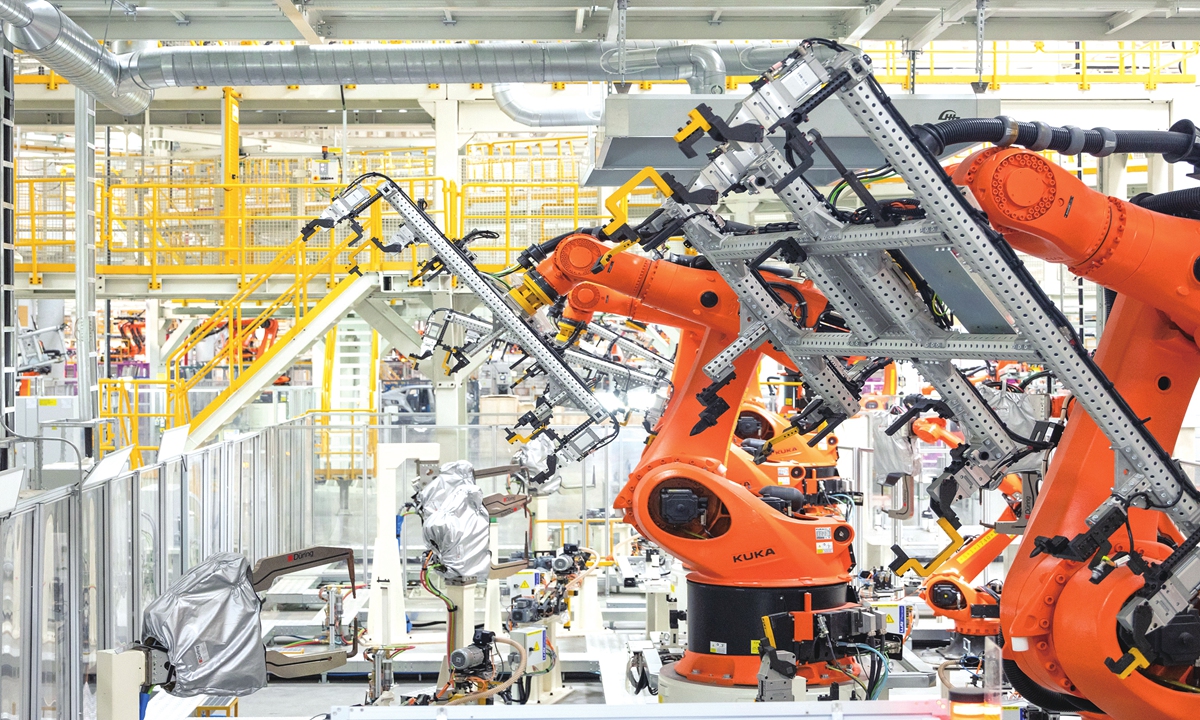
Industrial robot arms operate at the vehicle body workshop of Volkswagen's smart manufacturing base in Hefei, East China's Anhui Province. Photo: Courtesy of Volkswagen
Buechner joined Volkswagen Anhui in 2021 and has personally participated in building systems and capabilities "from the ground up." By the end of 2025, the Phase III project of Volkswagen Group China Technology Company (VCTC) was successfully put into operation in Hefei.
This R&D center holds direct product decision-making authority and release rights, marking the first time in Volkswagen's history that it can complete the full development process of a new vehicle platform - "from concept to market readiness" - outside of Germany. Since becoming operational, it has directly shortened the vehicle development cycle by approximately 30 percent and optimized development costs by about 40 percent.
From 'master-apprentice' to 'partners'
The rise of the "Hefei experience" has given Buechner a profound appreciation for the deeper logic behind Sino-foreign cooperation. He told the Global Times that against the backdrop of a rapidly-evolving Chinese NEV industry, the role of foreign automakers in China's NEV transformation has evolved from "one-way knowledge transfer" to "two-way co-creation."
Buechner's story is far from an isolated case - over the decades, automotive professionals from around the world have together crafted a rich industrial narrative of mutual learning, mutual inspiration, and win-win cooperation between Chinese and foreign carmakers. In this process, there has been a two-way dynamic marked by role reversals, fierce competition where each side demonstrates its strengths, and fruitful outcomes of mutually beneficial cooperation in the new era.
Sun Xiaohong, secretary-general of the automotive branch of the China Chamber of Commerce for Import and Export of Machinery and Electronic Products, told the Global Times that the continued advancement of global cooperation is the fundamental driving force behind China's rise to become the world's largest automobile producer, as well as its transformation from "following" to "keeping pace with" and even "leading" in the construction of NEV industrial systems, supply chain support, and independent R&D capabilities. Global cooperation also serves as the profound underlying impetus that accelerates the iterative progress of global NEV technologies, drives the green transformation process, and benefits hundreds of millions of households worldwide, Sun noted.
Chinese President Xi Jinping, also general secretary of the Communist Party of China Central Committee and chairman of the Central Military Commission, made an inspection to GAC Aion New Energy Automobile Co in April 2023. Stressing the significance of the real economy and self-reliance for a country as big as China, Xi said core technologies in key fields should be based on independent research and development while international cooperation is also welcomed.
China adheres to the dialectical unity of an open policy and independent innovation, which has laid a solid foundation for deep cooperation between Chinese and foreign automakers. Driven by China's rapid pace of innovation and iteration efficiency, a path of "reverse innovation" is quietly taking shape: an increasing number of multinational corporations have been relocating their decision-making hubs and innovation centers to China, partnering deeply with local software and technology companies, and integrating themselves into China's innovation industrial chain.
In this wave of multinational automakers "looking East," global technological cooperation has also been deepening continuously.
Thomas Ulbrich, Chief Technology Officer (CTO) of Volkswagen Group China, told the Global Times that Volkswagen is currently engaged in in-depth cooperation with a number of Chinese companies, including Horizon Robotics and XPeng, with a focus on intelligent connected vehicles and system-level chips. "China is at the forefront of global innovation, particularly driving progress in electric and intelligent vehicle technologies. The pace of change in China is faster than anywhere else," Ulbrich said.
Feng Shiming, executive director of Shanghai Minghua Youdao Business Consulting Co, told the Global Times that in the past, cooperation between Chinese and foreign automakers was more like a "master-apprentice relationship," where foreign companies provided technology and brand strength, while Chinese companies mainly served as production bases and sales channels.
"Today, the cooperation has evolved much closer to a true 'partner model.' For example, the German side can share its scientific development processes, automotive-grade standards, and rigorous testing methodologies, while the Chinese side can contribute advanced new energy technologies, ultra-low costs, and enormous supply chain advantages. The result naturally achieves 1+1 > 2. In some cases, the roles even reverse - the Chinese side becomes the teacher, and the foreign side the apprentice," Feng noted.
From 'in China, for China' to 'in China, for the world'
In March 2024, the moment Xiaomi's EV factory in Beijing's Yizhuang district was unveiled, it instantly captured global attention across the automotive industry. According to a report by the Wall Street Journal, Ford's CEO Jim Farley had a Xiaomi SU7 specially shipped to the US and spent six months driving it. He said that the maker of the sporty sedan, Xiaomi, was "the Apple of China."
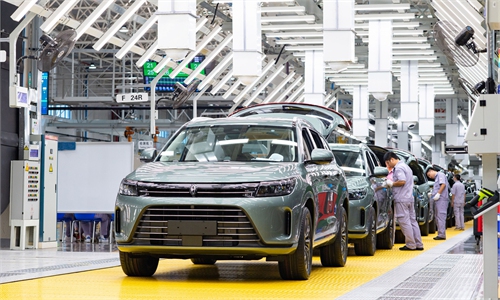
In Xiaomi's EV factory, a new vehicle rolls off the production line every 76 seconds. Over 700 robots work in coordinated harmony, achieving 100 percent automation across key processes including large-scale die-casting, stamping, body joining, body assembly, painting, and final assembly.
Ma Lan, general manager of the comprehensive management department at Xiaomi Yizhuang, told the Global Times that since production began, industry professionals from around the world - especially from traditional automotive powerhouses - have flocked to the factory to exchange ideas, "learn from the experience," and in many cases, sign orders or discuss cooperation deals on the spot.
Vehicles move through the automated assembly process at Xiaomi's final assembly workshop. Photo: Courtesy of Xiaomi
Feng noted that the Chinese NEV market has become a globally recognized battlefield characterized by the most intense competition, the most diverse consumer demands, and the fastest pace of technological iteration. It is precisely because of this that some foreign automakers have turned their attention to China, proactively visiting with a genuine mindset of "learning." He further added that this market is gradually evolving into the "frontier testing ground" for the global automotive industry's electrification and intelligent transformation, and even emerging as an innovation hub that defines the future direction of mobility.Helga Zepp-LaRouche, founder of the Schiller Institute based in Germany, told the Global Times that German and other automotive investors in China are benefiting from the rapid pace of innovation in China's industrial chain. An increasing number of multinational automakers are beginning to view China as a key pivot for leveraging their global business, harnessing the technological advantages and manufacturing capabilities accumulated in China to feed back into and strengthen their worldwide markets.
According to media reports, the CEO of Mercedes-Benz Group Ola Källenius said that "China is a home away from home" and "a key player in global innovation." He added that the company is shifting strategy from "in China, for China" to "in China, for the world."
With regards to the feedback effect, Ulbrich said that the Volkswagen Group is continuously reassessing and strengthening China's role within its global system, not only to serve local demand, but also to explore how capabilities developed in China can support other regions.
From single-vehicle sales to 'full-stack' exports
In 2020, the General Office of the State Council issued the NEV Industry Development Plan (2021-2035). In Chapter 7 titled "deepening open cooperation," the document explicitly stated that China would promote the formation of an open, transparent, and inclusive international market environment for NEVs and build new platforms for international cooperation.
Six years on, this plan has been transformed into tangible industrial momentum and global influence.
Ma, who works at the Xiaomi factory, has a profound sense of this shift. Ma shared an interesting observation with the Global Times: nowadays, when senior executives from foreign automakers visit Xiaomi's EV factory, the questions they ask most frequently include the timeline for exporting vehicles, the composition of suppliers and the domestic-to-international ratio, domestic pricing, as well as how Xiaomi managed to achieve a full auto supply chain layout in just three years.
Many foreign visitors, after touring the factory, are particularly eager to know one thing: "When will Xiaomi cars come to my country?"
Data from the China Passenger Car Association showed that China's NEV exports surged to 3.43 million units in 2025, nearly doubling in just three years. What's even more noteworthy than the sheer numbers is the qualitative transformation: Chinese NEVs are advancing toward a comprehensive, "full-stack" systematic export model - one that localizes production and coordinates the industrial chain.
Feng told the Global Times that the 2.0 version of Chinese NEV companies' overseas expansion wave officially entered an acceleration phase in 2025. While NEV makers intensively launched factory projects in emerging markets such as Southeast Asia and Latin America, they simultaneously accelerated localized deep cultivation in mature markets like Europe, achieving a dual-track coordinated layout between emerging and mature markets.
According to a Reuters report, BYD's plant in Szeged, southern Hungary, will start mass production in 2026. István Joó, Government Commissioner and CEO of the Hungarian Investment Promotion Agency pointed out that BYD has chosen Hungary also as the location for its European headquarters and R&D center, helping the economy to move toward higher value-added activities.
In the upstream, BYD has arrived; in the midstream and downstream, CATL has come, joined with EVE Battery, Sunwoda, and other Chinese players. Piece by piece, the footprint of China's new energy giants has been steadily embedding itself into Hungary's industrial landscape.
Today, the historic auto manufacturing hub in Central and Eastern Europe along the Danube is riding the momentum of China's new energy industrial chain, ushering in a fresh wave of electrification-driven industrial upgrading.
According to industry insiders, Chinese companies' "full-stack" exports to Hungary not only fill gaps in the European supply chain and provide stable new energy battery supplies for major European automakers, but also bring advanced manufacturing processes, intelligent production expertise, and supply chain management models - which directly reshape Hungary's industrial foundation.
More than forty years ago, the first Sino-foreign joint venture automobile enterprise was set up in Beijing, opening the door to cooperation between China and foreign countries in the auto industry.
Forty years on, the NEV sector in China's expansive market continues to witness endless tales of mutual pursuit and win-win collaboration - from multinational giants evolving their strategy from "in China, for China" to "in China, for the world," to Chinese enterprises that are pursuing a comprehensive upgrade in their global expansion. All point to one profound truth: cooperation is the right way to tackle global challenges and drive industrial upgrade. Cooperation is the way forward.
Sun believed that China has steadfastly pursued opening-up, maintained low tariff levels, prioritized open cooperation, and minimized administrative interference - thus fostering a "stable, sustainable, and predictable" environment for Sino-foreign collaboration. As China enters the 15th Five-Year Plan period (2026-2030) and further expands high-level opening-up, it is providing countries around the world with a clear list of opportunities for shared development.
RELATED ARTICLES