Business leaders hope China-US talks to serve as ‘new starting point’ of mutual co-op, not just ‘meet-and-greet’ affair
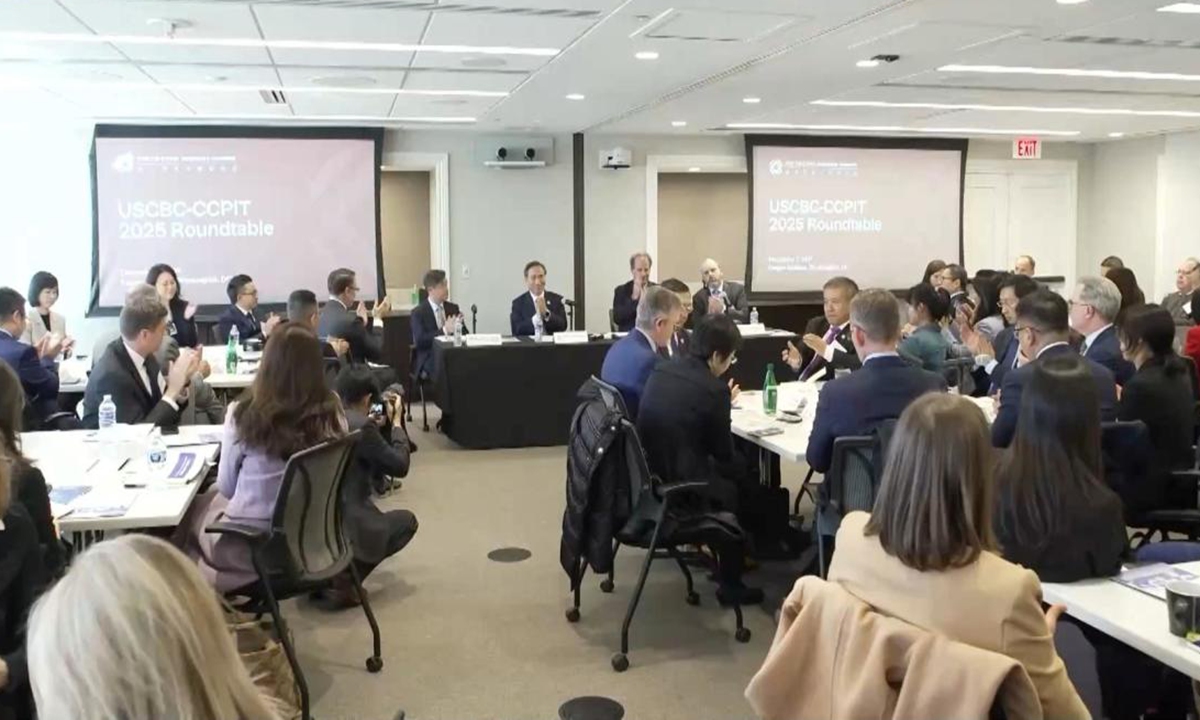
At the invitation of the US Chamber of Commerce, the China Council for the Promotion of International Trade organizes a delegation of Chinese entrepreneurs to visit Washington, San Francisco and Oakland from December 2 to 6, 2025. Photo: CCTV News
Although the visit of Chinese business delegation to the US has concluded, the atmosphere of engagement lingered. Several business leaders told the Global Times that the US side demonstrated clear goodwill for cooperation during the exchanges, with both sides engaging proactively and conducting in-depth discussions.
Some of them said they did not want the meeting to be merely a "meet-and-greet affair," but hoped it would serve as a starting point for cooperation between the Chinese and US business communities.
At the invitation of the US Chamber of Commerce, the China Council for the Promotion of International Trade (CCPIT) organized a delegation of Chinese entrepreneurs to visit Washington, San Francisco and Oakland from December 2 to 6, according to the CCPIT's official website.
The visit sought to rally business communities of both countries to actively implement the key consensus reached by the two heads of state at their meeting in Busan and during their November 24 phone call, while further deepening economic and trade exchanges and cooperation. The delegation included 25 companies drawn from China's key industrial sectors.
Ian Zhou, director and founding partner of Real Value Capital, a US-based investment firm, told the Global Times that he still remembers the scene of his first meeting with US business representatives in Washington. "There was a strong sense of cooperation in the room that went beyond an ordinary business meeting," he recalled. "Everyone was excited, and many viewed it as a strong signal of deeper economic and trade cooperation between the two sides."
Zhou Xin, general manager of Dalian Jinma Weighing Apparatus Co, shared a similar view. He noticed the care shown by the US side in the reception arrangements, including seating participants by industry and even placing representatives from potentially compatible companies next to one another.
"Both sides were genuinely curious about each other, constantly exchanging information. The atmosphere was extremely lively," he told the Global Times.
What impressed Zhou Xin most was a small gesture by Sean Stein, president of the US-China Business Council. When Stein learned that Zhou Xin was from Liaoning Province, he greeted him warmly in fluent Chinese as "laoxiang," or fellow townsman in Chinese, instantly narrowing the distance between them.
According to their talks, Stein has lived and worked in China for many years and has a deep understanding of the country's language and culture, with extended experience in Northeast China's Liaoning Province.
"That small detail says a lot," Zhou Xin said. "It shows that the business environment is different from the political one. Business is ultimately about collaboration, cooperation and building partnerships."
During their visit, the CCPIT delegation, in cooperation with the Oakland city government, the US Chamber of Commerce, the US-China Business Council, the US Semiconductor Industry Association and the US Soybean Export Council, among others, jointly hosted multiple China-US business matchmaking events.
The delegation held discussions with more than 170 US companies and institutions. The CCPIT noted that the series of intensive and efficient interactions helped build direct channels of dialogue between the business communities of the two countries.
The warm atmosphere reflects an urgent desire to restart cooperation, the Global Times has found. Ian Zhou said that as high-level "ice-breaking" signals have been released, the widespread anxiety caused by earlier trade frictions is gradually fading. "People were quite nervous before," he said. "Now they feel more confident about planning additional investment and expansion."
During the visit, tangible outcomes from pragmatic cooperation continued to emerge, a representative from the China Chamber of International Commerce (CCOIC) told the Global Times. The trip delivered dual effects by enabling cross-sector exchanges while facilitating in-depth engagement within specific industries, the representative said.
At a roundtable hosted by the US-China Business Council, COFCO Oils and Oilseeds, a major Chinese state-owned agribusiness company, established a direct communication channel with senior executives of Corteva Agriscience, a US-based agricultural technology firm. The move broke away from the previous practice of relaying exchanges through representative offices in China and significantly improved communication efficiency, the representative noted.
Through high-level and multi-dimensional engagement with government bodies and industry associations, Optimize Intergration Group, a Chinese company specializing in cross-border cold-chain logistics and food supply chains, made notable progress in advancing the pace and effectiveness of its cross-border cold-chain cooperation in the North American market.
A Chinese expert also noted that the exchange underscored the strong willingness for cooperation between the two sides and the vast opportunities that still exist in China-US economic and trade engagement.
As the world's two largest economies, China and the United States have vast potential for cooperation, deeper collaboration between their business communities aligns with economic realities and serves their respective interests, Song Guoyou, a deputy director of the Center for American Studies at Fudan University, told the Global Times. "With a constructive political and diplomatic environment, businesses on both sides are willing to expand cooperation and are well positioned to create greater value through such engagement."
Many participating companies clearly expressed expectations for establishing long-term mechanisms, proposing that a list be drawn up for cooperation intentions or memorandums reached during the visit, with regular follow-up and implementation to ensure sustained progress, a representative from CCOIC told the Global Times.
The American Chamber of Commerce in China released a white paper this year, saying that American companies continue to see opportunities in China, particularly in strategic sectors aligned with long-term growth. The White Paper reports that 49 percent of AmCham China members still rank China among their top three global investment destinations
RELATED ARTICLES