Multiple foreign automakers seek co-op with China’s industrial chains amid nation’s rising NEV competitiveness
By Ma Jingjing and Published: Feb 04, 2026 09:23 PM

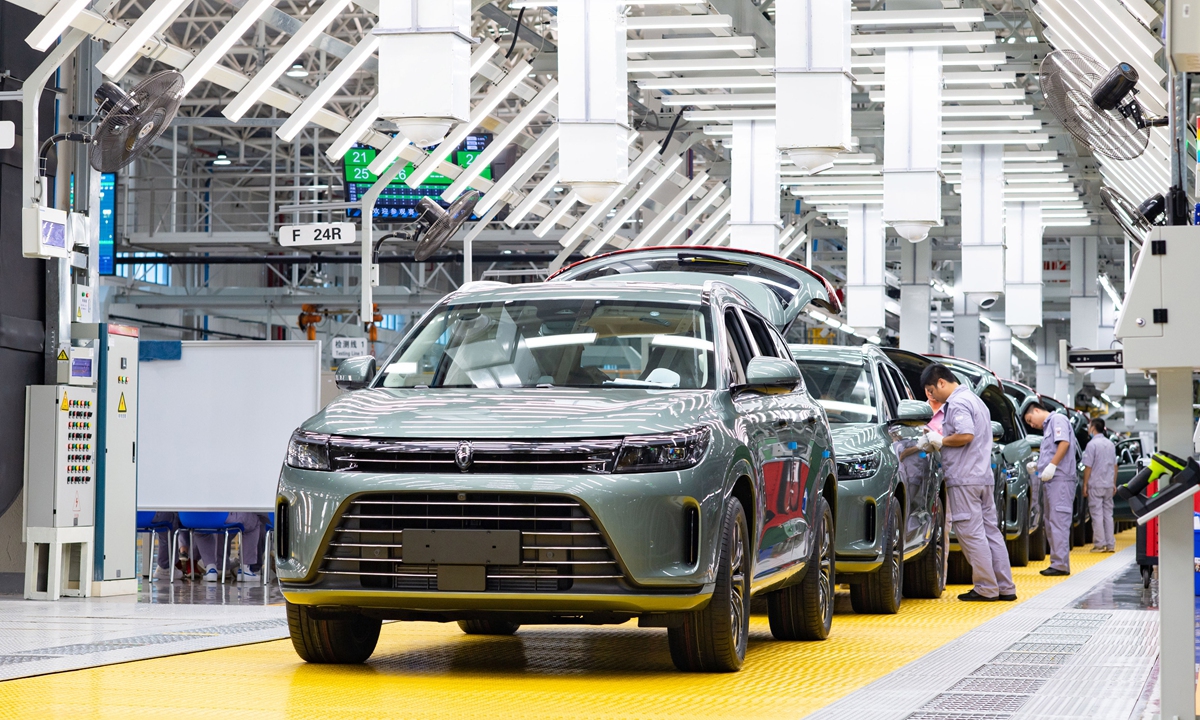
An NEV manufacturing line in Southwest China's Chongqing Municipality Photo: VCG
Foreign automakers have increasingly sought cooperation with China's auto industrial chains since the beginning of 2026. Industry analysts said that this trend underscores the nation's strong and complete new-energy vehicle (NEV) industrial and supply chains, and multi-layered international cooperation will continue to contribute to the transformation and upgrading of the global automotive industry.
French multinational automaker Renault will build a new small electric vehicle (EV) engine in France using parts supplied by Shanghai Edrive Co, an automobile parts manufacturer in China, Reuters reported on Wednesday, citing a Renault spokesperson.
Renault will assemble the entry-level engine at its factory in Cleon in northern France, setting up a new production line from early 2027 to make up to 120,000 engines per year, the report said, citing a company statement. It said that the French automaker aims to reduce costs and protect margins in a sluggish European market through the partnership.
US automaker Ford is reportedly in discussions with Chinese automaker Geely about a potential partnership, according to a separate Reuters report on Wednesday, citing people familiar with the matter.
Cui Dongshu, secretary-general of the China Passenger Car Association, told the Global Times on Wednesday that these foreign automakers' moves reflect the international competitiveness of China's automobile industrial and supply chains.
The Chinese branch of Germany's Volkswagen Group recently said that it had started on-schedule production of the first vehicle built on its China Electronic Architecture, the group's first zonal electronic architecture, according to a press release sent to the Global Times.
With 18 months from concept to production, the project marks the fastest timeline Volkswagen Group has ever achieved for an all-new electronic architecture, it said. Ralf Brandstätter, chairman and CEO of Volkswagen Group China, said: "This is how we scale Intelligent Connected Vehicles in China - combining local speed with Volkswagen DNA."
"China maintained the top global position in terms of production and sales of NEVs for the 11th straight year in 2025, featuring the world's largest and most complete industrial chain. Thanks to scale effect, the cost of components is relatively cheap compared with those produced outside the country," Zhang Xiang, secretary-general of the International Intelligent Vehicle Engineering Association, told the Global Times on Wednesday.
Although companies in Western markets such as the US and the EU also manufacture NEVs, they import a lot of components from countries such as China, Zhang said, noting that China's development of NEVs boasts advantages such as technological level and cost effectiveness. Zhang said that China's NEVs and their related technologies, experience and development models contribute to the global green transition and the improvement of global industrial and supply chains.
The international cooperation of China's NEV sector has recently made solid progress. Canada decided that it will grant China an annual quota of 49,000 EVs. Vehicles within this quota will enjoy the most-favored-nation tariff rate of 6.1 percent and be exempted from the 100 percent additional tariff, with the quota volume set to increase year by year at a certain ratio, according to the Canadian government website.
Moreover, China and the EU have agreed on the necessity of providing general guidance on price undertakings for Chinese companies exporting battery EV passenger cars to the EU, according to China's Ministry of Commerce on January 12.
On January 29, the Liverpool City Council announced that Chinese carmaker Chery Commercial Vehicle had selected Liverpool as the site for its first European headquarters, which the council said was a milestone for the city's advanced manufacturing sector, according to the council's website.
In areas such as EV supply chains, China's manufacturing scale and speed intersect with the UK's strengths in research, regulation, project finance, and systems integration, John Quelch, executive vice chancellor and distinguished professor of social science at Duke Kunshan University, told the Global Times in a written interview.
"The UK may gradually follow Canada's approach in opening its market to Chinese electric vehicles, particularly if this can be linked to Chinese manufacturing investment within the UK itself. Such an approach would help balance industrial policy objectives with consumer interests and climate goals," Quelch said.
RELATED ARTICLES