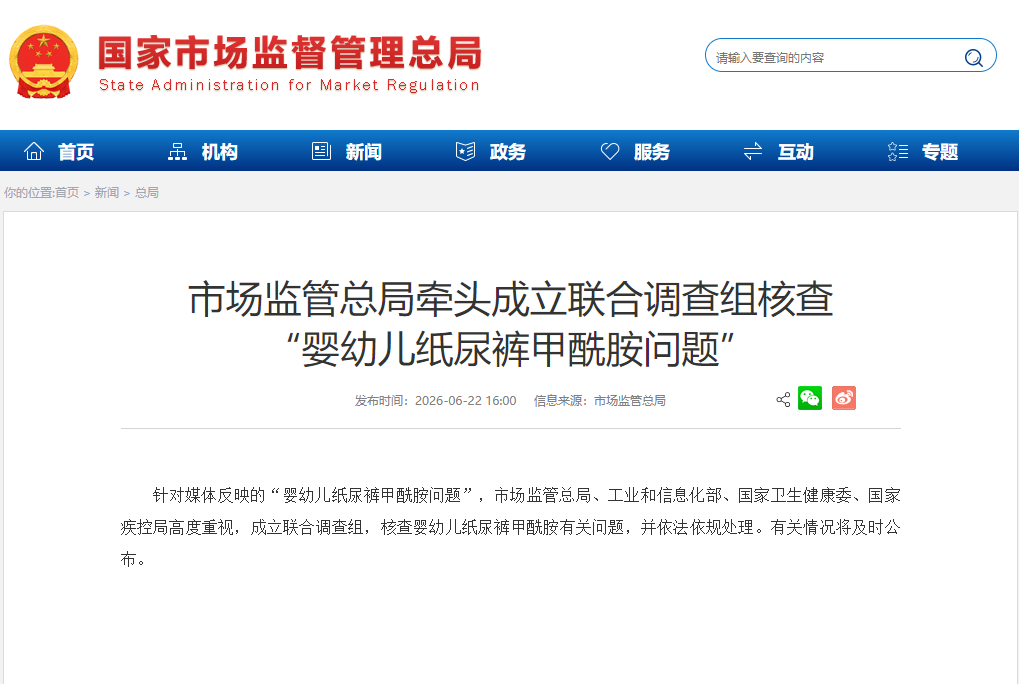
Photo: Screenshot from the State Administration for Market Regulation's official website
Multiple Chinese departments, including the State Administration for Market Regulation (SAMR), the Ministry of Industry and Information Technology, the National Health Commission, and the National Disease Control and Prevention Administration, have formed a joint investigation team to look into matters concerning the alleged presence of formamide in infant diapers, vowing to handle the matter in accordance with laws and regulations, according to a post on the SAMR's official website on Monday.
Relevant updates will be announced in due course, said the post.
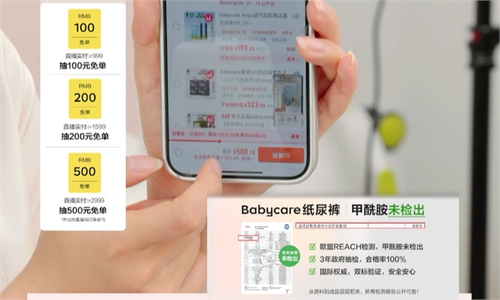
The moves came after days of intense public concern triggered by an investigative report published on June 18 by the Beijing-based Economic Information Daily, a newspaper under the Xinhua News Agency, which said that certain diaper products made by Huggies, Bibabebe and Babycare had tested "positive" for formamide, a toxic substance.
Over the weekend, the controversy escalated among consumers, especially parents, after Wang Wenzhi, the reporter behind an investigative report that set off a national whirlwind of concern, issued an open letter denying he was "making up news." Two of the embroiled brands, Babycare and Huggies, called for the authorities to get involved and announce an official testing result as soon as possible.
On Sunday evening, Wang posted an open letter on his Sina Weibo account, explaining the background of his investigative report, which he said was "backed up by laboratory testing by the Shandong Public Health Clinical Center." Wang denied online claims that his "formamide-containing diaper" report was fabricated in order to promote "related equipment" for personal gain.
In the letter, Wang said that public attention since the story broke had drifted away from the "central issue" — "the source of the formamide found in children's bodies" — and instead focused on whether his report contained flaws or whether he was chasing online traffic.
In his letter, Wang asked the relevant authorities to set up an investigation team to conduct a full-chain review of all the facts of the incident he has exposed. "I firmly believe a national-level investigation will clarify all the facts, eliminate potential risks, and provide millions of concerned parents with a definitive answer," Wang wrote.
Early on Monday morning, Babycare issued a statement again asking relevant government departments to release official diaper-testing results as soon as possible. The company also called on the authorities to conduct a comprehensive investigation into "where the formamide in children's bodies came from," saying the truth behind reports of excessive formamide levels found in children's blood samples from certain regions of the country should be fully probed and clarified.
Huggies posted a statement on its Weibo account on Sunday, saying that it had completed a review of its full product line and raw materials, with all results "meeting standards." The company said that it had requested independent sampling by the regulators.
In the statement, Kimberly-Clark China, Huggies' parent company, asked relevant authorities and authoritative bodies to form a joint investigation team to examine key issues in the case, including testing standards, methods and samples, and said that it hoped that relevant government inspection agencies could publish their results promptly.
The June 18 report said that some consumers had complained that their babies developed recurring diaper rashes and even skin lesions after using certain brands of diapers, with symptoms improving after the products were discontinued.
To verify the complaints, the reporter, Wang, commissioned a professional testing agency to sample those diaper brands on the market. The report said that toxic formamide was detected in products made by brands including Huggies, Bibabebe and Babycare. A medical testing institution also reportedly found the substance in some infants' blood and urine samples, according to Wang's report.
On June 18, the three diaper brands each issued initial responses. Bibabebe said that it was arranging third-party retesting and reviewing its production process, raw materials and warehousing, while asking the Economic Information Daily for details on the sample source, testing environment and testing process cited in the report. Babycare and Huggies, in their announcements on the same day, denied their products had any safety problems.
On June 21, the three companies each released third-party test results, saying that "no formamide had been detected" in their products.
On June 19, the China Technical Association of Paper Industry questioned the testing process mentioned in Wang's investigative report, saying that it did not disclose key information such as detected values, testing institutions, standards, equipment and methods.
The dispute over the evidence chain in the report intensified on June 19. Other domestic media reports alleged that the clinical institution referenced in the Economic Information Daily article denied conducting research that linked infant blood and urine test results to diaper products.
Wang released some audio material, saying the "denial statement by the expert" who was quoted in his original report was done "under pressure."
Some local market regulators have already stepped in. Authorities in Hangzhou, Huzhou, Shanghai, Nanjing and Tianjin have conducted inspections or sampling checks involving diapers made by the three brands, covering company sites, production links, raw materials and products on sale, according to media reports. No official test results had been released as of Monday.
RELATED ARTICLES