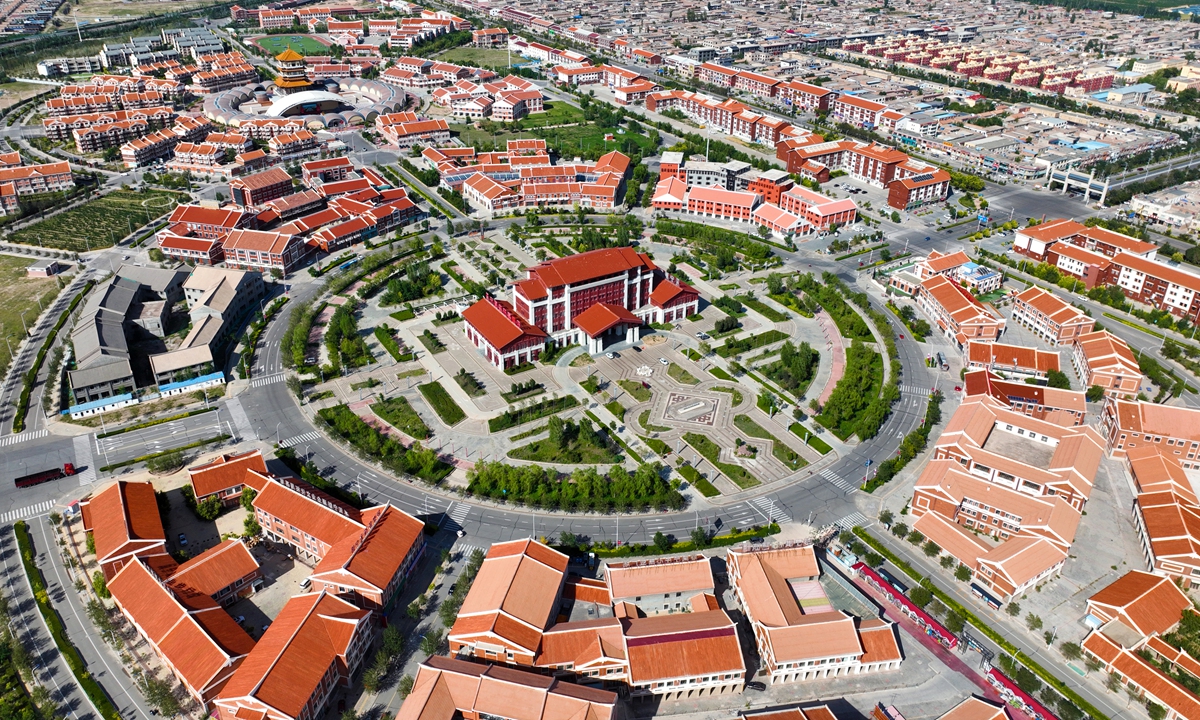
An aerial view of Minning township in Yinchuan, Northwest China's Ningxia Hui Autonomous Region Photos on this page: VCG
A sound mechanism must stand the test of both time and results. Spanning more than 4,000 kilometers, the partnership between East China's Fujian Province and Northwest China's Ningxia Hui Autonomous Region has now lasted for three decades.
"Grandma, there's no sand here. Why is this place still called the 'golden beach'?"
"Let's go to the town museum and find the answer."
Not long ago, 81-year-old Lin Yuechan, former director of Fujian's poverty alleviation office, returned to Minning township in Yinchuan, Ningxia, with her granddaughter.
Despite having visited more than 40 times, Lin still finds herself deeply moved. In 1997, when the Fujian-Ningxia poverty alleviation program helped establish Minning Village, Lin, then executive deputy director of Fujian's Minning office, turned the first shovel of earth at the groundbreaking ceremony.
Back then, Minning Village was little more than a barren stretch of desert. Sandstorms were constant. Schools lacked blackboards, forcing students to write on the ground with sticks. The first settlers dug caves into the earth for shelter.
Yet, Chinese President Xi Jinping, then deputy secretary of the Communist Party of China Fujian Provincial Committee, envisioned a different future in a congratulatory message: "Minning Village is now a sandy land, but it will be a fertile land in the future."
Thirty years later, that prediction has become reality. What was once a desolate frontier settlement has grown into a thriving town of 66,000 residents, with annual per capita income exceeding 20,000 yuan ($2954).
Over the past three decades, Fujian has coordinated 7.68 billion yuan in assistance funds for Ningxia. More than 160 demonstration villages, 78 resettlement communities and 423 relocation sites have been established through the cooperation, helping relocate more than 1.23 million people from the impoverished Xihaigu region. Across Ningxia, "golden beaches" have emerged one after another, contributing to lifting all 803,000 rural poor residents in the region out of poverty by 2020.
From poverty alleviation to rural revitalization, from digging wells and building terraces to fostering modern industries, from organized migration to cultural integration, the Fujian-Ningxia cooperation has continued to demonstrate its value.
Entering a new stage of development, the partnership is now focusing on higher-quality growth. In 2025 alone, 143 Fujian enterprises established operations in Ningxia, including firms in emerging sectors such as green computing and advanced equipment manufacturing.
At 30, the partnership remains vigorous. The story of cooperation between the mountains and the sea is still being written.
Strategic vision, industrial integration
On the winding road to Jianxin Village in Tongxin County, Ningxia, a sudden mountain rainstorm swept across the landscape.
"In the old days, whenever it rained, we would rush outside with every container we could find to collect water," recalled villager Ding Guizhi with a smile as she boiled tap water and prepared a pot of traditional Eight Treasures Tea.
Nearly three decades ago, Ding's family depended on bitter-tasting water stored in underground cisterns. Even a cup of fragrant tea was considered a luxury.
In 1996, China launched a "pairing-up" initiative, linking Fujian with Ningxia for targeted poverty alleviation.
Gradually, Jianxin Village gained access to reliable water supplies. With water came opportunities for development. Today, the village raises more than 1,800 head of beef cattle. Ding's family now keeps 15 cattle and earns more than 60,000 yuan annually. Seven members of the family have attended university.
"Life has really improved," she said.
Over the past 30 years, more than 4,100 projects have been implemented under the Fujian-Ningxia cooperation program, benefiting 2.44 million people.
The Fujian-Ningxia cooperation is not only a story of perseverance but also one of targeted policymaking.
The principles of "complementary strengths, mutual benefit, long-term cooperation and common development" have remained the cornerstone of the program.
At the foot of the Helan Mountains, the ponds of an ecological aquaculture base shimmer under the sun. Shrimp, mud crabs and large yellow croaker swim beneath the surface.
Few would expect fresh seafood on a northwestern Chinese dinner table to come from landlocked Ningxia.
"No one believed it could be done," said Qiang Zuozhou, head of the aquaculture base. "But technology eventually proved everyone wrong."
Fisheries experts from Ningde in Fujian spent years solving challenges related to water quality, breeding and environmental adaptation. After more than two decades of experimentation, raising marine fish inland became a reality.
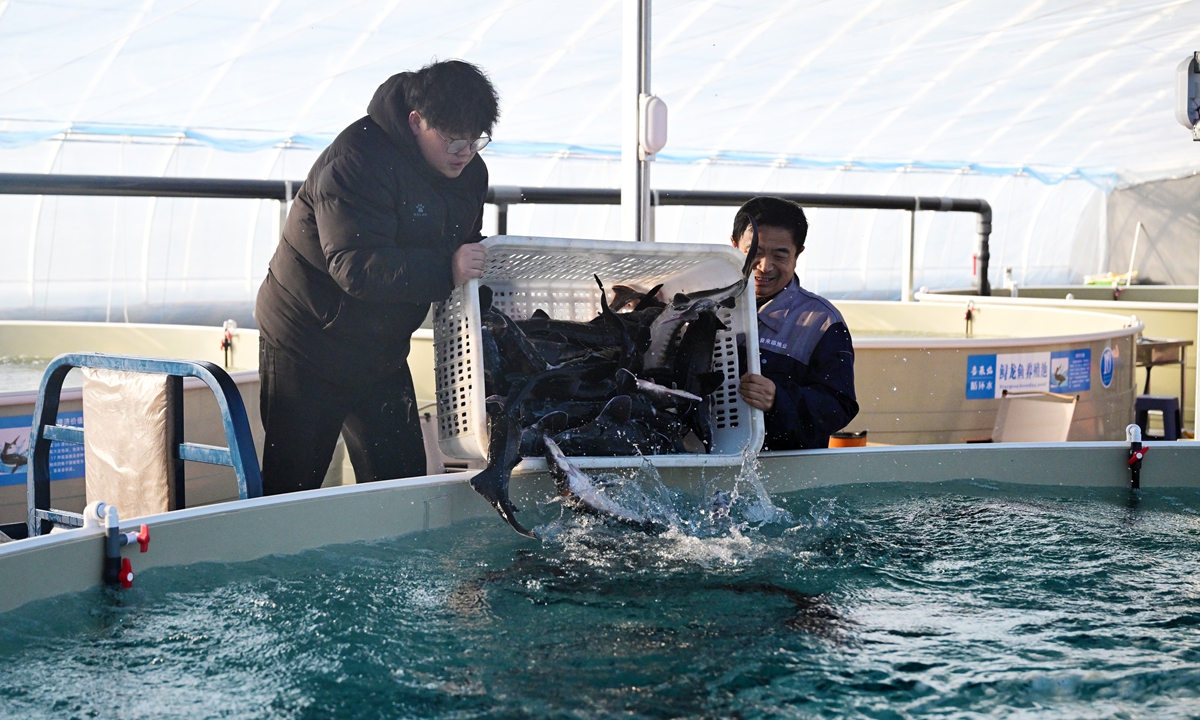
Fish farmers in Minning township prepare sturgeon for sale on February 7, 2026.
Today, Ningxia produces more than 2,000 tons of seafood annually and has become the most diverse and productive fishery region among China's five northwestern provincial-level regions.
Guided by the principles of innovation, coordination, green development, openness and shared benefits, Fujian-Ningxia cooperation continues to broaden its horizons.
A jointly built green electricity and digital intelligence center in Minning township is expected to begin operation soon. It has already reached cooperation intentions with more than 30 companies nationwide and signed 21 projects, making renewable energy and computing power new links connecting the two regions.
Today, 12 Fujian-Ningxia industrial parks now host nearly 400 companies, generating close to 35 billion yuan in annual output. Nearly 6,000 Fujian-invested enterprises and merchants operate steadily in Ningxia.
Common prosperity through joint endeavors
Spread a map of China, and the Hu Huanyong Line cuts the country in two, with stark disparities in population distribution and regional development on either side. To narrow such gaps, Fujian-Ningxia cooperation has never been merely economic support; it serves the broader national strategy.
The warmth of cross-regional solidarity manifests itself in countless touching stories.
Starting in 1999, graduate volunteer teaching teams from Xiamen University have journeyed to Xihaigu, embarking on a 27-year relay of educational support.
In Haiyuan County, the story of the "two sisters running a small shop" has spread far and wide.
Ma Xiaohua and Ma Lingling's parents run a convenience store at the gate of Guanqiao Middle School. Supported by Xiamen University's volunteer teachers, the two sisters were admitted to Xiamen University one after another. After graduation, they returned to their hometowns. One sister became a public school teacher, and the other a grassroots selected civil servant. "Our volunteer teachers once told us to become people who plant stars," they recalled.
The first batch of funds under Fujian-Ningxia cooperation went to digging water cellars, converting sloped farmland into terraces, relocating residents through suspended village migration, as well as building primary schools and medical institutions.
Once upon a time, residents of Xihaigu had to travel hundreds of kilometers to Yinchuan for serious illnesses. Today, at Tongxin County People's Hospital, a medical support team dispatched from Quanzhou has cultivated a cohort of young local medical workers. The success rate of critical emergency treatment exceeds 60 percent, and survival rates for cardiopulmonary resuscitation have surged more than tenfold.
Over the past 30 years, Fujian has sent more than 7,000 professional technicians in education, healthcare and other fields to Ningxia for team-based paired assistance. A total of 122 Fujian schools and 41 Fujian hospitals have formed twinning partnerships with 84 Ningxia schools and 29 Ningxia hospitals respectively.
During his inspection tour of Qinghai in 2024, Xi highlighted the notable achievements of the collaboration between the country's eastern and western regions as well as paired assistance, particularly in education. This fully showcases the strength of the Party's leadership and the socialist system with Chinese characteristics, as well as the support for each other among members of the big family of the Chinese nation, Xi said.
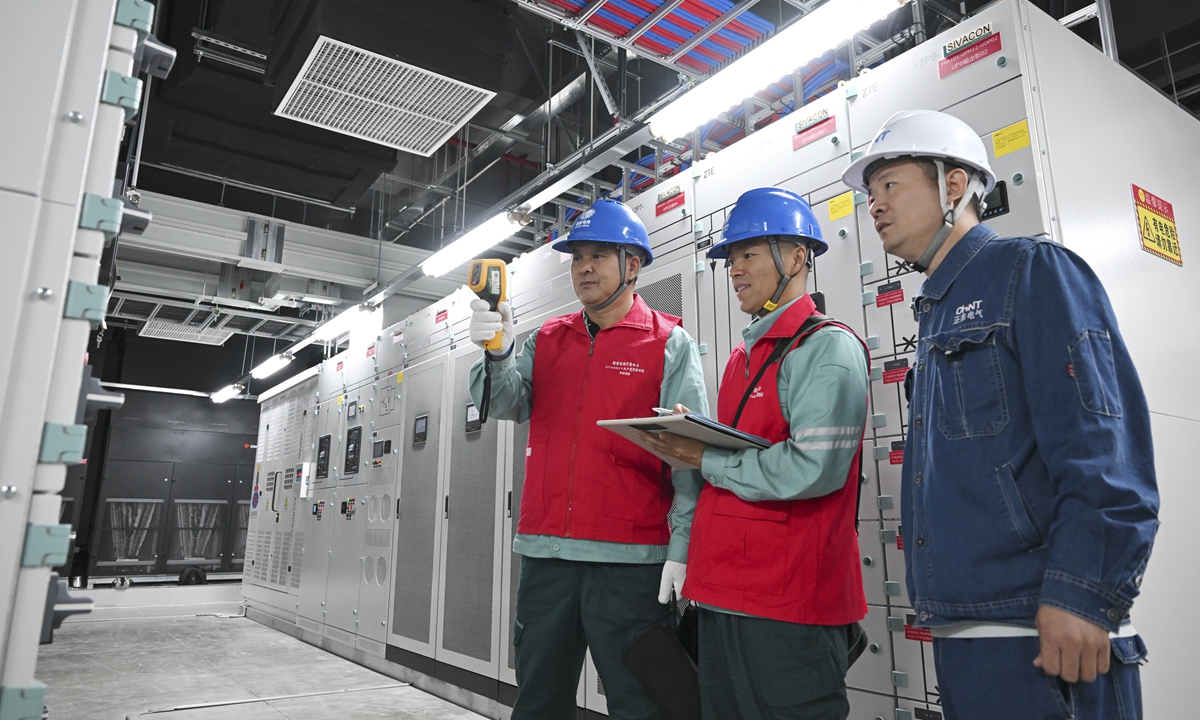
Staff provide electricity services for enterprises at a green electricity and digital intelligence center in Minning township, Ningxia, on June 15, 2026.
A model for the world
On June 1, 24 trainees from six countries including Rwanda and The Gambia gathered in Minning township. Together with Professor Lin Zhanxi from Fujian Agriculture and Forestry University, they unveiled the plaque for the Fujian-Ningxia Collaboration Juncao Technology Workstation.
"When promoting Juncao technology in Africa, every time I see locals widen their eyes in amazement watching mushrooms grow, I think of Ningxia. The global journey of Juncao technology began in the cave dwellings of Xihaigu," said the 84-year-old Lin.
Responding to the call of Fujian-Ningxia cooperation in 1997, Lin traveled to Pengyang County, Ningxia, teaching local farmers mushroom cultivation in abandoned cave houses with guaranteed product buyback. "What is this?" farmers looked on with doubt at first.
After one growing season, all skepticism vanished: "Mushrooms grown in three caves earn more than 1.8 hectares of wheat. This works!"
Within just a decade, 17,500 Ningxia farming households joined the Juncao industry, with each household earning an extra 5,000-plus yuan ($738) annually. At present, Ningxia produces over 90 million edible fungus sticks each year, with a total output value of 680 million yuan.
In 2000, Lin took Juncao technology overseas. Today, the technology has taken root in 106 countries and regions worldwide.
At the 7th China-Arab States Expo, 12 new energy projects were signed with a total investment of roughly 8.4 billion yuan, with a batch of projects set to land in Belt and Road partner countries.
The world has witnessed the wisdom embedded in Fujian-Ningxia collaboration.
Shortly after leaving Ningxia, Lin Yuechan and Li Huiqin - two generations of practitioners of Fujian-Ningxia solidarity - connected via video call.
"Our generation turned impossibility into reality," Lin Yuechan said. "It falls to you to turn what is possible into something even better."
This was compiled and translated by the Global Times based on an article originally published on page 2 of the People's Daily on June 17, 2026.