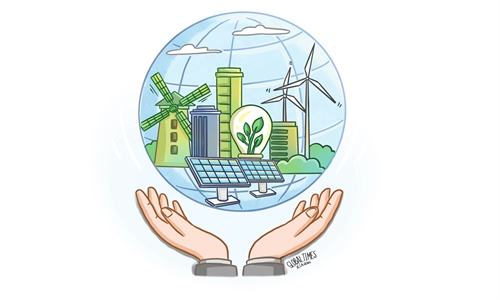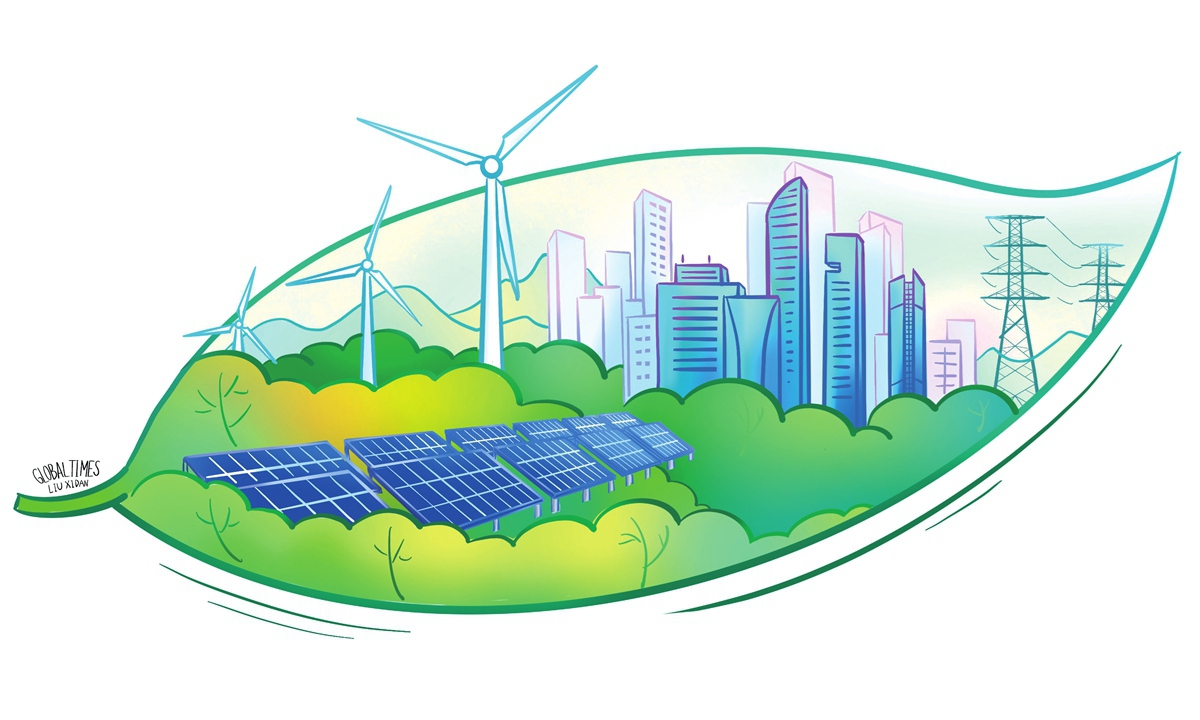
Illustration: Liu Xidan/GT
India will host the 11th BRICS Energy Ministers' Meeting in Gurugram, Haryana state in north India this week, bringing together energy ministers and officials from member nations to advance cooperation on energy security, sustainability and innovation, according to a press release from India's Press Information Bureau on Sunday.As a cluster of emerging economies spanning Asia, Africa, Europe and Latin America, BRICS countries have carved out differentiated energy transition paths based on their respective resource endowments, forming complementary strengths in the new-energy sector. China boasts full-industry-chain advantages in the photovoltaic, wind power and energy storage sectors, capable of providing comprehensive and mature clean energy solutions. South Africa keeps expanding its solar energy projects, leveraging its abundant solar resources, while Brazil is accelerating the construction of wind power facilities.
Despite divergent development paths, BRICS members hold considerable potential for technological exchange, project coordination, and market integration. Amid profound shifts in the global energy landscape and mounting climate pressures, the question of whether BRICS members can deepen collaborative efforts to drive the global green transition carries profound significance - not only for their own sustainable growth but also for the broader Global South.
BRICS countries account for nearly half of the global population, more than 30 percent of the world's economic output, and nearly half of the world's primary energy consumption. Such a huge scale means that collective actions taken by BRICS nations in energy transition will have far-reaching impacts on global climate governance and international energy security.
All BRICS members are in a critical period of industrialization and modernization, with energy demand continuing to rise steadily alongside economic growth. The dual imperative of safeguarding energy security while advancing the green transition is both pressing and complex.
Given these shared realities, BRICS countries face similar development challenges and possess mutually compatible experiences in energy transition. In recent years, they have actively pursued pragmatic green energy cooperation by leveraging their respective renewable energy endowments, such as solar and wind power, and have launched a host of green projects that stimulate economic growth and improve local people's livelihoods.
For instance, the China-built Lagoinha solar project in Brazil generates 400 million kilowatt-hours of electricity annually, enough to power 240,000 homes, according to the Xinhua News Agency.
It is worth noting that when the world urgently needs collective action to tackle climate change, some Western countries have hesitated, stalled, or even erected new barriers to green cooperation out of geopolitical considerations. Yet this has not altered the broader trajectory of BRICS nations deepening their collaborative efforts.
Breakthroughs and progress achieved by major emerging economies in green transition tend to have far reaching demonstration effects for the broader Global South. The challenges confronting developing countries are strikingly similar to those faced by BRICS members. If BRICS members, through deeper cooperation, can forge a practical pathway that balances economic growth with carbon reduction, it could offer a valuable reference for all developing nations.
BRICS members differ in their national conditions, resource endowments, and transition pathways. This reality precisely underscores the need for enhanced policy communication and coordination and building consensus to ensure coordinated and efficient cooperation mechanisms. At the same time, green low-carbon transition also creates new driving forces for high-quality economic development. BRICS nations can further advance industrial green upgrading cooperation, enhancing the "green content" of collaboration while raising the "gold value" of development.
Deepening pragmatic new energy cooperation within the BRICS framework aligns with the broader trajectory of global climate action. More importantly, it demonstrates BRICS members' firm commitment to upholding multilateralism and holds the potential to guide the Global South on its low-carbon journey.
RELATED ARTICLES