Footage obtained by Global Times shows Chinese mainland research vessel countering interference from Japanese aircraft, Taiwan authority's vessels
China's multi-pronged actions firmly safeguard its maritime sovereignty: expert
By and Fan Wei Published: Jun 22, 2026 11:43 PM


A Japanese military aircraft flies over Chinese research vessel Xiangyanghong 22 during the latter's environmental survey mission from June 16 to 18, 2026. During the survey activities, Japanese aircraft repeatedly approached and harassed the Chinese operation. Photo: Courtesy of Wang Yuerui
Under clear blue skies and over turquoise waters east of Taiwan island, researchers aboard the Chinese research vessel Xiangyanghong 22 meticulously deployed survey equipment to conduct comprehensive physical oceanography, seawater chemistry, and marine ecological surveys. The vessel also established multiple sampling stations.
This footage, obtained by the Global Times on Monday, shows part of a marine environmental survey operation conducted from June 16 to 18 in waters under China's jurisdiction east of Taiwan island by the East China Sea Bureau of the Ministry of Natural Resources. Under the escort of two China Coast Guard vessels, 2304 and 2502, the Chinese survey operation employed a rich variety of methods and yielded detailed data.
Frontline research team told the Global Times that during the survey activities in the waters off eastern Taiwan, Japanese aircraft repeatedly approached and harassed the Chinese operation. The Taiwan authorities also dispatched a vessel in an attempt to interfere. Nevertheless, the research vessel Xiangyanghong 22 overcame various adverse factors and resolutely carried out the survey in the waters east of Taiwan, achieving fruitful results.
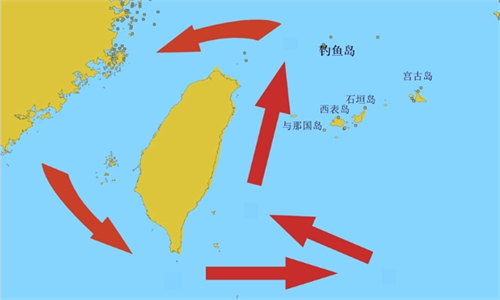
This marine environmental survey was primarily conducted in the sea area between 123°E to 125.2°E and 21.5°N to 23.5°N off the eastern coast of the island of Taiwan.
Shi Jun, deputy director of the East China Sea Ecology Center with the East China Sea Bureau of China's Ministry of Natural Resources who headed the frontline voyage, told the Global Times on Monday that the survey adopted a multidisciplinary synchronous approach, collecting data on seawater environmental DNA, birds, cetaceans, marine chemistry, and hydro-meteorological conditions. These efforts have laid a foundation for China to further understand the key habitats in this sea area, conduct ecosystem health assessments, and provide scientific support for marine biodiversity conservation in the region.
The data and samples obtained from this survey will further clarify the distribution characteristics of rare and endangered species - including fish and marine mammals - in the waters east of Taiwan, offering critical data support for the better protection of marine biodiversity and typical ecosystems, Shi said.
The Global Times noted that this marine environmental survey was carried out in the waters between 123°E-125.2°E and 21.5°N-23.5°N. Compared with the previously announced so-called delimitation area east of Taiwan island proposed by Japan and the Philippines, the Chinese survey area this time includes waters covered by the illegal and invalid claims put forward by Japan and the Philippines in collusion.
Video obtained by the Global Times shows the daily operations of this survey mission, including scenes of the Xiangyanghong 22 team's mission command, deck operations, on-site bird and cetacean observations, laboratory analysis, and sample pretreatment.
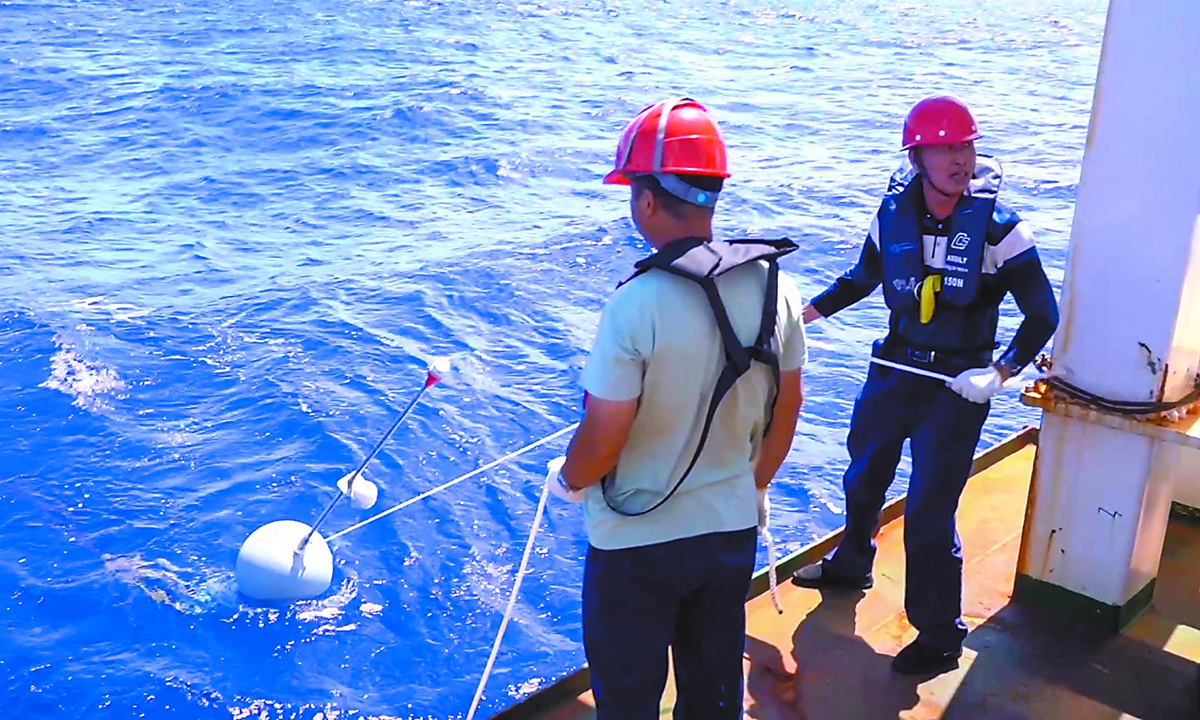
Researchers aboard Xiangyanghong 22 deploy survey equipment during a marine environmental survey operation. Photo: Courtesy of Wang Yuerui
Persistent harassment vs professional and steady progress
Shi further revealed that during the survey, the team aboard Xiangyanghong 22 also captured photographs of Japanese aircraft. "On the morning of June 17 and the afternoon of June 18, Japanese aircraft flew close to the ship and circled it twice. Based on our preliminary assessment, these were aircraft from the Japan Coast Guard," he recalled.
Evidentiary photos taken by the research vessel Xiangyanghong 22 and obtained by the Global Times show that the Japanese aircraft involved in the harassment bears the registration number JA573A. The aircraft is a Dassault Falcon 2000EX operated by the Japan Coast Guard. Public records indicate that this aircraft is stationed at Japan's Naha Air Base and is responsible for maritime surveillance missions around China's Diaoyu Dao.
In response to the Japanese harassment, the Xiangyanghong 22 declared its position through radio communication: "We are the Chinese research vessel Xiangyanghong 22, conducting routine marine scientific research in waters under China's jurisdiction. Please do not interfere with our normal operations and maintain a safe distance."
In addition to Japanese interference, the Taiwan authorities' "coast guard administration" also dispatched vessels in an attempt to disrupt the Chinese mainland survey. According to reports by Taiwan media such as Taipei Times, the Taiwan "coast guard" stated on the June 19 that they dispatched the Lanyu patrol vessel and the boat PP-10077 to shadow the Chinese mainland ship and issue radio warnings ordering it to leave.
Regarding the Taiwan authorities' claims, Shi provided Global Times with a firsthand account of the incident: "At around 23:40 on the evening of June 18, while the Xiangyanghong 22 was underway, a vessel from the Taiwan 'coast guard' hailed our ship. However, due to poor high-frequency communication quality, our team members could not clearly hear the content. Following established practice, we still responded via radio to state our position."
During this survey, two large-tonnage China Coast Guard vessels provided escort. In the face of improper interference from the Taiwan side, the Xiangyanghong 22 adhered to laws and regulations, steadily and orderly advancing all scheduled tasks. "We demonstrated a high level of professionalism, and the relevant survey work has been successfully completed," Shi said.
A multi-departmental joint governance model east of Taiwan
Since early June, the situation in the waters east of Taiwan island has changed. According to a briefing by the China Coast Guard, on June 1, the China Coast Guard Daishan Fleet conducted law enforcement patrols in the waters east of Taiwan island in accordance with the law. Subsequently, on June 6, the Ministry of Transport organized multiple maritime safety administrations to carry out a special maritime traffic law enforcement operation in the waters east of Taiwan island.
The operation involved China's 10,000-ton-class maritime patrol vessel Haixun 09, the large Taiwan Straits patrol and rescue vessel Haixun 06, the professional hydrographic survey vessel Haixun 08, and the professional rescue vessel Donghai Jiu 113, all working together. The action fully exercised China's maritime administrative law enforcement jurisdiction, strengthened deep-sea patrol and law enforcement capabilities as well as traffic control in key waters, ensured maritime traffic safety, and safeguarded national rights and interests.
Experts noted that both operations on June 1 and 6 explicitly stated that these were necessary actions taken in response to Japan and the Philippines unilaterally announcing the launch of the so-called maritime delimitation negotiations east of Taiwan island, which seriously infringes upon China's territorial sovereignty and maritime rights and interests.
The geographical framework of Taiwan island dictates that any delimitation between Japan and the Philippines cannot circumvent China's maritime rights and claims. Unilateral delimitation negotiations between Japan and the Philippines affect China's rights and the final delimitation outcome, and are inconsistent with the United Nations Convention on the Law of the Sea, Ding Duo, director of the Research Center for International and Regional Studies at the National Institute for South China Sea Studies., told the Global Times.
The recent marine environmental survey conducted by the Ministry of Natural Resources is regarded by maritime experts as yet another breakthrough in China's exercise of jurisdiction in the waters east of Taiwan island.
"From the series of recent actions by multiple Chinese departments, it is clear that China's management of the waters east of Taiwan island has entered a new stage, characterized by a multi-departmental joint jurisdiction and governance model," Chen Xidi, an expert at China Institute for Marine Affairs, Ministry of Natural Resources, told the Global Times.
He noted that China's jurisdiction and governance in these waters represent the exercise and reaffirmation of its legitimate rights. Multiple Chinese departments are all entitled to exercise their respective authorities in the area in accordance with the law.
According to previous official briefings, the relevant actions by various maritime departments have produced positive outcomes. The Ministry of Transport's special maritime traffic law enforcement and hydrographic survey operation east of Taiwan Island covered a total distance of 1,030 nautical miles, with a surveyed distance of 1,025 nautical miles. It inspected 198 vessels and addressed three violations, thereby reinforcing patrol and law enforcement capabilities as well as traffic control in the waters east of Taiwan island and further improving maritime safety.
"The relevant operations demonstrate that China's ability to maintain a regular presence and conduct sustained governance in the waters east of Taiwan island is firm and unquestionable," Chen noted. The recent series of actions have showcased China's capacity to respond appropriately to developments in the area and have helped shape a constructive situation. Moving forward, should relevant parties continue to pursue the so-called "delimitation negotiations," China will take further necessary actions and measures in the region, Chen said.
RELATED ARTICLES