China's 4th supply chain expo highlights openness, global cooperation, hailed by international participants
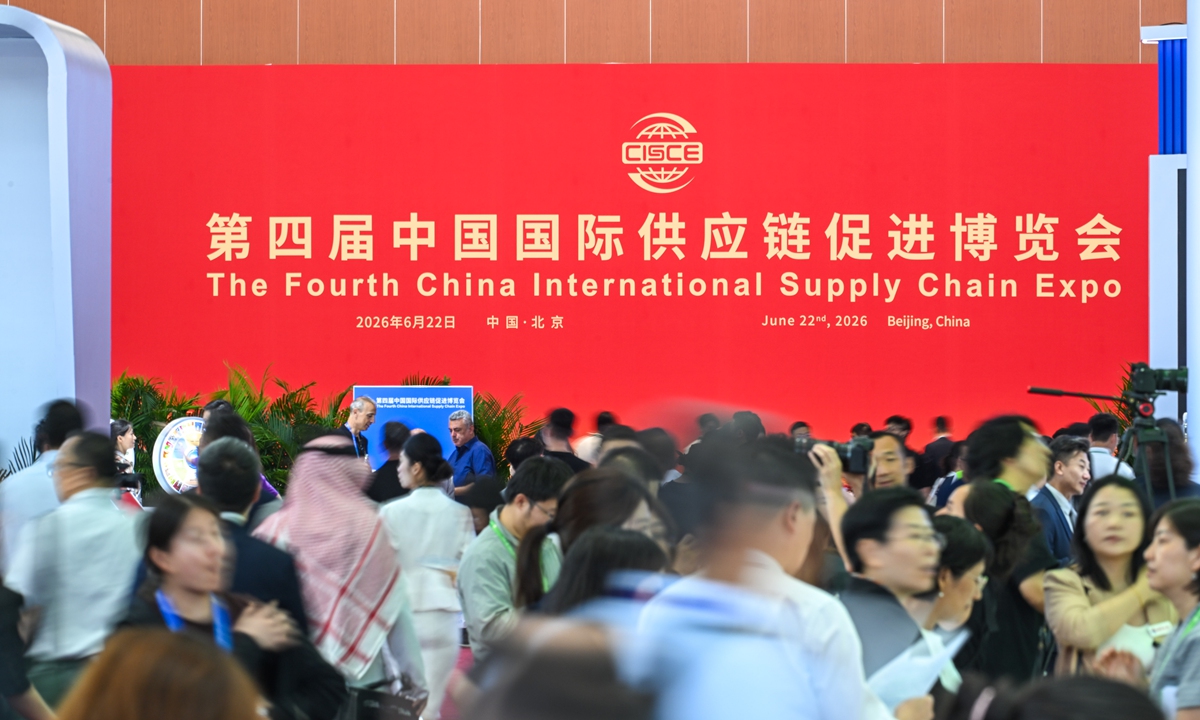
The 4th China International Supply Chain Expo opened on June 22 at the China InternationalExhibition Center (Shunyi Venue) in Beijing. Photo: Chen Tao/GT
Instead of buyers and sellers, exhibitors showcased their cooperation with upstream and downstream partners at the 4th China International Supply Chain Expo (CISCE). The expo opened on Monday under the theme "Connecting the World for a Shared Future," sending a strong signal of China's commitment to openness and international collaboration amid a complex global environment, participants said.
As one example of supply chain cooperation, Yum China officially unveiled its latest "full-chain artificial intelligence + robotics operating system," which demonstrated the innovative achievements resulting from Yum China's close collaboration with its supplier partners, Zhang Lekai, vice president of supply chain strategy at Yum China, told the Global Times on Monday at the expo's special station for debuts.
This is just one representative action among the 676 companies and institutions from 85 countries, regions, and international organizations participating in the expo, according to official data.
The expo, with a record 36.5 percent of exhibitors from overseas, has become a major platform for strengthening global industrial and supply chain cooperation. When including upstream and downstream partners, the total number of participating entities exceeds 1,200, Ren Hongbin, chairperson of the China Council for the Promotion of International Trade (CCPIT), the host of the expo, said at the opening ceremony on Monday.
At the expo, Cargill showcased its nearly $500 million grain and oil processing project under construction in Nantong, East China's Jiangsu Province.
The company positions itself as a bridge between farmers and markets through an integrated supply chain spanning procurement, storage, processing, and distribution, Liu Chang, vice president of Cargill Investments (China) Co, said in a statement sent to the Global Times.
Several international agricultural giants, including Cargill, China Oil and Foodstuffs Corp, McDonald's, Syngenta and Louis Dreyfus, jointly released a Beijing initiative on building the resilience and security of global agricultural and food supply chains at the 4th CISCE, aiming to deepen international cooperation, green transformation, and technological innovation to enhance the security and sustainability of global food systems.
AstraZeneca is participating the CISCE for the fourth consecutive year, demonstrating its long-term commitment to deepening its presence in China, strengthening its full value chain, and promoting green, low-carbon, and sustainable development in the healthcare industry, Lin Xiao, general manager of AstraZeneca China, said in a statement sent to the Global Times.
"China is a key market in AstraZeneca's global strategy. From announcing plans to invest over 100 billion yuan ($14.8 billion) in China by 2030 earlier this year, to actively participating in the CISCE, we continue to take concrete actions to fulfill our commitment to long-term development in China and growing together with the country," said Lin.
GE Healthcare also highlighted its deep roots in China. Wang Yi, vice president and supply chain general manager of GE Healthcare greater China, told the Global Times that the company has built a resilient supply chain ecosystem with annual procurement exceeding 10 billion yuan, supporting more than 1,000 suppliers and helping cultivate more than 160 specialized high-tech enterprises in China.
Australia is participating as the Guest Country of Honour for the first time at the expo. Dominic Trindade, general manager of the Australian Trade and Investment Commission in charge of the Chinese mainland, Hong Kong and Taiwan regions, said at the CISCE that "In an increasingly complex global environment, resilient and efficient supply chains are critical to economic growth. The CISCE provides a valuable platform for Australian and Chinese businesses to connect and develop partnerships."
Ren also noted that this year's expo focuses on high-quality development and high-level opening-up.
James Zimmerman, Chairman of the American Chamber of Commerce in China, delivered a clear message reflecting American businesses' sentiment: "The expo's theme of openness, connectivity, and synergy is exactly right and important. No economy has ever succeeded with a closed or semi-closed system.
"Connectivity through people-to-people exchanges is vital, and synergy means leveraging the respective strengths of China and the US for mutual benefit. This expo represents a strategic plan and direction for all of us moving forward this year," Zimmerman told the Global Times at the CISCE.
"Regarding American companies, China remains very important. Our economies are integrated and interdependent." He noted that the era of "decoupling" is over, and the US business community is optimistic about moving toward "constructive strategic stability."
Daniel Mabey, the Asia region president for the United Natural Products Alliance (UNPA), told the Global Times on Monday that he came to the expo with a group of industry colleagues.
"We are working with several Chinese companies on a new program where we want to connect the US industry directly with the Chinese suppliers," Mabey said. The UNPA is an international trade association representing more than 120 dietary supplement and natural health companies.
From Australian exporters seeking deeper cooperation to multinational giants including Cargill, Intel, and GE Healthcare expanding their presence, the expo clearly showed that China continues to be a major engine and attractive destination for global supply chain cooperation, analysts said.
This can also be seen from a key outcome of the expo - the Beijing Initiative, jointly issued by the CCPIT and global business representatives on Monday. It calls for upholding multilateralism, supporting the World Trade Organization-centered trading system, reducing institutional barriers, promoting innovation and new quality productive forces, accelerating digital and green transformation, and opposing protectionism.
Over the past four years, the CISCE, the world's first national-level exhibition specifically dedicated to global supply chains, has evolved rapidly. It has transformed from a "Chinese platform" into a global public good, Ren said.
This year's event will host more than 60 business exchange activities and see the debuts of more than 160 new products, technologies, services, and application scenarios, further boosting global supply chain cooperation by showcasing the fruitful results, Ren noted.
RELATED ARTICLES