China's cross-border travel surges during Dragon Boat Festival holidays as trips reach 6.67m
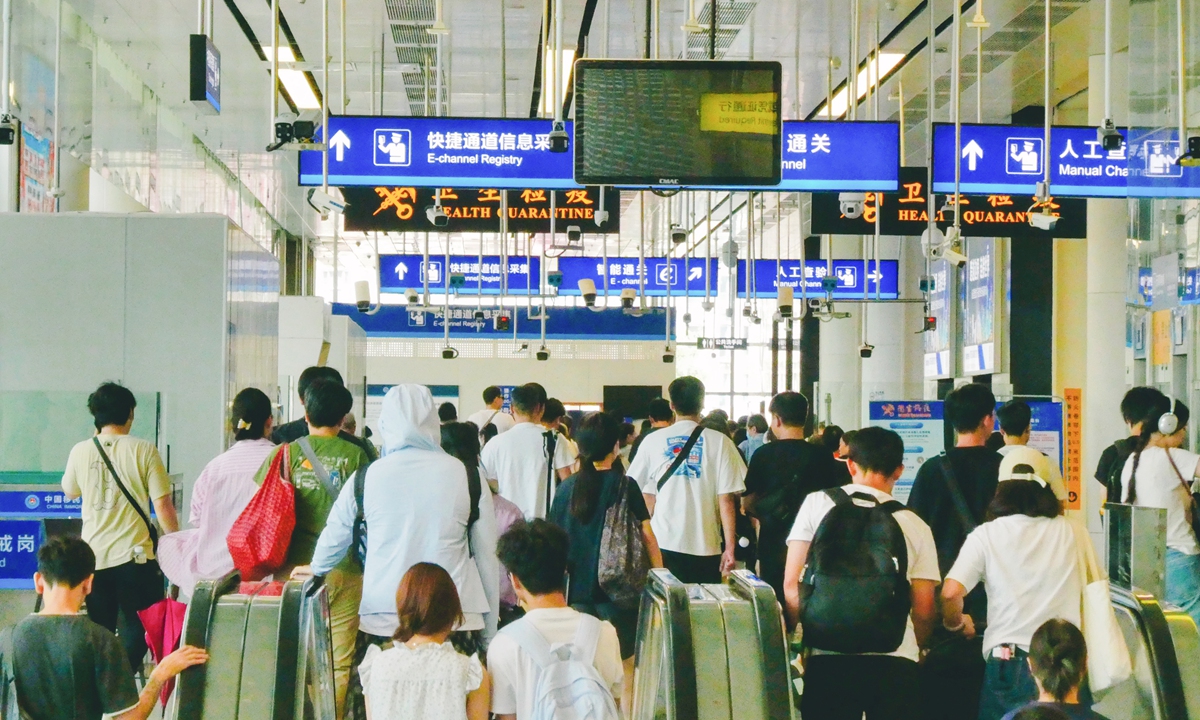
Passengers heading to Hong Kong Special Administrative Region via Futian Port in Shenzhen surged during the Dragon Boat Festival holiday on June 20, 2026, marking a peak in cross-border travel. Photo: VCG
China's border inspection authorities recorded 6.667 million cross-border trips during the Dragon Boat Festival holidays, up 12.9 percent year-on-year, with daily crossings averaging 2.222 million, data from the National Immigration Administration (NIA) showed. The busiest day of the holiday travel period was June 20, when cross-border trips reached 2.308 million.
Residents of the Chinese mainland accounted for 2.921 million cross-border trips during the holidays, up 5.5 percent year-on-year, while residents from Hong Kong, Macao and Taiwan made 2.969 million trips, up 18.4 percent. Foreign nationals made 777,000 cross-border trips, up 23.3 percent from a year earlier, the NIA said.
Among inbound foreign travelers, 266,000 entered China under visa-free arrangements, a year-on-year increase of 15.2 percent. Border inspection authorities also processed 305,000 inbound and outbound transport movements, including aircraft, vessels, trains and vehicles, up 16 percent year-on-year, according to the NIA.
Travel platforms' figures echoed the strong cross-border travel momentum seen during the holiday period.
According to Fliggy, outbound travel bookings during the Dragon Boat Festival holidays rose nearly 20 percent year-on-year, with Thailand, South Korea, Hong Kong, Malaysia and Singapore ranking among the most popular destinations. Inbound travel bookings surged nearly tenfold, with travelers from Thailand, South Korea, Malaysia and Singapore accounting for some of the largest source markets.
Outbound travel during the Dragon Boat Festival holidays continued to be dominated by short-haul regional destinations. Data from Tongcheng Travel showed that South Korea, particularly Jeju Island and Seoul, Thailand, including Phuket and Bangkok, and Malaysia, including Sabah and Kuala Lumpur, ranked among the most popular destinations among travelers extending their holidays with additional leave days.
In terms of source markets, outbound travel demand from non-first-tier cities grew notably, with Hangzhou, Chengdu, Qingdao, Shenyang, Nanjing and Xiamen all ranking among the top 10 outbound travel source cities during the holiday period.
Bian Yongzu, executive deputy editor-in-chief of Modernization of Management magazine, told the Global Times that the rise in outbound travel during the Dragon Boat Festival holidays was partly driven by the end of the gaokao. Many families chose to take graduation trips after the exam, and with rising incomes and stronger demand for overseas travel, the holiday period provided a timely opportunity for students and their parents to travel abroad.
Bian noted that travel demand from Hong Kong, Macao and Taiwan residents was also particularly strong during the holiday period. In addition to the holiday itself, these regions enjoy well-developed international transport links and greater access to overseas destinations. The convenience of cross-border travel and broader visa-free arrangements available to local travel document holders have also helped support stronger growth in outbound trips, he said.
On inbound travel, Bian said that the continued expansion of China's visa-free policies made visiting the country easier and more affordable for foreign travelers. At the same time, China's growing global profile and rising interest in Chinese culture have attracted more visitors. Traditional events associated with the Dragon Boat Festival, such as dragon boat races and folk celebrations, offer overseas tourists a chance to experience Chinese culture firsthand.
RELATED ARTICLES