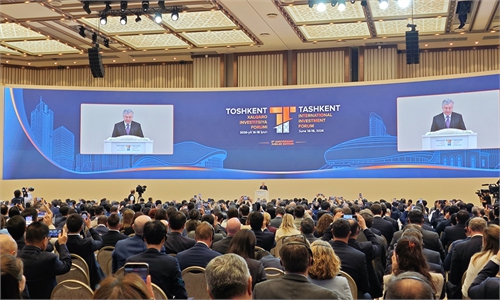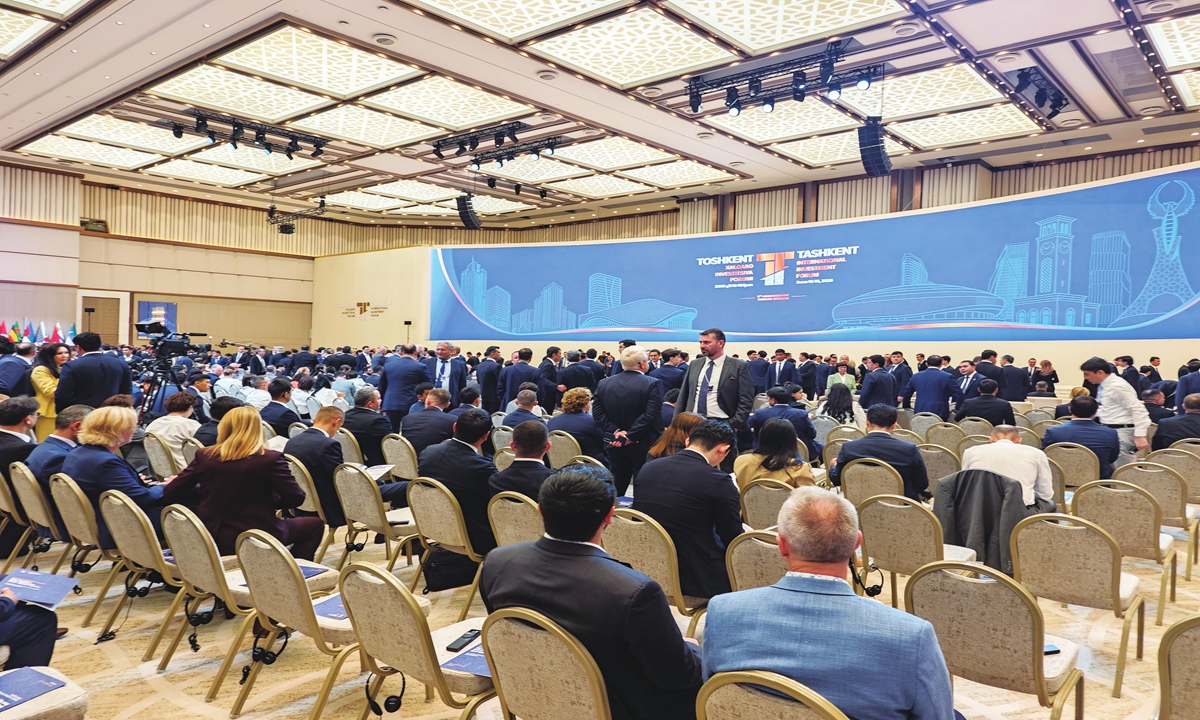
Attendees and guests converse ahead of the opening ceremony of the plenary session of the fifth Tashkent International Investment Forum in Tashkent, Uzbekistan, on June 17, 2026. Photo: Xia Wenxin/GT
"What are you going to Tashkent for?" midway through my flight from Beijing to the capital of Uzbekistan, an Uzbek man sitting next to me asked me in Chinese unexpectedly.
When he learned that I was going there to cover the fifth Tashkent International Investment Forum (TIIF-2026), the young man around my age, whose name I later learned was Mamur, mentioned that he might drop by the venue the following day. He said that this is the biggest investment event in Uzbekistan and he wants to "try his luck" for the company he works for. After the flight landed, we exchanged WeChat accounts to keep in touch.
The moment I stepped into the Central Asian Expo Uzbekistan, the main venue for TIIF-2026, the enthusiasm was palpable, and I realized why my new Uzbek friend would like to pay a visit. The bustling halls teemed with Western executives in tailored suits and Middle Eastern delegates in traditional robes. Everywhere, participants were locked in lively discussions, as a polyglot symphony of English, Russian, Chinese, and Uzbek reverberated through the air.
This is just a glimpse into the increasing interest of foreign investors in opportunities in Uzbekistan. Over four years since its first edition, the number of international participants at the TIIF has expanded significantly, rising from 1,050 in 2022 to 3,802 representing 102 countries this year, according to official statistics. By the time the three-day TIIF-2026 concluded, a milestone was set: 166 investment agreements totaling $43.1 billion were signed, flashing a clear signal that international interest in Uzbekistan is translating into tangible investment commitments.
The pull of Uzbekistan
Why has this Central Asian country become a magnet for foreign capital in recent years?
While rich geological endowments provide a natural foundation, the key driver lies in the country's sweeping economic liberalization initiated by President Shavkat Mirziyoyev since taking office. The systematic abolition of foreign exchange controls, extensive tax optimization, and the permission of 100 percent foreign ownership in most sectors have fundamentally reshaped the nation's business climate, noted Cao Wei, an associate professor at the School of Politics and International Relations, Lanzhou University.
This institutional pivot was further punctuated by Mirziyoyev during his keynote address at the opening ceremony of the forum's plenary session. Acknowledging today's fragmenting global economy, the Uzbek leader noted that as the global map of capital rapidly shifts and trade tensions escalate, "it is quite natural that any investor seeks to invest in countries where the rights and freedoms of entrepreneurs are reliably protected, where the economy is growing at an accelerated pace, where broad opportunities exist."
To deliver on this guarantee, the Uzbek president detailed a series of pioneering systemic measures designed to elevate the country's investment resilience, including the official rollout of the Tashkent International Financial Centre, the adoption of new laws to push reform, the proposal of the joint implementation of investment projects worth $30 billion in various emerging industries and $27 billion in public-private partnerships for infrastructure. All these efforts powerfully demonstrate that Uzbekistan is actively engineering a transparent, rules-based investment environment for global capital.
Highlighting TIIF's role as a catalyst for direct engagement, Ferhan Kara, chief advisor to the Rector of Samarkand State Architecture and Construction University, told the Global Times that this event effectively centralized government leadership and global executives onto a unified platform. On the sidelines of the forum, Kara directly engaged with multiple regional governors and city mayors to officially sign memoranda of understanding for three concrete projects. Kara, who is, originally from Turkey, also praised the Uzbek government's efforts to protect investor rights through legal reforms. "This is a monumental historical opportunity for external capital," he said.
Yet while investors from around the world were drawn to Uzbekistan, one country stood out not only for its presence, but also for the scale of its commitment.
The China factor
At TIIF-2026, China's presence was impossible to miss. As I moved through the packed venue and wondered if I might run into Mamur again, an unexpected reunion awaited me. I bumped into an old university classmate whom I had not seen for nearly a decade. He was attending TIIF-2026 as part of a delegation from a major Chinese state-owned energy enterprise.
That brief encounter captured a broader reality of the forum: Chinese participation was visible throughout the venue. From energy and chemicals to advanced manufacturing and emerging technologies, Chinese capital and industrial expertise were not only welcomed in Uzbekistan, but actively sought after by local partners.
If TIIF-2026 demonstrated Uzbekistan's growing appeal to global investors, it also highlighted how Chinese companies have become one of the most active contributors to the country's development ambitions. China is already a major source of Uzbekistan's investment. At TIIF-2026, the Chinese delegation, comprising nearly 300 top-tier enterprises, secured 61 projects totaling $12.724 billion, the organizers told me. This accounts for nearly 30 percent of TIIF-2026's entire contract volume.
To maximize industrial cooperation, dozens of government-to-business and business-to-business meetings were conducted alongside a dedicated Uzbekistan-China Business Forum, which brought together representatives from over 100 companies to establish direct dialogue and expand joint investments, said the organizers.
Another major theme on vivid display at the event is the evolution of Chinese engagement in Uzbekistan, which is no longer confined to traditional sectors, such as energy and mining. Increasingly, it is extending into the country's rapidly growing digital economy, with Uzum, Uzbekistan's first tech unicorn, offering one of the most prominent examples.
Last year, the company secured nearly $70 million in equity financing led by Tencent and VR Capital. "Chinese capital plays an important role," Nikolay Seleznev, co-founder and chief strategy officer at Uzum, told me in an interview. He emphasized that the presence of the Chinese tech giant brings far more than capital; it brings valuable experience to the region in building super-apps and technology in fintech and e-commerce.
For many Uzbek businesses, China is no longer just a source of capital, but increasingly a source of technology, industrial know-how, and development experience.
Chinese investment in Uzbekistan is successfully transitioning from a traditional capital-injection model to a strategic, technology-driven, and highly diversified partnership, said Cao. As the forum concluded, I never did manage to cross paths with Mamur again. By the time I landed back in Beijing, however, a WeChat message from him was waiting on my phone: "Hope we can meet up in Tashkent."
We missed each other this time. But in a way, that brief encounter on the flight had already reflected something larger. Across the exhibition halls of TIIF-2026, I saw investors, entrepreneurs and officials from China and Uzbekistan actively exploring new opportunities, partnerships and connections. If the momentum generated at this forum is any indication, a future reunion with Mamur in Tashkent may not be far away.