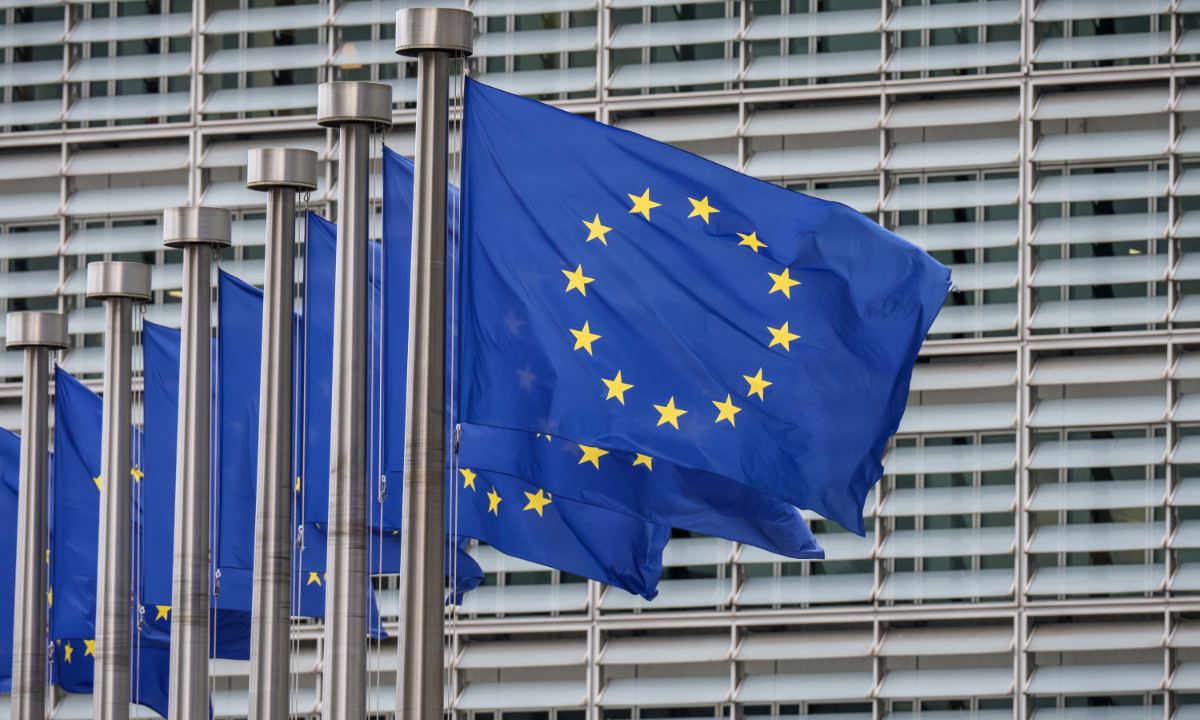
The European Union (EU) flags in front of EU headquarters in Brussels, Belgium. Photo: VCG
Following the EU's announcement to officially launch Ukraine's accession process, Ukrainian President Volodymyr Zelensky once again urged the bloc to grant fast-track membership to Ukraine during the recent EU summit. The launch of Ukraine's accession process is not merely another step in routine diplomatic procedures between Kiev and Brussels; it represents a historic turning point in their relationship. It is likely to reshape Europe's geopolitical landscape, with significant practical risks.Since gaining independence in 1991, Ukraine has struggled to define a clear and stable geopolitical orientation. Beginning in 2014, the country formally embraced a westward development strategy, and in 2019 it amended its constitution to enshrine membership in the EU and NATO as strategic goals. The opening of accession negotiations marks the transition of Ukraine's "return to Europe" strategy from a political slogan to a substantive implementation phase.
For the EU, the launch of Ukraine's accession talks may symbolize an important transformation in the bloc's post-Cold War diplomatic paradigm and signal a shift in the traditional logic of EU enlargement. Historically, the EU's eastward expansion was driven primarily by economic integration and the promotion of European values, following the technical principle of "fulfilling the requirements before negotiations start." Since the outbreak of the Russia-Ukraine conflict, however, the EU's diplomatic approach has evolved from a values-centered framework to a more realist strategy that balances values with geopolitical and security considerations.
By adjusting its established procedures, granting Ukraine candidate status and opening accession talks, the EU appears to be signaling that enlargement is no longer guided solely by economic and normative criteria. Rather, it has become an important instrument through which the bloc seeks to strengthen its eastern security buffer and offset strategic pressure from Russia. The structural confrontation between the EU and Russia is thus likely to become entrenched over the long term.
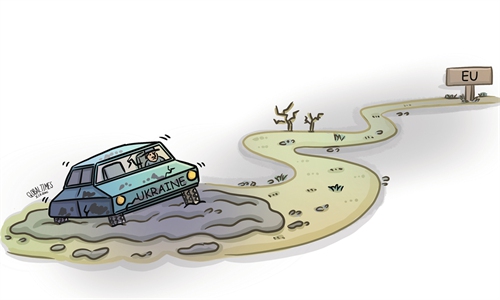
However, Ukraine's path toward full EU membership is likely to be long and fraught with obstacles. Domestically, international media reports have highlighted persistent challenges in the country, including government corruption, the influence of oligarchic interest groups over politics and key sectors of the economy, and shortcomings in judicial independence. External supervision from the EU alone is unlikely to produce rapid and comprehensive reforms, making these structural issues a major obstacle to accession.
From a geopolitical and security perspective, Ukraine's pursuit of EU accession amid ongoing war could potentially trigger the EU's collective defense mechanism in the future, thereby drawing all member states into the conflict and escalating the risk of EU-Russia confrontation. This concern has led many member states to adopt a cautious approach.
In terms of the EU fiscal and interest distribution, Ukraine's weak economic foundation means that once it formally joins the bloc, the EU would need to allocate substantial annual fiscal subsidies, which could dilute the policy dividends of existing member states and further intensify internal interest conflicts. Meanwhile, Eastern European countries are entangled in complex historical grievances, with numerous divergences in areas such as cross-border minority rights and border governance, making multilateral coordination extremely difficult. These intertwined factors could turn Ukraine's EU accession into a complex strategic game.
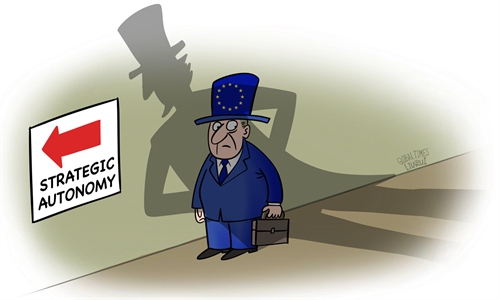
Overall, the launch of accession talks can be regarded as a milestone in EU-Ukraine relations. For Ukraine, it offers an opportunity to redefine its regional identity and advance institutional transformation. For the EU, it reflects a significant shift in diplomatic strategy and represents an effort to proactively reshape the regional order and enhance strategic autonomy. But it is likely to deepen and prolong the structural confrontation between the EU and Russia.
Given the numerous constraints, Ukraine is unlikely to achieve formal EU membership in the near future, and its accession process may prove to be a tortuous one. Nevertheless, the geopolitical consequences of the process are already unfolding and will continue to shape Europe's political landscape for years to come.
The author is a research fellow at the Institute of Russian, Eastern European and Central Asian Studies at the Chinese Academy of Social Sciences. opinion@globaltimes.com.cn
RELATED ARTICLES