US provides Philippines with four autonomous surveillance vehicles; equipment emboldens Manila’s maritime provocations, risks increased miscalculation: Chinese experts
By Published: Jun 23, 2026 09:59 PM

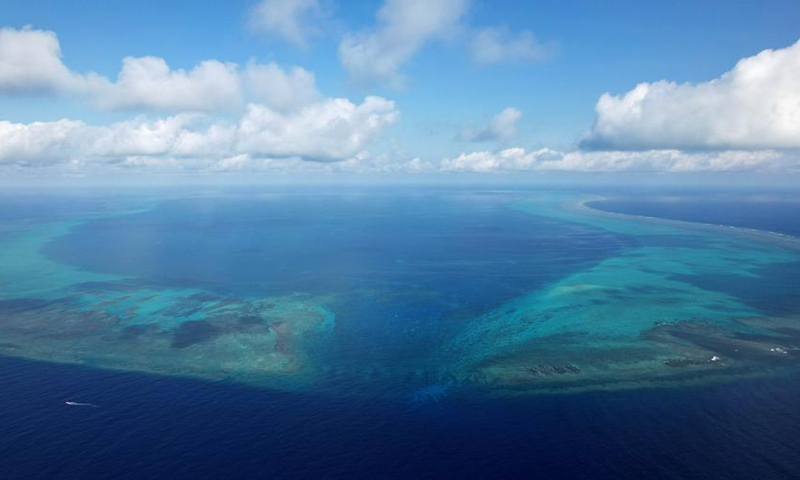
An aerial drone photo taken on May 12, 2026 shows a view of China's Huangyan Dao in the South China Sea. (Xinhua/Chen Bin)
The US has given four autonomous underwater and surface vehicles to the Philippines to boost maritime surveillance, according to media reports on Tuesday. The delivery comes as the Philippines is continuing its provocative acts in the South China Sea, and if the Philippines increasingly deploys unmanned systems in these waters, the risk of a miscalculation could rise, some Chinese observers warned.
The US government has given four Ocean Aero Triton autonomous underwater and surface vehicles to the Philippine military to boost Manila's ability to monitor its waters and spot "potential threats," Reuters reported, citing the US Embassy in the Philippines.
The Philippine Navy spokesperson claimed the unmanned systems are not only surface unmanned systems but also underwater unmanned systems, and this will contribute to maritime domain awareness not only of the Philippine Navy but also of the Armed Forces of the Philippines, Philippine media outlet the Inquirer reported on Tuesday.
Both Reuters and the Inquirer highlighted the delivery of these drones comes as frictions between the Philippines and China are growing in the South China Sea.
By giving autonomous underwater and surface vehicles to the Philippines, the US emboldens Manila to ramp up its provocative maritime capabilities through unmanned equipment, Chen Xiangmiao, a research fellow at the National Institute for South China Sea Studies, told the Global Times on Tuesday, warning that this would increase the risk of friction and even unintended escalation.
In addition to the joint drill that is considered a disruption to regional peace, the US is also stirring regional security tensions by acting through the Philippines by delivering those unmanned vehicles as on the surface, these systems are being provided to the Philippine Navy for its use. However, the key aspects of operation and control may still remain in American hands, Song Zhongping, a military affairs expert, told the Global Times on Tuesday.
"While the equipment is deployed at Philippine military bases and operated on a day-to-day basis by Philippine personnel, data collection and remote-control functions are likely to be managed by the US through satellite communications," Song said.
This would allow the US Navy to obtain real-time maritime environmental data gathered by the systems, potentially supporting navigation analysis, operational planning and other military purposes, Song added.
When asked about the joint military exercise between the US and Philippines that included about 10,000 US services members and also included Japanese forces, Chinese Foreign Ministry spokesperson Guo Jiakun said at a press conference on April 20 that what the Asia-Pacific needs most is peace and tranquility, and the last thing the region needs is division and confrontation as a result of the introduction of external forces.
No military and security cooperation should be conducted at the expense of mutual understanding and trust as well as peace and stability in the region, Guo said.
RELATED ARTICLES