China remains major, growing market for Australian businesses, products: AustCham China chair

Vaughn Barber, AustCham China chair Photo: Courtesy of Vaughn Barber
China remains a major and growing market for Australian exports, Vaughn Barber, chair of the China-Australia Chamber of Commerce (AustCham China), told the Global Times in an exclusive interview. He noted strong complementarity across a wide range of sectors that go beyond traditional resources and energy, with real opportunities also emerging in areas such as agribusiness and food, education, healthcare and professional services.
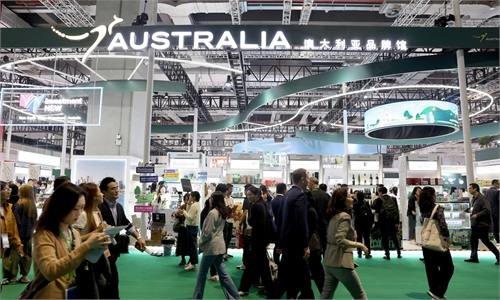
The remarks were made on the sidelines of the 4th China International Supply Chain Expo (CISCE), the world's first national-level expo dedicated to supply chains, which runs from Monday to Friday in Beijing.
This year's expo is a significant moment for Australia. It marks Australia's first national-level participation and its first time as Guest Country of Honour — in China's APEC host year — anchored by a national pavilion that leads with clean and smart energy, alongside agriculture, health and services, according to Barber.
"For Australian business, taking part at this level says something straightforward: this is a relationship our members want to build on, not simply manage," the AustCham China chair noted.
What stands out this year, beyond Australia's role, is how the expo itself has matured, Barber said, giving examples of overseas "Guest Provinces" and a dedicated artificial-intelligence zone making its debut.
For Australian businesses, the significance goes beyond any single expo. As 2026 marks the first year of China's 15th Five-Year Plan (2026-30), the Australian business representative sees a broad range of opportunities in the China market and remains optimistic about sectors with strong growth potential.
That export relationship (between China and Australia) is the foundation, and it isn't going anywhere, said Barber. "What's newer is the other direction: accessing China's industrial and clean-energy capability, through both trade and investment," he said.
Clean energy is where that newer opportunity is one of the clearest, as Barber noted that Australia's delegation is a renewable-energy delegation, led by the Smart Energy Council with Austrade — matching with Chinese partners and investors, visiting solar, battery and electric vehicle manufacturing sites — with clean and smart energy the theme of Australia's pavilion.
"The aim is real commercial outcomes, not attendance; and the goal isn't only to import, but to bring that capability onshore through partnerships and investments that build manufacturing, skills and jobs in Australia," he said.
Barber said that "Our Doing Business in China survey points the same way — the capabilities members most want to access are electric vehicles (EVs) and clean-energy technology, solar PV and battery storage at the core."
Strong interest in cooperation with Chinese EV makers is reflected in data showing that EV sales in Australia hit a new high in May, the Xinhua News Agency reported, citing data released by the Federal Chamber of Automotive Industries in June.
The importance of bilateral cooperation is also reflected in a recent survey released by the Lowy Institute, an independent Australian think tank. In this year's poll, a clear majority of Australians (61 percent) said that they see China more as an economic partner than a security threat, an 11-point increase since 2025, according to the think tank.
After all, as Barber noted, the "longer-term prize" for Australia-China cooperation is "joint capability."
RELATED ARTICLES